Romance Scams Aimed at Diaspora Women: Tactics to Watch for in 2026
By Bola Eboh —
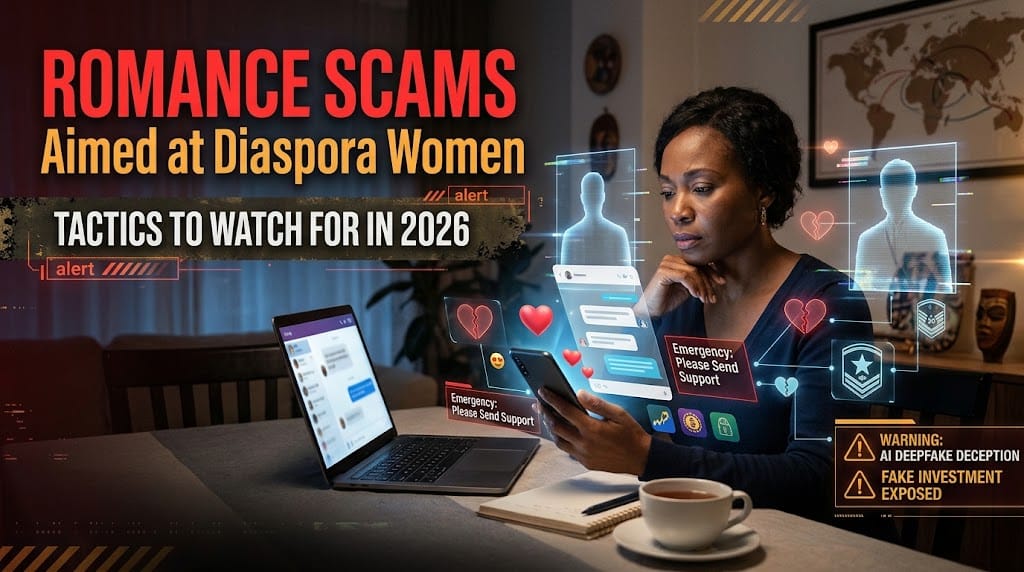
Organised fraud syndicates have overhauled their methods, moving away from crude email scripts and focusing on tailored, long-term deceptions directed at professional women living away from their countries of birth. Cross-border romance fraud now costs victims hundreds of millions of dollars each year, with diaspora communities increasingly singled out by groups operating across West Africa, Southeast Asia, and North America.
Data from the Canadian Anti-Fraud Centre reveals that romance fraud consistently ranks among the most financially damaging categories of cybercrime, exceeded only by investment fraud. In recent years, those two categories have merged into a hybrid threat. For diaspora women balancing professional careers in Canada, the United Kingdom, or the United States with cultural ties to their homelands, the schemes exploit shared values, faith commitments, and family expectations.

The Exploitation of Cultural and Faith Affinity
Modern romance scams directed at diaspora women rely heavily on affinity fraud. Scammers construct detailed online identities that reflect the exact educational, cultural, and spiritual background of their targets. Rather than posing as foreign royalty or distant military contractors, perpetrators present themselves as diaspora professionals—often civil engineers, diaspora doctors, or transnational entrepreneurs who divide their time between African commercial capitals and western cities.
Initial contact rarely begins on generic dating websites. Instead, operations have shifted to professional networking applications, alumni groups, church fellowship forums, and community Facebook pages. Scammers adopt specific regional vocabularies, references to shared home-town neighbourhoods, and familiar religious phrasing to disarm skepticism early in the exchange.
By mirroring the victim's social identity, the scammer bypasses the instinctive suspicion that accompanies contact from an outsider. The conversation moves quickly from public groups to private encrypted messaging channels, where the perpetrator spends weeks or months establishing emotional dependency before introducing any discussion of money.
Synthetic Audio and Video Verification Tricks
One of the traditional defences against online courtship fraud—demanding a live video call—has been compromised by consumer-grade artificial intelligence tools. Transnational fraud rings now use real-time face-swapping software and voice-cloning technology to stage short, convincing live interactions.
These synthetic media tactics follow a predictable pattern. The scammer agrees to a video call via WhatsApp or FaceTime to eliminate suspicion. During the call, the video displays a living face whose lip movements match the spoken audio, though the interaction is kept deliberately brief. Scammers blame poor offshore internet connections, restricted military bandwidth, or hospital network regulations for sudden disconnections after twenty or thirty seconds.
In other cases, scammers harvest audio clips from a stolen public profile, such as a LinkedIn webinar or an Instagram video, and run the sample through generative voice models. Victims receive spontaneous voice notes on messaging apps with realistic ambient room noise, local accents, and accurate inflections, effectively neutralising suspicions about the sender's identity.
The Hybrid Crypto-Romance Scheme
Direct requests for emergency medical funds or wire transfers for stranded travel luggage have largely been supplanted by investment-led confidence operations. Known internationally as financial grooming or pig butchering, this tactic frames financial transactions as a mutual venture for a shared future.
Once emotional rapport is secure, the scammer casually mentions personal success in high-yield cross-border trade, diaspora property development, or decentralised finance. They offer to guide the target through the process, portraying the venture as a practical foundation for their anticipated life together.
Victims are instructed to move legitimate funds from their Canadian or British bank accounts into well-known cryptocurrency exchanges, convert the money into stablecoins, and transfer those tokens to a fraudulent trading platform controlled by the syndicate. The mock platforms display simulated portfolio gains, encouraging the target to deposit increasingly larger sums, including personal savings and lines of credit. When the victim attempts to withdraw funds, the platform demands additional payments for fictitious liquidity taxes or international clearance fees.
| Tactic Dimension | Traditional Romance Fraud | 2026 Diaspora-Focused Fraud |
|---|---|---|
| Initial Contact Platform | Public dating sites, mass unsolicited emails | Professional networks, faith-based forums, diaspora community groups |
| Assumed Identity | Foreign military officers, western oil-rig workers | Transnational diaspora professionals, returnee investors, engineers |
| Identity Proof | Stolen static photographs, refusal to use video | Short AI-generated video calls, cloned voice notes, simulated glitches |
| Financial Mechanism | Gift cards, direct wire transfers, Western Union | Cryptocurrency platforms, fake property portals, illicit remittance pools |
| Emotional Angle | Immediate declarations of love, sudden medical crises | Deliberate multi-month grooming, mutual financial growth, cultural unity |
Money Muling and Secondary Legal Hazards
The financial losses associated with these operations frequently extend into direct legal trouble for the victims. Scammers regularly ask targets to receive funds from third parties and forward them through international remittance operators or local cash conduits, claiming their own business accounts face cross-border tax holds.
In these scenarios, the victim serves as an unwitting money mule, moving capital stolen from other fraud targets through their personal bank accounts. Canadian financial institutions, monitoring for suspicious anti-money-laundering patterns under federal regulations, frequently respond by freezing accounts, cancelling credit facilities, and reporting the activity to law enforcement agencies.
Victims not only lose their personal capital to the syndicate, but also face the termination of their primary banking relationships, severe credit rating damage, and potential investigation by police for participating in the laundering chain.
Structural Indicators of Modern Courtship Fraud
Identifying sophisticated fraud requires looking beyond overt requests for cash. Modern syndicates follow structural playbooks that leave distinct operational signatures across digital communications:
- Rapid migration of channels: Immediate insistence on abandoning the original application to communicate exclusively on encrypted messaging services.
- Unverifiable local connections: Claims of mutual acquaintances or shared community heritage that cannot be independently confirmed through established family or civic networks.
- Asymmetrical financial visibility: Detailed displays of personal wealth, real estate acquisitions, or investment earnings paired with constant technical excuses for why direct liquid assets are temporarily inaccessible.
- Controlled access to platforms: Direction to use specific web links rather than official mobile applications found in verified app stores to view investment portfolios or transfer funds.
- Pressure toward financial secrecy: Explicit instructions to keep shared investment projects hidden from family members, accountants, or bank branch personnel under the guise of surprise gifts or family privacy.
Institutional Response and the Limits of Recovery
Reporting fraud immediately to official authorities remains necessary, though the recovery of funds remains rare once transactions pass through foreign exchange protocols or distributed blockchain ledgers. Canadian residents targeted by cross-border syndicates must file reports with both their municipal police service and the Canadian Anti-Fraud Centre to create an official investigative trail.
When cryptocurrency is involved, tracking depends on private forensic firms and specialised financial intelligence units. However, because syndicates rapidly route assets through decentralised mixers and international cash-out operations across several sovereign jurisdictions, freezing stolen balances requires swift international legal coordination.
Commercial banks routinely refuse to reimburse losses if the account holder personally authorised the transfers, categorising the incident as authorised push-payment fraud rather than account takeover. Documentation of all messages, digital wallet addresses, transaction receipts, and phone numbers provides the only viable basis for formal law enforcement inquiries and any later tax-loss relief claims.
Conclusion
Romance fraud targeting diaspora women has evolved from transparent, opportunistic schemes into sophisticated financial confidence operations run by international criminal networks. By combining synthetic identity tools, deep cultural mimicry, and fake investment structures, these syndicates systematically exploit trust, faith, and ambition. Recognising these evolving operational patterns and guarding personal banking channels is the most effective defence against financial and legal harm.
Sources
- Canadian Anti-Fraud Centre (CAFC)
- Federal Bureau of Investigation: Internet Crime Complaint Center (IC3)
- Action Fraud UK
- INTERPOL Financial Crime and Anti-Corruption Centre
Disclaimer: This article is for informational purposes only and does not constitute legal, cybersecurity, or licensed financial advice. If you suspect you have been targeted by financial fraud, contact your local police service and financial institution immediately.
Category: Lifestyle