US Health Insurance: How Open Enrolment Works and How to Choose the Right Plan
By Matthew Ayandare —
A single emergency room visit in the United States can generate medical bills running into tens of thousands of dollars. Unlike countries such as the United Kingdom, where the National Health Service provides tax-funded care free at the point of delivery, or Nigeria, where patients often negotiate private fees or pay out of pocket, medical care in the US relies almost entirely on private commercial insurers and government-regulated insurance marketplaces. For workers and residents, the annual open enrolment period represents the primary window to secure, adjust, or renew this coverage.
Missing this window can leave an individual uninsured for an entire calendar year, exposed to catastrophic financial liability. Choosing the wrong policy, conversely, can lead to hundreds of dollars wasted each month on coverage that does not fit personal healthcare requirements. Making an informed choice requires breaking down enrolment dates, understanding cost mechanisms, and comparing plan networks.

The Open Enrolment Calendar and Special Circumstances
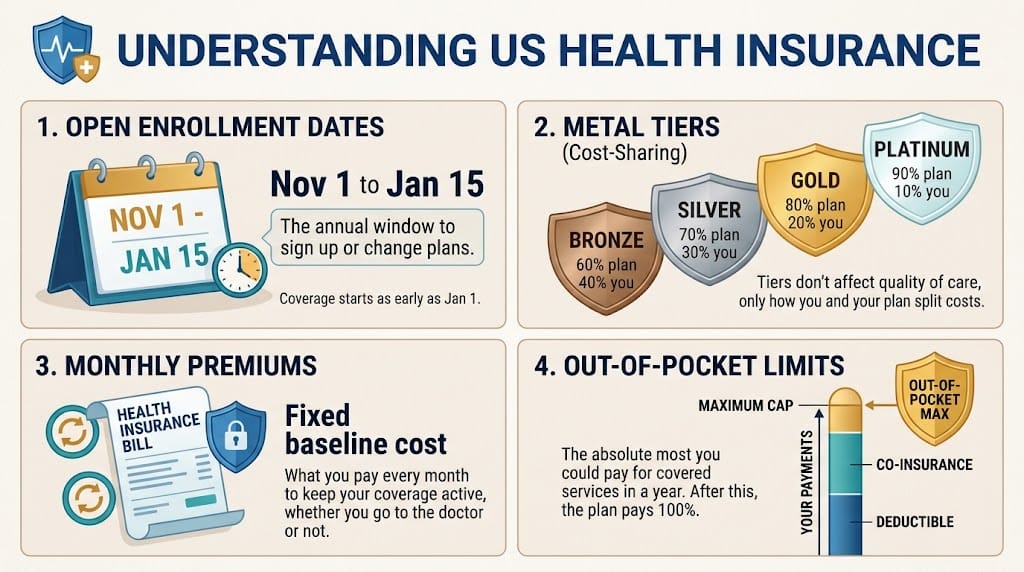
Open enrolment is the designated time of year when individuals can join, switch, or drop health insurance policies without needing a qualifying life event. For individual coverage purchased through HealthCare.gov - the federal exchange established under the Affordable Care Act (ACA) - the standard enrolment period runs from 1 November to 15 January in most states. Enrolling by 15 December ensures that coverage begins on 1 January. Those who enrol between 16 December and 15 January see their policies take effect on 1 February.
Several states operate their own independent marketplaces, including California (Covered California), New York (NY State of Health), and Massachusetts (Massachusetts Health Connector). These state-based exchanges often extend their annual enrolment windows into late January or early February. For employer-sponsored health insurance, companies set their own internal timetables, typically holding open enrolment across two to four weeks between October and November.
Outside of these scheduled dates, individuals can only alter coverage through a Special Enrolment Period (SEP). An SEP is triggered by specific life changes, known as qualifying life events. These events include getting married, having a baby or adopting a child, moving to a new county or zip code that changes available plan networks, or losing existing qualifying health coverage through job loss or divorce. In most cases, applicants have 60 days from the qualifying event to enrol in a new plan, accompanied by documentation verifying the change.
Decoding the Core Financial Terms
Selecting an insurance policy requires analysing how costs are split between the policyholder and the insurer. Every plan combines four primary cost figures that determine overall expenditure.
- Premium: The monthly fee paid to the insurer to keep the policy active. This fee is owed regardless of whether medical services are used. In employer plans, premiums are typically deducted directly from gross salary before income tax is calculated.
- Deductible: The fixed amount the policyholder must pay out of pocket for covered medical care each year before the insurer starts paying a share of bills. Routine preventive care, such as annual check-ups and standard immunisations, is exempt from the deductible under ACA rules and covered at 100 per cent.
- Copayment (Copay): A flat dollar fee paid at the point of service for a specific medical interaction. For example, a plan might charge a $30 copay for a general practitioner visit or a $15 copay for generic prescription drugs.
- Coinsurance: The percentage split of costs between the insurer and the patient after the deductible has been met. Under an 80/20 coinsurance arrangement, the insurer pays 80 per cent of an approved bill, and the patient pays the remaining 20 per cent.
- Out-of-Pocket Maximum: The absolute ceiling on what a patient pays for covered services in a single plan year. Once a patient's combined deductible, copayments, and coinsurance reach this threshold, the insurer pays 100 per cent of all covered medical costs for the rest of the year. Premiums do not count towards this limit.
A policy with a low monthly premium almost always comes with a high deductible and a high out-of-pocket maximum. Conversely, plans with higher monthly premiums typically offer lower deductibles and smaller copayments.
Comparing Network Structures: HMO, PPO, EPO, and POS
Health insurers maintain proprietary networks of doctors, hospitals, pharmacies, and specialists with whom they have negotiated discounted rates. How a policy handles care outside this network defines its structural plan type.
A Health Maintenance Organisation (HMO) requires patients to select a primary care physician (PCP) who coordinates all routine care. To consult a specialist, such as a cardiologist or dermatologist, the patient must first obtain a formal referral from their PCP. HMOs do not cover care received outside their provider network, except in authentic medical emergencies. They tend to feature lower premiums and predictable copays, but offer limited flexibility.
A Preferred Provider Organisation (PPO) offers greater freedom. Patients can consult specialists without a referral and may visit healthcare providers outside the network, though doing so incurs higher deductibles and coinsurance rates. This flexibility makes PPOs popular among individuals who travel regularly or wish to retain specific physicians, but monthly premiums are considerably higher than those for HMOs.
An Exclusive Provider Organisation (EPO) represents a hybrid model. Like an HMO, an EPO provides zero coverage for out-of-network care except in emergencies. However, like a PPO, it usually allows patients to see in-network specialists without first securing a primary care referral.
A Point of Service (POS) plan combines elements of HMO and PPO designs. Patients must designate a primary care doctor and obtain referrals for specialist visits, but they retain the option to see out-of-network providers at a higher cost share.
Marketplace Metal Tiers and Subsidies
Individual policies sold on the ACA exchanges are grouped into four "metal tiers": Bronze, Silver, Gold, and Platinum. These labels reflect the actuarial value of the policy - the average proportion of healthcare expenses the plan pays across a standard population - rather than the quality of medical treatment provided.
| Metal Tier | Average Insurer Share | Average Patient Share | Typical Premium | Typical Deductible |
|---|---|---|---|---|
| Bronze | 60 per cent | 40 per cent | Lowest | Very high ($5,000 to $8,000+) |
| Silver | 70 per cent | 30 per cent | Moderate | Moderate ($2,500 to $5,000) |
| Gold | 80 per cent | 20 per cent | High | Low ($1,000 to $2,000) |
| Platinum | 90 per cent | 10 per cent | Highest | Very low or zero |
Financial assistance is available on individual exchanges based on household income compared to the Federal Poverty Level (FPL). Advance Premium Tax Credits (APTC) lower the monthly premium cost for eligible households. In addition, households earning between 100 per cent and 250 per cent of the FPL qualify for Cost-Sharing Reductions (CSRs). These reductions apply exclusively to Silver-tier plans, artificially elevating their coverage level to resemble Gold or Platinum policies by lowering deductibles, copayments, and out-of-pocket maximums.

High-Deductible Health Plans and Health Savings Accounts
A High-Deductible Health Plan (HDHP) is a specific category of health insurance that carries a high deductible and low premium, structured to meet federal thresholds defined by the Internal Revenue Service (IRS), the US tax authority. Enrolling in a qualified HDHP grants eligibility to open a Health Savings Account (HSA).
An HSA provides significant tax advantages. Contributions made to an HSA are tax-deductible (or pre-tax via payroll deductions), funds inside the account can be invested and grow tax-free, and withdrawals spent on qualifying medical expenses are exempt from federal income tax. Unlike employer Flexible Spending Accounts (FSAs), which generally require funds to be spent before year-end, HSA balances remain with the individual indefinitely, carrying over from year to year even through career changes or retirement.
Assessing Annual Total Cost
Selecting an insurance policy by comparing monthly premiums alone leads to poor financial decisions. The correct calculation requires estimating the total potential cost over a 12-month span across different health scenarios.
To calculate the minimum baseline cost, multiply the monthly premium by 12. This is the guaranteed amount paid even if no medical care is required during the year. To calculate the worst-case financial scenario, add the 12-month premium sum to the plan's out-of-pocket maximum figure. This combined sum represents the maximum possible expenditure in the event of major surgery, an extended hospital admission, or intensive treatment.
Individuals who take regular prescription medications or visit specialists regularly should review plan drug formularies and provider directories before enrolling. Formularies categorise drugs into tiers, with generic medications costing minimal copays and speciality medications requiring substantial coinsurance percentages. Verifying that preferred physicians and ongoing prescriptions appear on an insurer's active in-network list prevents unexpected bills.
Conclusion
Open enrolment presents a decisive financial choice for anyone living and working in the United States. Evaluating health insurance demands a systematic approach: identifying whether you require an HMO or PPO network, balancing monthly premiums against deductibles, verifying federal subsidy eligibility on exchange plans, and checking that preferred doctors and medications are fully covered. By calculating the total annual financial risk rather than focusing solely on the monthly premium, policyholders can secure medical protection that guards both their health and their household savings.
Sources
- HealthCare.gov - US Federal Health Insurance Marketplace
- KFF (Kaiser Family Foundation) - Health Insurance Research and Analysis
- Internal Revenue Service - Health Savings Accounts and Other Tax-Favoured Health Plans (Publication 969)
Disclaimer: This article is provided for general informational purposes and does not constitute financial, legal, or health insurance advice. Insurance rules, tax treatments, and deadlines vary by individual circumstance and US state; readers should consult a licensed insurance broker or qualified financial adviser.
Category: Fin-Advisor