Life Insurance in the UK, US, Canada and Nigeria: A Cross-Border Guide
By Matthew Ayandare —
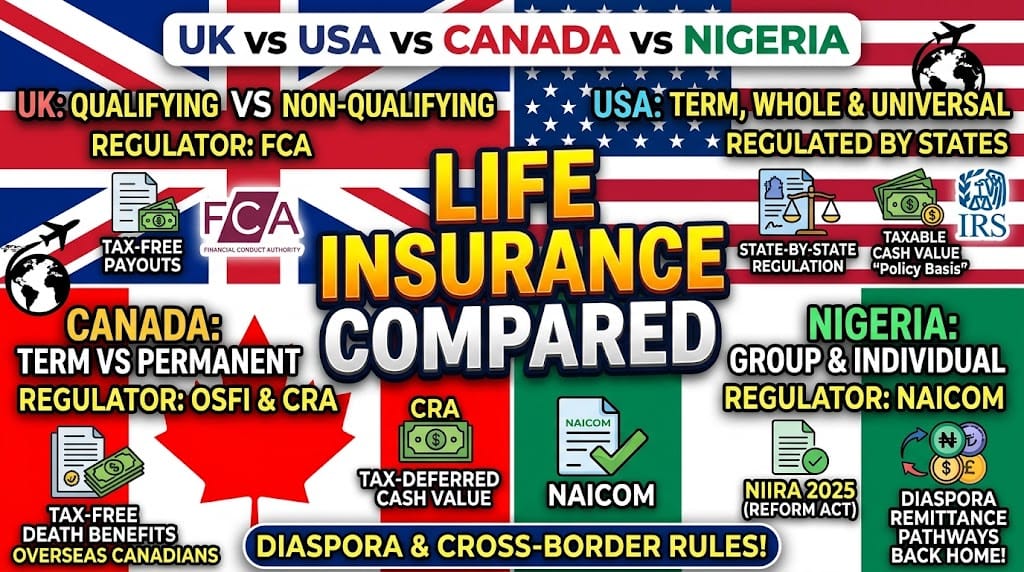
How National Insurance Systems Differ
Life insurance provides financial protection against premature death, but the contracts, tax rules and regulatory frameworks vary significantly across jurisdictions. A family moving between London, Toronto, Houston and Lagos faces distinct statutory definitions, tax liabilities and legal claims on death benefits. Understanding these distinctions prevents unexpected inheritance taxes, administrative delays and currency losses.
In mature Western markets such as the United Kingdom, the United States and Canada, life insurance operates alongside established estate-planning structures, trust laws and state safety nets. In Nigeria, the industry combines statutory group coverage with an expanding retail sector governed by federal pension and insurance statutes, operating against a backdrop of macroeconomic volatility and foreign exchange shifts.

Core Policy Structures Across Borders
Two primary categories exist in all four jurisdictions: temporary protection and permanent cover. Term insurance provides a payout if the insured dies within a fixed window, such as 10, 20 or 25 years. It carries no cash accumulation and expires without value if the policyholder survives the term.
Permanent coverage remains active until death, provided premiums are maintained. In the UK, this is called whole of life assurance. In North America, permanent products split into whole life, which offers guaranteed premiums and fixed cash values, and universal life, which unbundles the insurance cost from an investment account. Universal life allows policyholders in the US and Canada to vary premium payments and choose underlying investment allocations.
In Nigeria, endowment policies remain common alongside term products. Endowments combine life cover with mandatory savings, paying out either upon the death of the life assured or at the end of a specified period if the policyholder survives. While attractive to savers seeking disciplined accumulation, high domestic inflation often erodes the real purchasing power of long-dated naira endowment maturities.
Taxation of Premiums and Death Benefits
Tax treatment dictates the net value received by beneficiaries. In the UK, individual life insurance premiums are paid from post-tax income and receive no tax relief. Lump-sum death benefits pass free of income tax and capital gains tax. However, if the policy is not written into trust, the payout forms part of the deceased person's estate and faces standard inheritance tax at 40 per cent on amounts exceeding the nil-rate threshold.
In the US, death benefits paid directly to a beneficiary are exempt from federal income tax under Internal Revenue Code Section 101(a). Premiums are not tax-deductible for individuals. The death benefit enters the gross estate for federal estate tax purposes if the deceased held incidents of ownership, such as the right to change beneficiaries or borrow against cash values. Affluent policyholders frequently establish Irrevocable Life Insurance Trusts to exclude the payout from their taxable estate.
In Canada, life insurance proceeds paid to named beneficiaries are completely exempt from federal and provincial income tax. The money bypasses the estate, avoiding provincial probate fees and claims by estate creditors. Premiums are funded with after-tax dollars and cannot be deducted against personal income taxes, except in specific corporate-owned arrangements where policies collateralise commercial loans.
In Nigeria, Section 33 of the Personal Income Tax Act allows individual taxpayers an income tax deduction for life insurance premiums paid on their own life or that of a spouse. Lump-sum death benefits paid out to beneficiaries are exempt from personal income tax. Nigeria does not impose an estate or inheritance tax at the federal level, meaning proceeds pass without an estate levy, though estate settlement through probate courts can incur local administrative fees.
Regulatory Oversight and Consumer Safety Nets
Consumer protections depend on statutory regulators and guarantee schemes that step in if an insurer becomes insolvent.
- United Kingdom: Dual regulation applies. The Prudential Regulation Authority oversees financial soundness, while the Financial Conduct Authority enforces conduct rules. If an authorised life insurer fails, the Financial Services Compensation Scheme protects 100 per cent of valid life insurance claims with no statutory upper cap.
- United States: Regulation occurs at the state level rather than federally. State insurance departments oversee solvency and licensing, coordinated nationally through the National Association of Insurance Commissioners. Each state maintains a life and health insurance guaranty association. Coverage limits vary by state, typically capping death benefit protection between $300,000 and $500,000 per insured person.
- Canada: The Office of the Superintendent of Financial Institutions supervises federally registered life insurers for solvency, while provincial regulators such as the Financial Services Regulatory Authority of Ontario oversee market conduct. Assuris, an industry-funded non-profit organisation, protects Canadian policyholders against insurer insolvency, guaranteeing up to 90 per cent of death benefit amounts or $1,000,000, whichever is higher.
- Nigeria: The National Insurance Commission governs the industry under the Insurance Act 2003. NAICOM enforces statutory reserve requirements, policyholder protection guidelines and market conduct. Policyholders do not have access to an equivalent comprehensive private guarantee fund like Assuris or the Financial Services Compensation Scheme; liquidations follow statutory priority lists overseen by the regulator and the federal high court.
Group Life Coverage and Employment Rules
Employer-sponsored life cover represents a major point of departure between these legal regimes. In Nigeria, group life insurance is a strict statutory requirement rather than an optional employee benefit. Under Section 4(5) of the Pension Reform Act 2014, every employer with three or more staff members must maintain a group life insurance policy. The policy must guarantee a minimum death benefit equal to three times the employee's annual total emolument. Failure to maintain this cover leaves the employer personally liable to pay the sum assured if an employee dies while in service.
By contrast, group life cover in the UK, the US and Canada is voluntary for employers. Many organisations provide death-in-service benefits or group term insurance as part of competitive compensation packages. In the UK, death-in-service payments typically range between two and four times base salary, structured through registered group life trusts to avoid inheritance tax. In the US, employers often provide tax-free group term life up to $50,000 under Internal Revenue Code Section 79, with coverage above that amount generating a taxable fringe benefit for the employee.
Cross-Border Comparison
| Jurisdiction | Primary Regulators | Insolvency Protection | Tax on Death Benefit | Group Life Rules |
|---|---|---|---|---|
| United Kingdom | PRA and FCA | FSCS covers 100% of claims with no cap | Income tax-free; taxable under IHT unless written in trust | Voluntary for employers; commonly 2x to 4x salary |
| United States | State Insurance Commissioners (NAIC) | State guaranty associations ($300k-$500k limit) | Income tax-free; subject to federal estate tax if owned by deceased | Voluntary; tax-free up to $50,000 base cover |
| Canada | OSFI (federal) and provincial authorities | Assuris covers up to 90% or $1,000,000 | Income tax-free; bypasses probate when beneficiary named | Voluntary; standard employer perk |
| Nigeria | NAICOM | Regulator-managed statutory settlement | Income tax-free; premium deduction allowed under PITA | Mandatory for employers with 3+ staff (3x annual emolument) |
Diaspora Realities and Cross-Border Claims
Individuals living abroad or holding assets across multiple countries encounter operational challenges when buying or claiming life insurance. Insurers evaluate residency, nationality and travel patterns during underwriting. Most UK, Canadian and US insurers require policyholders to be legal permanent residents or citizens physically present in the country when applying for coverage.
Policy administration presents friction when an insured person dies outside the country where the policy was issued. If a Nigerian expatriate holding a Canadian or UK policy dies in Nigeria, the foreign insurer requires official documentation before releasing funds. This includes a certified death certificate from the National Population Commission, hospital medical records, police reports where applicable, and verification by an authorised consular office. Insurers may appoint local loss adjusters to investigate claims, extending settlement timelines from days to months.
Currency risk introduces substantial financial consequences. A term policy denominated in Nigerian naira held by a professional in the diaspora may lose significant purchasing power relative to foreign obligations due to exchange rate depreciations. Conversely, paying premiums on hard-currency policies from Nigeria requires managing official foreign exchange availability and international transfer costs. Some international carriers offer offshore life policies denominated in US dollars, British pounds or euros, but these products fall outside domestic safety nets and require careful legal evaluation.
Beneficiary Designations and Intestacy
Across all four jurisdictions, the beneficiary designation remains the most powerful administrative instrument. Naming an individual or trust directly on the insurance contract transfers the death benefit outside the deceased person's will.
When a policyholder fails to name a valid beneficiary, the proceeds default to their legal estate. In Canada and the UK, this exposes the payout to estate administration delays, probate fees and potential claims from creditors. In Nigeria, an unassigned payout requires the family to secure a Grant of Letters of Administration from the state high court probate registry. This process involves statutory publication periods, administrative taxes, and prolonged legal oversight before funds reach dependents.
Conclusion
Life insurance offers protection across the UK, the US, Canada and Nigeria, yet the legal mechanisms, tax treatments and statutory obligations differ markedly. While UK and North American markets focus on estate planning, trust structures and consumer insolvency guarantees, Nigeria pairs statutory employer requirements with income tax relief on premiums. Individuals maintaining ties across these countries must track where their policies are domiciled, how beneficiaries are named, and how local revenue agencies treat lump-sum payouts upon death.
Sources
- Inheritance Tax Act 1984 (United Kingdom)
- Financial Conduct Authority (United Kingdom)
- Internal Revenue Service: Publication 525, Taxable and Nontaxable Income (United States)
- National Association of Insurance Commissioners (United States)
- Financial Consumer Agency of Canada: Life Insurance
- Office of the Superintendent of Financial Institutions (Canada)
- National Insurance Commission (Nigeria)
- National Pension Commission: Pension Reform Act 2014 (Nigeria)
Disclaimer: This guide provides general comparative information and does not constitute financial, legal or insurance advice. Tax rules, compensation limits and regulatory provisions change over time; readers should consult a qualified, licensed insurance advisor or estate planner in their respective jurisdiction before purchasing or restructuring cover.
Category: Fin-Advisor