Another oilsands boom? Smith, Carney say this time Canada will be ready
By CelebUD Newsroom —
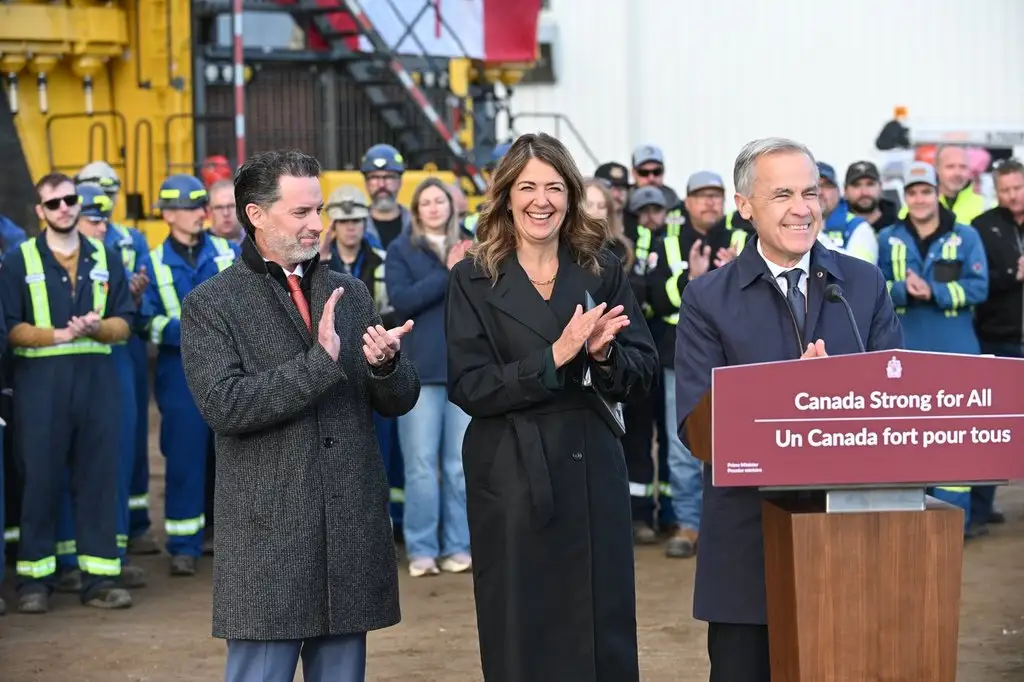
Following a decade marked by subdued capital expenditure and cautious asset management, Canadian energy leaders are positioning the Alberta oilsands for a calculated resurgence. Prime Minister Mark Carney and Alberta Premier Danielle Smith appeared together in Fort McMurray to outline how a landmark pipeline venture and a simplified regulatory approach could reshape the nation’s primary petroleum basin, insisting that lessons learned from prior eras of rampant inflation and overstretched public infrastructure will prevent historical missteps.
A Flagship Pipeline Receives National Priority Status
Central to the revitalization strategy is the Pacific Link pipeline, a project designed to move one million barrels of crude oil per day from Alberta across British Columbia to a deepwater marine terminal located on the southern B.C. coastline. Prime Minister Carney confirmed that the ambitious infrastructure initiative is the premier proposal to secure designation under federal legislation approved last year, which formally classifies projects of profound economic consequence as vital to the national interest.
By securing this official classification, Pacific Link qualifies for an expedited regulatory assessment. The approval mechanism is set to be coordinated and supervised directly by the Calgary-based major projects office, cutting through previously bureaucratic layers that industry executives long faulted for multi-year project delays. The ultimate commercial success of Pacific Link rests entirely on the willingness of exploration and production operators to commit significant new capital to boost upstream extraction volumes.
When questioned on whether this shift signals an imminent return to the breakneck expansion cycles that previously defined the region, Carney declined to adopt the traditional terminology.
“I wouldn’t use the term ‘boom,'” he replied. “I would use ‘sustained growth.'”
Carney noted that local governments and Indigenous leadership are engaged far earlier than in previous cycles, ensuring a broader distribution of economic rewards. “We learned lessons from the past in building infrastructure,” Carney said, pointing to closer coordination with municipal planners and the arrival of another phase of technical innovation across the sector.
Avoiding the Pitfalls of Past Expansion Cycles
Between the mid-2000s and mid-2010s, runaway investment generated extreme volatility across northeastern Alberta. Surging demand created severe housing bottlenecks, acute regional labour shortages, and relentless operational cost increases that eroded profit margins. Energy companies later abandoned large-scale "green field" development—a shift highlighted by Suncor Energy Inc.’s Fort Hills mine, the last completely new open-pit mine constructed in the basin. Between receiving its final sanction in 2013 and entering commercial operation in 2018, Fort Hills saw its capital budget inflate from $13.5 billion to over $17 billion.
Over the intervening decade, operators pivoted from multibillion-dollar mega-developments toward modest brownfield expansions, debottlenecking, and refining operational efficiencies within existing plants. This defensive stance was driven by limited export conduit space, complicated regulatory regimes, heavy environmental restrictions, and a prolonged price slump exacerbated by the pandemic-driven collapse of global energy consumption.
| Metric / Characteristic | Historical Peak (Mid-2000s to Mid-2010s) | Emerging Model (2026 and Beyond) |
|---|---|---|
| Growth Strategy | Large greenfield mines built from scratch (e.g., Fort Hills) | Incremental debottlenecking, brownfield expansion, technology adoption |
| Haulage & Field Operations | High-cost, fly-in fly-out manual drivers in remote work camps | Autonomous heavy haulers, remote command centres, stabilised workforces |
| State of the industry | Fragmented ownership with heavy multi-national participation | Concentrated ownership among consolidated domestic alliances |
| Pipeline Regulatory Path | Protracted multi-agency hearings prone to multi-year impasses | Simplified national interest process managed via the Calgary major projects office |
By 2026, shifting international conditions have created fresh impetus. Geopolitical conflict across the Middle East has exposed critical fractures in international supply networks, driving importing nations to pursue stable trading partners. In parallel, federal policy rollbacks have dismantled several contentious energy regulations dating from the previous administration, opening a clearer path for Canadian heavy oil to reach emerging, high-value consumer hubs in the Asia-Pacific basin.
Automation, Infrastructure, and Sector Consolidation
Technological change stands at the core of the new operational model. Speaking alongside Carney in front of massive autonomous haul trucks, Premier Danielle Smith highlighted that modern self-driving vehicles have dramatically altered site logistics. In earlier decades, companies paid six-figure compensation packages to long-distance commuter equipment operators housed in temporary workforce lodges.
“(Companies) have managed to find a way to increase production without having the kind of dramatic pressure that we saw in the past of a large number of people moving here, not able to find homes,” Smith said.
Smith emphasised ongoing coordination with municipal officials regarding critical transport links, specifically citing planned improvements to Highway 881. The corridor runs east of Highway 63 and links multiple steam-assisted gravity drainage operations south of Fort McMurray. “There’s lots of ways that we can partner with the federal government to make sure those key infrastructure projects get built, so we build on a pace that allows us to keep up,” the premier added.
Market dynamics have also matured structurally. Wave after wave of corporate mergers and exits by multinational conglomerates—such as Total and Shell—combined with domestic acquisitions involving players like Husky and MEG Energy, have concentrated ownership into a smaller cohort of dominant firms.
Andrew Botterill, who leads the national oil, gas, and chemicals division at Deloitte Canada, observed that regional producers now coordinate more than in previous decades:
“What we have is a more efficient, far more aligned group of producers up there than maybe what it was 10, 15 years ago. They’ve come together as an alliance and really recognize that ‘We’ve got to share labour, we’ve got to be less competitive, we’ve got to find ways that we can do things together and not just drive up costs.'”
Labour Constraints Across the Broader Economy
Despite these internal advancements, external execution risks remain. Lance Mortlock, managing partner at EY Canada, cautions that the broader resource and utilities ecosystem faces intense competition for skilled labour. The concurrent execution of export conduits, electrical transmission networks, clean hydroelectric dams, and specialised mining ventures risks pulling from an identical pool of specialised personnel.
“We’re going to need tens of thousands of workers across the country to build this stuff: engineers, professionals, welders, pipe fitters. I’m not sure where all these people are going to come from if we do half the projects that we have the desire to construct,” Mortlock said. “So I’m hoping that there’s going to be more conversation about the workforce and more conversation about how do we sequence these things so we optimize the system from a labour force perspective?”
Foreign credentials and trade certification
Foreign-trained tradespeople and engineers considering Canada will find opportunities shaped by strict credential rules. While federal authorities and provincial governments frequently adjust Express Entry draws and the Alberta Advantage Immigration Programme to target construction trades, arrival does not guarantee an immediate start on an industrial site. Canada requires most skilled trades, including pipefitters and welders, to obtain provincial certification or complete the Interprovincial Standards Red Seal examination.
For professionals in the UK, South Africa, or Nigeria, bridging programmes and assessments of hours logged under accredited supervisors remain necessary before securing unionised wages. Engineering applicants face a similar hurdle through bodies such as APEGA, the Association of Professional Engineers and Geoscientists of Alberta, which reviews overseas university degrees and technical experience before granting independent practice licences.
Conclusion
The push by Ottawa and Edmonton to advance the Pacific Link pipeline marks a concerted attempt to unlock fresh market avenues for Canadian petroleum without triggering the destabilizing spikes in housing, wages, and project budgets that defined previous eras. Whether the sector achieves steady growth will depend on how effectively industry alliances balance capital discipline against an increasingly tight national market for skilled trades and engineering expertise.
Category: Business