The Future of Nigerian Technology: The Big Dream of the Black Man
By Tunde Ibrahim Amusa —
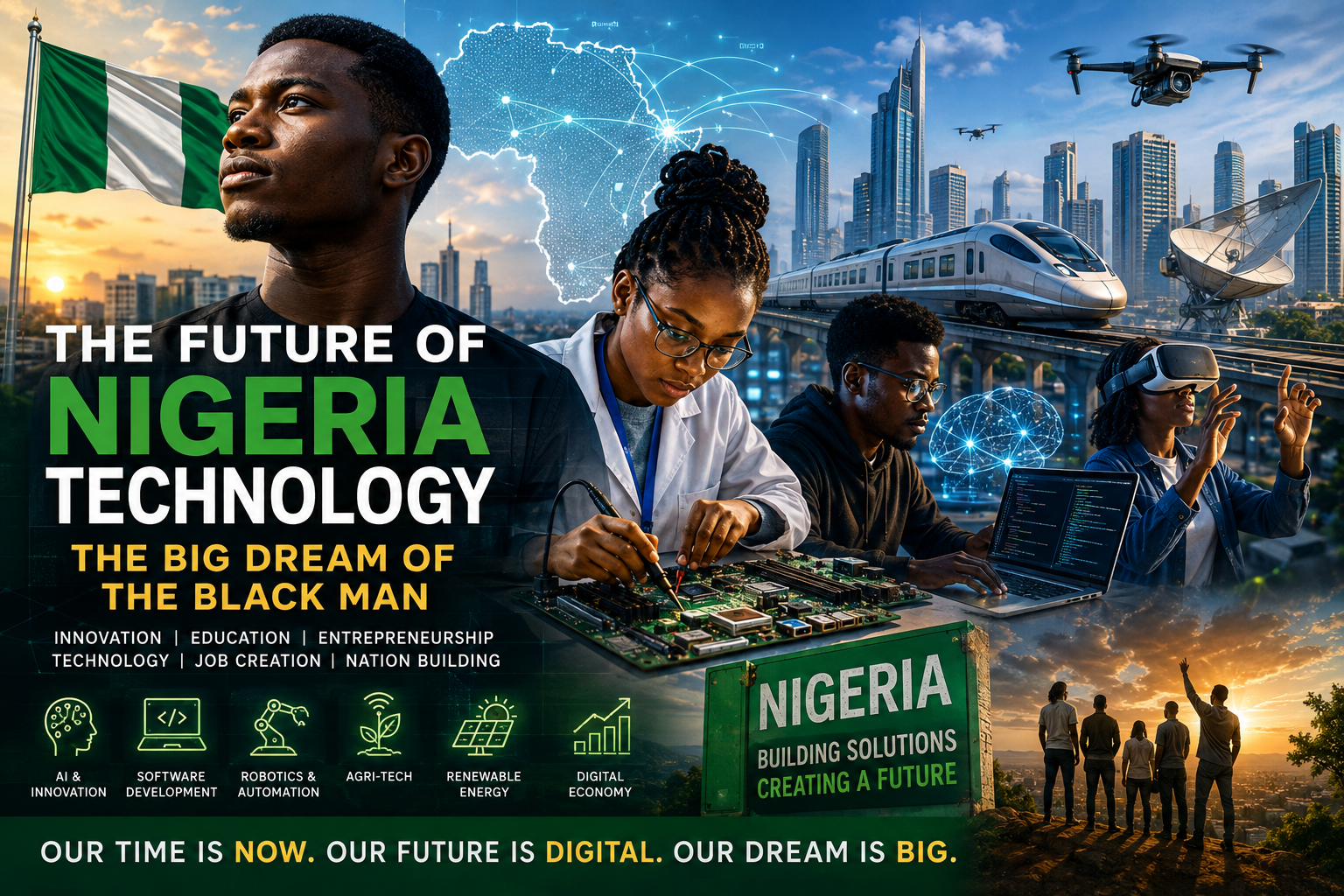
Nigeria Must Build the Technology Future It Wants
From consumers to creators: why Nigeria’s next generation must design, build, and lead Africa’s technological future
A New Question for a New Generation
For generations, the story of Africa has often been told by others. They told us about our problems, measured our poverty, described our weaknesses, and imported solutions for our challenges.
But a new generation is asking a more powerful question: what if Africa begins to design its own future?
Nigeria stands at the centre of that question. With its youthful population, entrepreneurial energy, and expanding digital economy, the country has the potential to become more than a market for imported technology. It can become a builder of solutions, products, platforms, and ideas that serve Africa and compete globally.
Technology Is Bigger Than Devices
When many people hear the word technology, they think of smartphones, laptops, social media, artificial intelligence, and internet services. Those are important, but technology is much bigger than devices and apps.
Technology is the ability to solve problems better. It is the farmer using data to improve production, the student using artificial intelligence to learn, the engineer designing machines for local industries, the developer building software for African businesses, and the technician repairing and rebuilding electronic equipment instead of simply replacing it.
Nigeria has millions of problems waiting for innovative solutions. That also means Nigeria has millions of opportunities waiting for technology.
From Consumers to Builders
One of Nigeria’s biggest technological challenges is that we consume more technology than we produce. We buy computers, phones, software, platforms, and equipment. There is nothing wrong with learning from the world; every serious nation does. But a serious technological future requires more than consumption.
We must learn to build.
A nation cannot achieve technological independence simply by buying the newest devices. Technological strength comes from knowledge: engineers, programmers, technicians, scientists, researchers, entrepreneurs, and young people who are given the opportunity to learn.
Imagine a Nigeria where a young person in Lagos builds software used across Africa; where an engineer in Kaduna designs agricultural technology for millions of farmers; where innovators in Aba develop advanced manufacturing systems; and where Nigerian researchers contribute to breakthroughs in medicine, energy, agriculture, artificial intelligence, and space technology.
This is not an impossible dream. It is a question of preparation, investment, education, infrastructure, and courage.
Artificial Intelligence Is an Opportunity—If We Build for Ourselves
Artificial intelligence is already changing how people work, learn, trade, govern, and create. For Nigeria, AI should not only be viewed as a threat to jobs. It should also be viewed as an opportunity to create entirely new industries.
The young Nigerian who learns how to use AI responsibly today may have a major advantage in tomorrow’s economy. But the bigger ambition should go beyond using foreign AI tools. Nigeria must help develop African datasets, African research, African applications, and African AI solutions that understand African realities, languages, markets, and challenges.
Nigeria’s linguistic, cultural, and economic diversity can become an advantage if it is treated as a foundation for innovation rather than as an obstacle. The technology that will serve Africa best must understand Africa from the inside.
The Nigerian Technician Must Not Be Forgotten
There is another part of the technology story that deserves more attention: technical skills. Not everyone will become a software engineer or build artificial intelligence models. Some people will become electronics technicians, computer repair specialists, network engineers, hardware engineers, and equipment maintenance professionals.
These skills are essential. The laptop that powers a business needs someone who understands hardware. The network connecting an organisation needs someone who understands infrastructure. The electronic equipment used in industry needs someone who can maintain it.
The future of technology requires both digital intelligence and practical technical competence. Nigeria must invest in both.
Schools Must Prepare Children for Tomorrow
If we want a technological Nigeria, we must begin with education. Children should not only learn how to operate computers; they should learn how computers work. They should learn problem-solving, programming, digital safety, electronics, robotics where resources permit, and responsible use of artificial intelligence.
Most importantly, they should be encouraged to ask: “How can I create something that solves a problem?”
Nigeria’s Young Population Can Become Its Greatest Advantage
Nigeria’s young population is often discussed as a challenge. But youth can become one of the country’s greatest technological assets if it is matched with the right education, infrastructure, mentorship, and opportunity.
A young population with practical skills can become an innovation workforce. But talent alone is not enough. Young Nigerians need reliable electricity, affordable internet, access to computers, technical training, research opportunities, startup funding, mentorship, and functional institutions.
If we give young people these tools, we should not be surprised when they begin creating extraordinary things.
Ibeju-Lekki and the Next Technology Economy
Places such as Ibeju-Lekki show why technology must be connected to physical development. As infrastructure, industry, logistics, housing, and investment expand around Lagos, there will be increasing demand for skilled workers and technology-driven businesses.
But communities should not only provide land and labour. They should develop knowledge. A community that prepares its young people for technology can participate in the economic opportunities created around it.
The future should not simply arrive in our communities. Our people should be prepared to help build it.
The Dream Must Become Bigger Than Nigeria
Nigeria’s technological ambition should eventually extend beyond its borders. The country has the population, entrepreneurial culture, and talent to become a major technology hub for Africa.
The goal should be to build products that can move from Lagos to Nigeria, from Nigeria to West Africa, from West Africa to Africa, and from Africa to the world.
A Nigerian company should be able to create a product in Lagos and find customers in Ghana, Kenya, South Africa, Rwanda, the United Kingdom, Canada, and beyond. That is how intellectual property becomes economic power.
The Big Question
The future will not ask whether Nigeria had talented people. We already know the answer. The future will ask what we did with that talent.
Did we build? Did we educate? Did we invest? Did we research? Did we create? Did we manufacture? Did we develop our own solutions—or did we remain permanent consumers of other people’s ideas?
That decision belongs to us.
The Dream Is Still Alive
The dream of technological advancement does not belong to one person, one company, or one generation. It belongs to all of us. The student learning computer skills today may become tomorrow’s software engineer. The technician repairing laptops today may eventually design electronic equipment. The entrepreneur building a small technology business today may one day employ thousands.
We should therefore stop treating today’s limitations as the permanent definition of tomorrow. Nigeria’s technological story is still being written.
The Future We Should Build
The future Nigeria needs will not be built by confidence alone. It will require deliberate choices: classrooms that teach creation, not only consumption; communities that value technical skills as much as certificates; businesses that invest in local talent; and leaders who understand that technology is now a foundation of national development.
The Nigerian child should not grow up believing that innovation is something that only arrives from elsewhere. The better question is not only, “Which foreign technology can I buy?” but “What problem can I solve, what product can I build, and what future can I help create?”
That mindset is where national transformation begins. Nigeria’s greatest technological achievement will not simply be importing more devices, using more applications, or adopting more artificial intelligence. It will be raising a generation with the skill, discipline, imagination, and confidence to build solutions of its own.
“A nation does not become great by consuming the future; it becomes great by building it.”
Nigeria’s technological future requires deliberate action, not confidence alone.
Schools should teach children to create, not just consume technology.
Communities should value technical skills as much as formal certificates.
Businesses need to invest in local talent and innovation.
Leaders must recognise technology as a foundation of national development.
Nigerian children should be encouraged to ask what problems they can solve and what products they can build.
The central mindset shift is from buying foreign technology to building Nigerian solutions.
· Nigerians must build Nigeria’s future.
In summary, the conclusion calls Nigeria to move beyond passive participation in the global technology economy and become an active builder of its own future. By investing in education, technical competence, innovation, and local talent, the country can raise a generation capable of solving African problems and contributing meaningful solutions to the world.
If you are young, start where you are. Learn one skill. Build one idea. Fix one problem around you. Ask questions, practise daily, use technology wisely, and work with others who want to create. Nigeria’s future will not be built only by experts in offices; it will also be built by curious young people who decide to begin.
The future is not waiting for Nigeria. It is waiting to be built by Nigerians.
Category: Technology