Mobile Money Compared: How M-Pesa, MTN MoMo, OPay and Wave Stack Up on Fees and Safety
By Victoria Odunola —
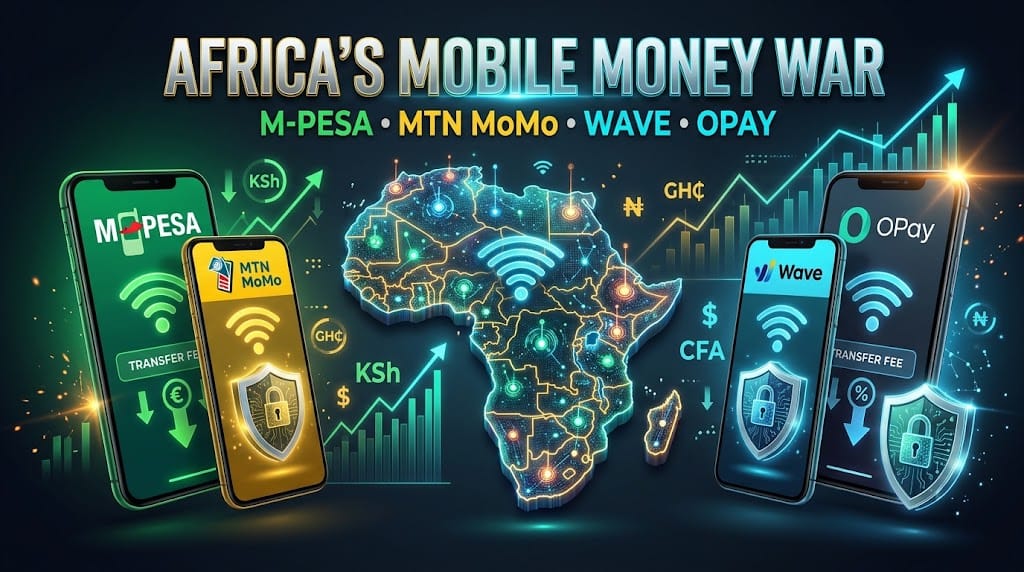
Daily commerce across sub-Saharan Africa runs on digital wallets rather than plastic cards or physical bank branches. From Nairobi street markets to bus terminals in Dakar and retail shops in Lagos, transactions that once demanded physical cash now settle in seconds over mobile networks. The market is led by distinct giants: Safaricom's M-Pesa in East Africa, MTN MoMo across Central, East, and West Africa, OPay in Nigeria, and Wave in Francophone West Africa. While each operator allows customers to store, transfer, and withdraw cash through a handset, their fee models and security protections differ sharply.
Choosing where to keep funds or how to move money across borders requires looking past marketing slogans. A pricing structure that looks cheap for small peer-to-peer transfers can turn expensive when converting wallet balances back into physical cash at an agent kiosk. At the same time, phone theft, social engineering scams, and SIM-card fraud mean account security tools matter as much as transaction rates.
The Diverging Pricing Models Across Africa
Mobile money fees fall into two main categories: tiered percentage pricing and aggressive flat-rate discounting. Safaricom's M-Pesa, regulated by the Central Bank of Kenya (CBK), relies on a tiered tariff schedule. Small transfers between registered M-Pesa users below 100 Kenyan shillings (around KES 100) attract zero fees. As transfer amounts grow, the charges scale upward. Sending KES 1,000 costs KES 13, while moving KES 50,000 incurs KES 108. Withdrawing funds from an agent carries a separate, steeper cost: taking out KES 1,000 costs KES 29, and pulling KES 50,000 costs KES 278. Safaricom removed the old penalty rate for unregistered recipients, aligning cross-network transfer charges to Airtel Money and Telkom T-Kash with internal M-Pesa rates.
MTN Mobile Money operates across multiple jurisdictions, including Ghana, Uganda, Cameroon, and Nigeria, adapting its tariffs to individual central bank directives. In Uganda, governed by the Bank of Uganda, MTN charges UGX 100 to send small sums up to UGX 5,000, with tariffs scaling up for larger transfers. Agent withdrawals in Uganda range from UGX 420 on micro-withdrawals to UGX 12,500 on large amounts. In Ghana, where MTN MoMo holds substantial market share, regulators closely monitor wallet-to-bank pricing. When MTN Ghana announced a planned 0.75 per cent fee on transfers from MoMo wallets to bank accounts, the Bank of Ghana ordered an immediate suspension to review the consumer impact. Ghana previously imposed an electronic transaction levy (E-Levy), which shaped consumer willingness to pay added platform charges.
Wave upended the market in Senegal and Côte d'Ivoire by introducing a flat-rate pricing model. Instead of complex tier schedules, Wave charges a flat 1 per cent fee for transfers in Senegal, while deposits and cash withdrawals at its agent network remain free for customers. In Côte d'Ivoire, merchant collection fees sit around 1.5 per cent, but personal transfers remain dramatically cheaper than legacy alternatives. This low-fee approach forced traditional mobile network operators like Orange Money to cut their transfer fees by up to 80 per cent in Senegal to retain their customer base.
In Nigeria, OPay gained dominant traction after a severe banknote shortage prompted millions of retail merchants and shoppers to adopt alternative payment methods. Licensed as a mobile money operator by the Central Bank of Nigeria (CBN), OPay built its user base by offering zero charges on transfers to any Nigerian commercial bank or digital wallet up to daily promotional limits. Cash withdrawals through POS agents in Nigeria depend on third-party terminal operators, who typically add a surcharge of 100 to 200 Nigerian naira (NGN 100 to NGN 200) per NGN 10,000 withdrawn.
Comparison of Major Mobile Money Networks
| Provider | Primary Markets | Transfer Fee Structure | Agent Withdrawal Cost | Core Security Defences |
|---|---|---|---|---|
| M-Pesa (Safaricom) | Kenya, Tanzania, Ethiopia | Tiered; free under KES 100, up to KES 108 for large transfers | Tiered; KES 29 for KES 1,000, KES 309 for top tier | Hakikisha instant name display, SIM toolkit PIN, app biometrics |
| MTN MoMo | Ghana, Uganda, Nigeria, Cameroon | Tiered by corridor and local currency limits | Tiered; deductions include local transaction taxes where enacted | Agent ID checks, USSD PIN confirmation, app-based session timeouts |
| OPay | Nigeria, expanding across West Africa | Free peer-to-peer and bank transfers (subject to daily tier limits) | Variable POS merchant fees; free wallet-to-wallet | NightGuard, Large Transaction Shield, Emergency Lock, Safety PIN |
| Wave | Senegal, Côte d'Ivoire, Mali, Burkina Faso | Flat 1 per cent on transfers | Free at agent network | QR card tokens, app biometrics, central fraud monitoring |
| Orange Money | Senegal, Côte d'Ivoire, Guinea, Cameroon | Tiered, slashed to match Wave in francophone hubs | Low to moderate tiered withdrawal fees | Orange Money PIN, SMS transaction validation, KYC verification |
The Gap Between Digital Spending and Physical Cash-Out
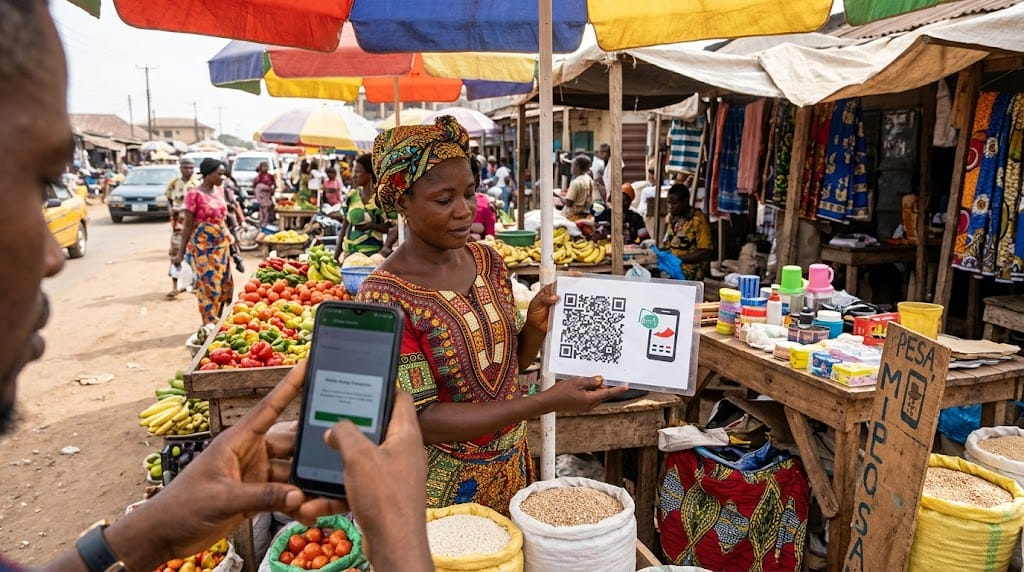
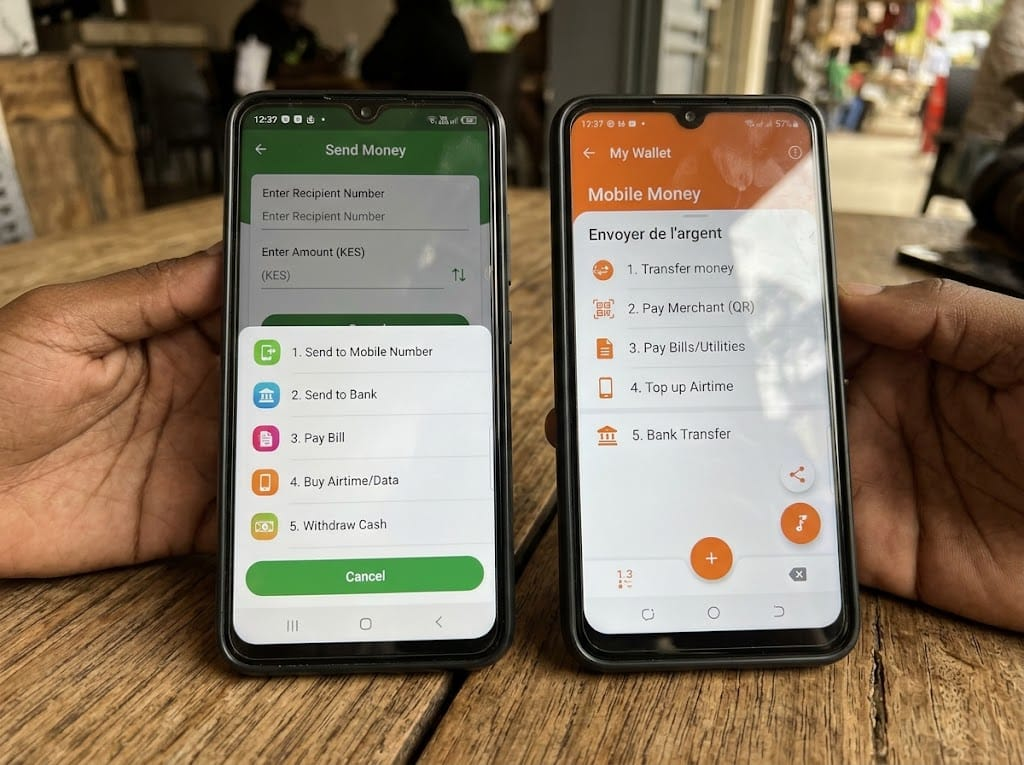
A mobile money account functions most economically when money remains inside the electronic loop. Paying utility providers, buying mobile airtime, and transferring money to grocery vendors who accept merchant till numbers usually carries little or no extra cost. In Kenya, Safaricom's "Lipa Na M-Pesa" service charges customers nothing when making regular retail purchases through merchant buy-goods tills.
The financial penalty occurs when a user converts electronic balances to physical bank notes. Agent kiosk owners earn their livelihood on commissions, meaning the platforms levy charges on cash-out transactions. A user moving KES 10,000 through M-Pesa incurs a KES 115 withdrawal charge at an agent. In Uganda, an MTN customer withdrawing UGX 100,000 pays UGX 2,400 to the platform, in addition to any local government taxes deducted automatically at checkout.
Wave disrupted this revenue model by funding agent commissions out of its flat 1 per cent transfer fee rather than billing the person withdrawing cash. For casual workers and traders who require physical cash at the end of each working day, Wave's zero-cost cash-out offers substantial monthly savings compared to conventional telecom-backed systems.
PIN Security, SIM Swaps, and Scam Verification
Security risks across African mobile money differ significantly from traditional online banking fraud in Europe or North America. Card skimming and web phishing exist, but the dominant threats are SIM-swap fraud, fake agent deposit messages, and phone theft accompanied by physical coercion.
M-Pesa addresses transaction errors through "Hakikisha", a confirmation tool built into both USSD and the SIM toolkit. When a customer enters an account number or mobile phone number, the network pauses the process to display the legal name of the registered recipient. The sender has 20 seconds to cancel the transfer if the recipient name does not match the intended contact. Safaricom also links wallet security to national identity registries, blocking duplicate SIM registrations and alerting banking partners when a SIM swap occurs on a line.
In Nigeria, where digital fraud syndicates frequently target phone owners through snatched devices, OPay introduced targeted defensive measures:
- NightGuard: Allows users to select specific overnight hours, such as 11:00 PM to 7:00 AM, during which outgoing transfers cannot proceed without a live facial recognition scan.
- Emergency Lock: Enables a user whose device is stolen to lock their account from another handset using a quick dial code, freezing outward movements for 24 hours without waiting for customer care queues.
- Safety PIN: Designed for coercion situations, allowing the customer to enter an alternative PIN that presents a fake low balance or dummy success screen to prevent unauthorised looting under threat.
- Large Transaction Shield: Imposes facial verification prompts whenever a single transaction exceeds user-defined limits between NGN 100,000 and NGN 600,000.
Wave built its initial Senegalese platform around physical QR cards paired with fingerprint or facial scans on the agent's smartphone. This bypassed the vulnerability of USSD menus displayed in plain view over someone's shoulder. Wave accounts registered on smartphones require device verification and app PIN codes, separating wallet access from the underlying physical SIM card.
Regulatory Oversight and Deposit Protection
Funds stored in mobile money wallets do not always carry the same legal safety nets as balances inside conventional commercial banks. Regulators enforce prudential guidelines to ensure payment providers do not treat customer floats as risk assets.
In Kenya, the CBK requires Safaricom to place all M-Pesa customer deposits in separate trust accounts spread across commercial banks, ring-fenced from Safaricom's corporate assets. If Safaricom encountered insolvency, creditors could not touch customer deposits. In West Africa, the Central Bank of West African States (BCEAO) enforces strict rules on e-money issuers across Senegal, Côte d'Ivoire, and six other member nations, requiring them to hold statutory reserves.
In Nigeria, OPay operates under a Payment Service Bank and Mobile Money Operator licence, with retail deposits insured up to regulatory thresholds by the Nigeria Deposit Insurance Corporation (NDIC). Central banks across all jurisdictions have stepped up enforcement against unregistered accounts. Users in Ghana must connect their MoMo accounts to the biometric Ghana Card, while Nigerian platforms enforce Bank Verification Numbers (BVN) or National Identification Numbers (NIN) for any account tier carrying meaningful transaction capacity.
Conclusion
Mobile money across Africa has evolved into a contested financial system where pricing strategies and defensive security tools determine market share. Safaricom's M-Pesa and MTN MoMo retain deep agent distribution and high convenience across East and West Africa, though their tiered cash-out tariffs create tangible expenses for users who need physical notes. Wave and OPay have used flat pricing, free basic transfers, and advanced software safeguards like facial verification and anti-coercion PINs to win millions of users. For consumers and small business owners, balancing lower withdrawal tariffs against reliable fraud prevention remains the deciding factor when choosing where to store and move daily funds.
Sources
- Safaricom Kenya - M-Pesa Tariffs and Security Protocols
- MTN Group - Mobile Money Tariffs and Regulatory Guidelines
- OPay Digital Services - Security Features and User Protection Center
- Wave Mobile Money - Pricing and Regional Compliance Documentation
- Banque Centrale des États de l'Afrique de l'Ouest (BCEAO) - E-Money Regulatory Framework
- Central Bank of Nigeria (CBN) - Guidelines on Mobile Financial Services
Disclaimer: This article provides general financial and technology information and does not constitute financial, investment, or legal advice. Mobile money tariffs, regulatory requirements, and security features vary by jurisdiction and operator and are subject to change.
Category: Technology