I watched a humanoid robot clean my apartment. It felt like a taste of the future.
By CelebUD Newsroom —
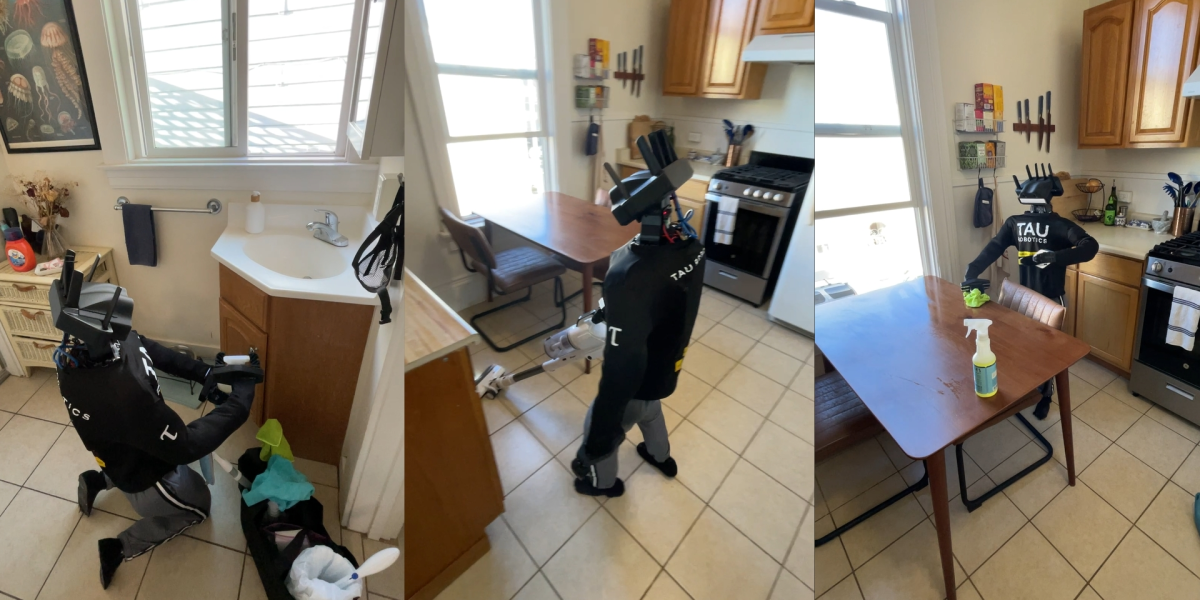
A new wave of domestic robotics has arrived in San Francisco living rooms, offering residents an early glimpse of futuristic housekeeping alongside the clumsy reality of early-stage hardware. Startup Tau Robotics has begun deploying compact humanoid robots into private apartments to wipe surfaces, scrub toilets, and fold clothes, blending remote human teleoperation with machine learning to train the autonomous domestic workers of tomorrow.
The Teleoperated Path to Autonomous Domestic Help
While the long-range ambition of Tau Robotics is full machine autonomy, its current fleet functions more like sophisticated radio-controlled devices than fully self-driving systems. Operators stationed at company headquarters pilot the machines in real time, viewing residential interiors through visual sensors mounted in the robots' heads and wrists.
Complex, fine-motor household chores—such as smoothing bedspreads or neatly folding garments—are currently executed through kinematic guidance. Under this setup, a human operator acts out physical movements while onboard sensors translate those precise gestures to the mechanical limbs. More repetitive chores like mopping and vacuuming can already run without manual steering, according to company leadership.
Every kitchen counter scrubbed and laundry piece folded feeds directly into algorithmic models. The company uses this active physical footage to train future iterations of autonomous software, turning current residential deployments into live research sessions.
Physical Anatomy and Early Trial Performance
Standing four and a half feet tall, each machine features a 3D-printed head equipped with communication antennae that relay video feeds and telemetry back to headquarters. Instead of delicate, human-style fingers, the units utilize 3D-printed claw hands designed to survive heavy, abrasive domestic labor. To protect residential floorboards, the machines are outfitted with grippy socks alongside branded company apparel.
Real-world testing reveals that navigating physical infrastructure remains a hurdle. During residential trial visits, the robot encountered major difficulty managing standard architectural barriers:
- Outdoor Staircases: Ascending eight exterior steps resulted in unsteady, stumbling footwork, though the machine maintained its balance without collapsing.
- Interior Carpeting: Thick indoor stairs stalled movement entirely, requiring human handlers to haul the unit manually.
- Hardware Sensitivity: Operating in warm temperatures caused monitoring screens at headquarters to overheat and shut down, ending one early deployment prematurely.
- Minor Clumsiness: The machine knocked over an air purifier, toppled a closed olive oil container, and left water faucets trickling.
Despite those growing pains, subsequent test runs demonstrated remarkable dexterity. Tasked with sanitizing a bathroom, the robot dislodged the head of its cleaning wand three separate times and successfully refastened the tool on each occasion by probing with the handle at precise angles.
Service Rates and Teleoperation Challenges
Because customer deployments double as vital training laboratories, pricing has been set well below the traditional capital cost of advanced robotics, though rates have shifted as the fleet expands.
| Deployment Tier | Pricing Structure | Operational Configuration |
|---|---|---|
| Early Beta Rate | $30 per visit | Single robot, one-hour cleaning session |
| Weekly Service | $60 per visit | Two robots, scheduled recurring visit |
| One-Time Booking | $100 flat fee | Two robots, single comprehensive visit |
Even with discounted pricing, the units work deliberately and slowly. Latency between headquarters and local residential networks also plays a factor in mechanical coordination. Tau cofounder Cornelia Weinzierl noted the technical strain involved in synchronizing hardware over distance:
“The amount of work and time that we spend just optimizing, for example, timings and connectivity is crazy.”
Weinzierl confirmed that while company staff previously escorted the robots directly into customer properties, unescorted deployments are now taking over as remote telemetry stabilizes.
Labor Implications and the Commercial Horizon
Tau Robotics has conducted only a couple hundred residential cleanings so far, underscoring that commercial scale remains distant. Teaching machine learning models to navigate millions of unique household clutter permutations requires massive repositories of physical interaction data.
The expansion of automated home services also renews debates surrounding manual labor displacement. While policy safeguards for workers displaced by artificial intelligence remain minimal in the United States, Weinzierl argues that domestic upkeep suffers from systemic labor shortages, high turnover, and physical strain.
“Cleaning is not a job that a lot of people really actively want to be doing—there’s high turnover, there’s a high risk of injury. We need people, and we don’t have them, and no one wants to do it.”
Beyond standard apartment maintenance, the company is evaluating harsher, hazardous applications for future units, including mold remediation and specialized home health support roles.
The hidden remote work potential in robot teleoperation
While the robots scrub floors in San Francisco apartments, the real mechanics rely on humans sitting at headquarters wearing sensors and piloting mechanical limbs through remote guidance. Modern artificial intelligence requires vast amounts of physical interaction data to learn human tasks. For tech-savvy youth in Lagos, Nairobi, and across Africa, this transition phase could quietly expand the digital gig economy from data annotation into remote physical teleoperation.
African tech talent has already played a substantial role in training global AI systems through content labeling and transcription. As network latency improves and robotics companies face pressure to lower pilot costs, teleoperating mechanical limbs from overseas offices could become a viable outsourcing model. Guiding an automated cleaner in North America from an office desk in Nigeria is technically possible once transmission protocols stabilize, opening new pathways for outsourced tech labor.
For remote freelancers and tech hubs across Nigeria, keep an eye on expanding robotics platforms: remote teleoperation may soon emerge as the next frontier of international data work.
Conclusion
Tau Robotics is pursuing an unconventional shortcut to autonomous housekeeping by using human teleoperators to generate the physical data modern AI requires. While the machines remain slow, imperfect, and prone to mechanical hiccups, their ability to scrub toilets and wipe surfaces signals that domestic humanoid robots are transitioning from science-fiction concepts into working household appliances.
Reporting based on coverage by MIT Technology Review.
Category: Technology