The Billion-Dollar Paradox: Darkness and Poverty in Nigeria's Ibeju-Lekki
By Matthew Ayandare —
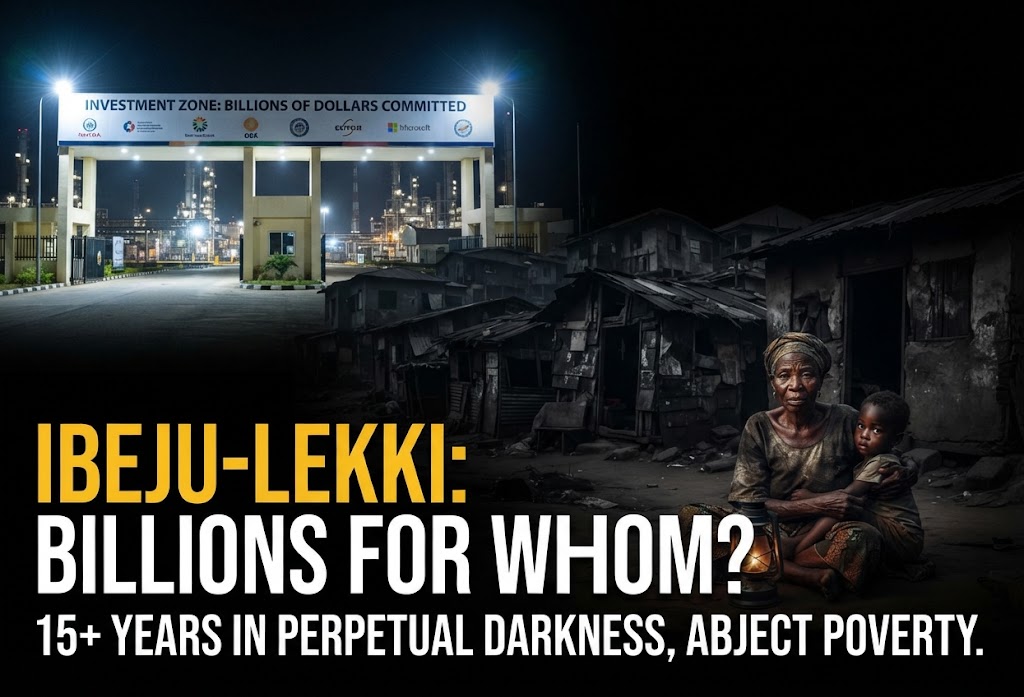
Across promotional brochures and glossy investor prospectuses, the coastal corridor of Ibeju-Lekki is celebrated as the vibrant epicenter of West Africa’s industrial future. Bounded by the Atlantic Ocean and the Lagos Lagoon, this once-sleepy expanse of fishing hamlets and mangrove swamps in Lagos State has been christened the “New Lagos.” It boasts tens of billions of dollars in foreign direct investment, anchored by critical mega-infrastructure that includes the massive Dangote Petroleum Refinery, the Lekki Deep Sea Port, and the expansive Lekki Free Trade Zone. Yet, step mere meters beyond the razor wire, security checkpoints, and floodlit perimeters of these industrial wonders, and a sharply contrasting, bitter reality unfolds.
For hundreds of thousands of indigenous residents, the gold rush in their ancestral backyard has delivered very little prosperity. Instead, many host villages remain plunged into perpetual darkness, completely cut off from the national power grid or subjected to chronic, months-long blackouts. As heavy industrial cranes reshape the coastline and international financiers toast to projected returns, the indigenous Yoruba, Epe, and coastal fisherfolk find themselves grappling with lost livelihoods, environmental degradation, severe land dispossession, and deep socio-economic exclusion.
The Multi-Billion-Dollar Transformation: West Africa’s Industrial Engine
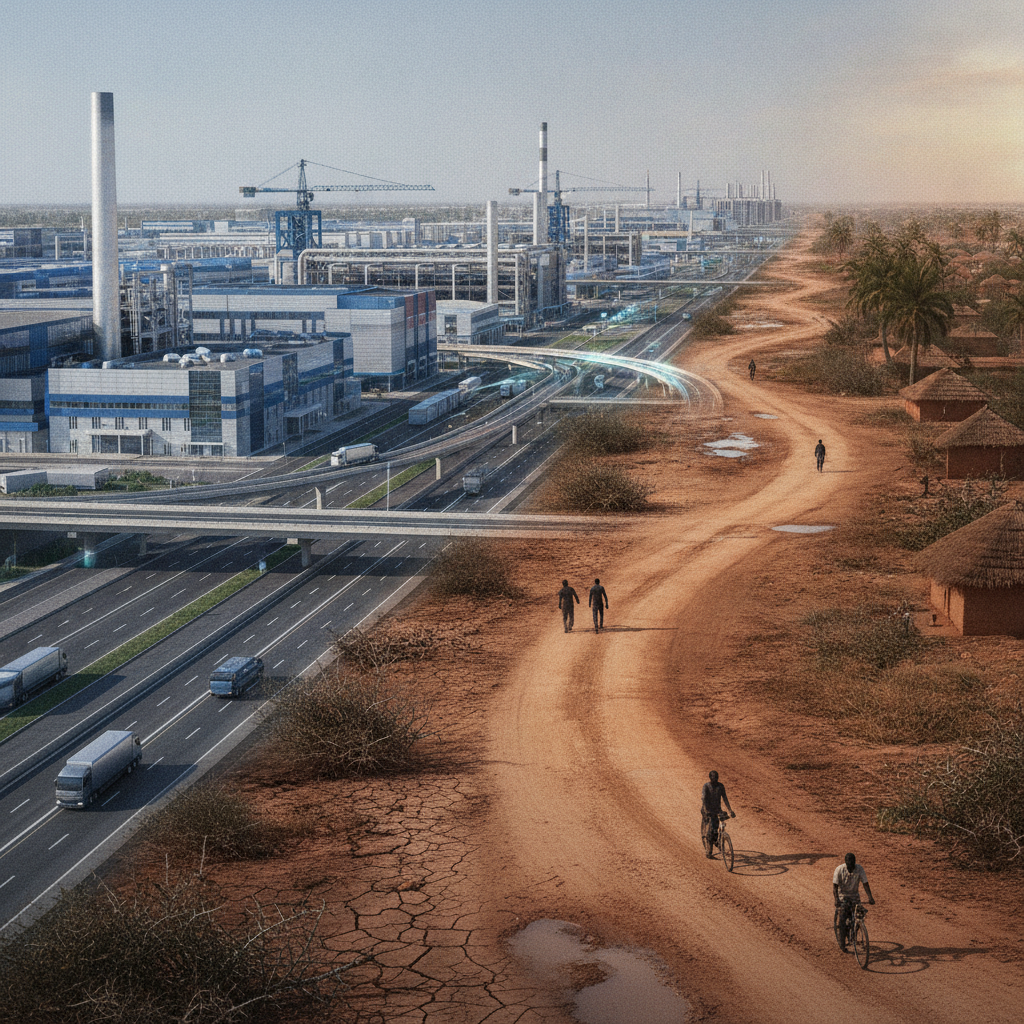
Over the past two decades, Lagos State urban planners and international consortiums have methodically transformed Ibeju-Lekki into a premier manufacturing and logistics zone. The crown jewel of this drive is the Dangote Petroleum Refinery and Petrochemical complex, an estimated $19-to-$20-billion facility designed to refine hundreds of thousands of barrels of crude per day. Operating alongside it is the multi-billion-dollar Lekki Deep Sea Port, Nigeria’s deepest maritime facility, built to handle colossal container vessels that previously bypassed West African waters.
Complementing these installations are extensive industrial parks, including Alaro City, private free-trade zones, luxury golf resorts, and proposed airport projects designed to shift the economic centre of gravity away from congested central Lagos. Land prices across the corridor have skyrocketed exponentially, turning speculative real estate developers into overnight millionaires. Commercial banks, engineering multinationals, and state delegations routinely tour the area, declaring it a triumphant testament to Nigeria’s modernisation potential.
Yet economic development that operates as an island of extreme wealth surrounded by an ocean of deprivation rarely remains sustainable. While the capital pouring into the Lekki axis is historic in scale, the trickle-down effect on the host communities has been almost imperceptible to the families who have inhabited these lands for generations.
The Realities on the Ground: Mega-Projects Versus Host Communities
To grasp the profound disconnect within Ibeju-Lekki, one must examine the stark contrast between the commercial promises promoted to the world and the daily deprivations faced by indigenous settlements such as Magbon-Segun, Idasho, Tiye, Okunraye, and surrounding coastal enclaves.
| Sector / Metric | The Industrial Promise | The Grassroots Reality |
|---|---|---|
| Electric Power | Dedicated captive power plants generating hundreds of megawatts for industrial operations. | Dozens of rural villages unmetered, off-grid, or enduring years of unresolved power blackouts. |
| Employment | Pledges of tens of thousands of direct and indirect technical and administrative jobs. | Local youths largely confined to precarious, low-wage day labour or bypassed entirely due to skill barriers. |
| Land & Housing | Planned smart cities, high-end gated estates, and prime commercial warehouses. | Ancestral farmland acquired with disputed compensation, driving up the cost of living and rent. |
| Marine Environment | World-class deep-sea maritime logistics and international container traffic. | Disrupted coastal ecology, restricted fishing channels, and shoreline erosion threatening coastal cottages. |
| Clean Water | Modern internal industrial desalination, water treatment, and distribution setups. | Villagers reliant on shallow, salty, or polluted groundwater wells and expensive sachet water. |
Living in the Shadows: Chronic Power Outages Next to Gigawatts
Perhaps the most visceral symbol of inequality across Ibeju-Lekki is the issue of electrical power. While the massive industrial sites maintain their own continuous, privately generated megawatts running 24 hours a day to power heavy machinery, vast sections of the local council area have spent years either totally disconnected from public electricity infrastructure or trapped in unending rolling blackouts.
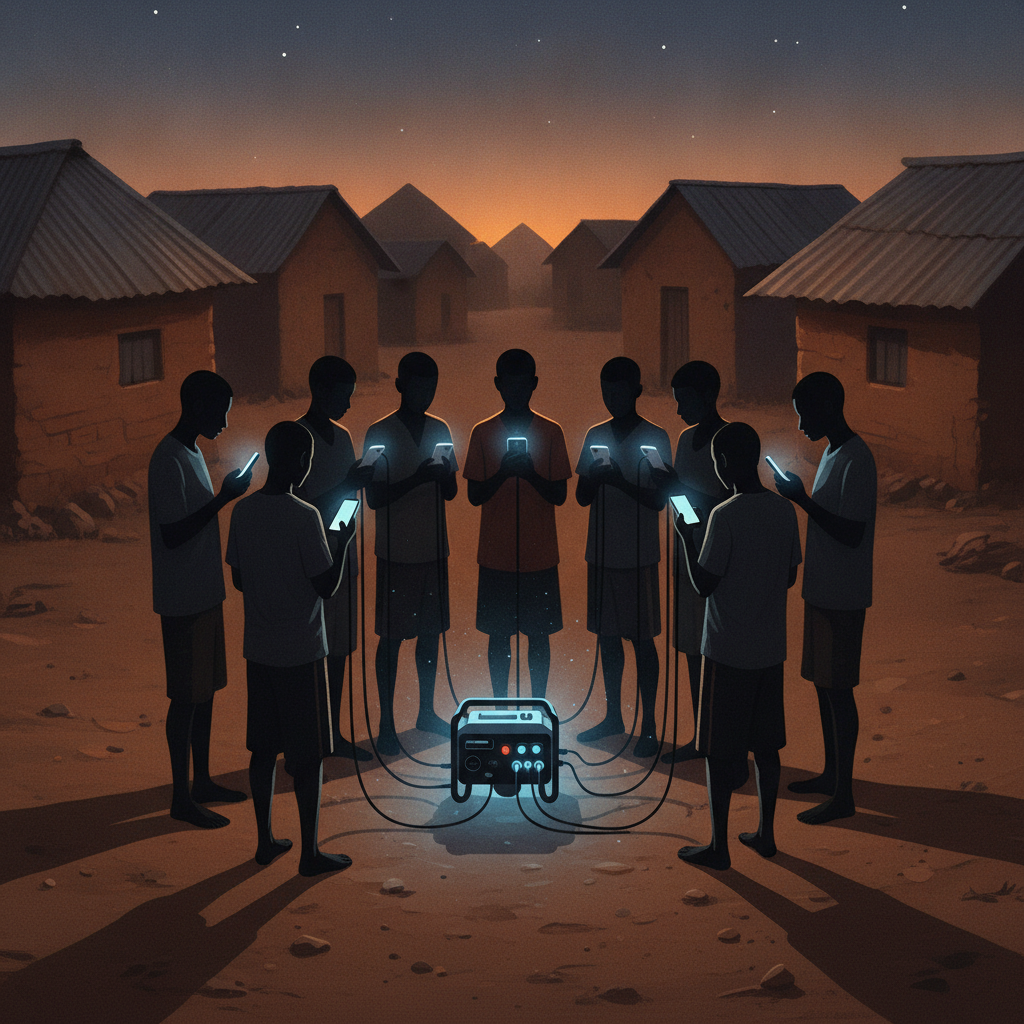
Local advocacy groups have repeatedly raised the alarm over communities whose distribution transformers have decayed or broken down without replacement for months or even years. Small artisan businesses—welders, tailors, food vendors, barbers, and refrigeration mechanics—find it virtually impossible to turn a profit due to the crippling cost of petrol and diesel needed to run small private generators. Children study by candlelight or battery-powered lanterns beneath night skies lit up by the brilliant, distant floodlights of private industrial complexes.
“We watch the high-tension lines run across our skies and see the refinery lit up like a modern city every night, but our homes remain pitch black. Our children cannot read, our fish spoils before we can sell it, and our workshops sit empty,” lamented one community youth leader during a local consultation forum.
This persistent energy poverty represents more than an inconvenience; it functions as an economic chokehold. In an era where digital access and small-scale entrepreneurship are critical pathways out of poverty, the lack of dependable electricity locks the next generation of Ibeju-Lekki indigenes into structural underdevelopment.
Lost Livelihoods: The Decline of Fishing and Farming
Before the arrival of dredging rigs and perimeter boundary walls, the indigenous economy of Ibeju-Lekki was rooted in the land and the ocean. Generations of families survived and built modest wealth as artisanal fishermen, fish processors, vegetable growers, and cassava farmers. The Atlantic provided abundant catches of croaker, sole, and mackerel, while the interior lagoons and fertile soils supplied coastal markets across the state.
The extensive dredging required to carve out deep-sea berths, combined with rapid coastal reclamation, has altered local water currents, led to noticeable coastal erosion in nearby settlements, and disrupted coastal fish migration paths. Fishermen report having to venture significantly further into dangerous ocean waters on small motorised wooden canoes, facing prohibitive fuel costs and diminished yields. Furthermore, vast tracts of community farmland were acquired by government authorities through compulsory purchase orders under the Land Use Act to create the Lekki Free Trade Zone boundaries.
While statutory compensation frameworks exist on paper, community elders and non-governmental legal watchdogs have long argued that payouts were either chronically delayed, fragmented, or fundamentally inadequate to replace the permanent loss of intergenerational land rights. Deprived of both their farms and open fishing grounds, many household heads have seen their earning power collapse.
The Myth of Automatic Employment
A recurring argument used by authorities to justify the sweeping industrialisation of the corridor was the promise of boundless employment opportunities for local youth. However, the modern industrial operations dominating Ibeju-Lekki—such as petrochemical refining, automated container handling, and advanced logistics—are overwhelmingly capital-intensive rather than labour-intensive. They require specialised engineering, maritime logistics, and software management credentials.
Because decades of infrastructural neglect left local state-run schools underfunded, few indigenous youths were historically prepared to walk straight into technical roles at the refinery or port. Instead, the high-paying white-collar and engineering jobs have gone to expatriates and skilled workers recruited from across Nigeria and the broader international market. When locals are hired, they are disproportionately channelled into short-term construction labour, security duty, or cleaning services—positions that offer low job security and minimal upward mobility.
While industrial operators have launched vocational training programs and scholarship initiatives in recent years, community organisations contend these programs remain modest in comparison to the thousands of idle, frustrated youths whose families lost traditional livelihoods to make way for the developments.
Corporate Social Responsibility: Cosmetic Fixes Versus Real Equity
Corporate entities and the state government often highlight their Corporate Social Responsibility (CSR) portfolios, pointing to newly drilled boreholes, renovated primary health centres, and community town hall events. Yet many of these interventions fall victim to inadequate maintenance or poor planning. Community leaders point out boreholes that broke down weeks after ribbon-cutting ceremonies, leaving villagers dependent on non-potable water, and solar streetlights that failed during the rainy season and were never repaired.
Socio-economic researchers argue that traditional CSR—which treats community benefits as discretionary charity rather than enforceable rights—is inadequate for mega-developments of this scale. Instead, civil society groups have repeatedly demanded legally binding Community Development Agreements (CDAs) that include guaranteed equity stakes, mandatory local hiring quotas, dedicated electrification infrastructure funded by industrial zones, and royalty distributions to support educational infrastructure.
Conclusion
Ibeju-Lekki presents a stark contemporary example of uneven development in modern Africa. The multibillion-dollar investments lining its shoreline prove that massive private and sovereign capital can mobilise to build world-class industrial infrastructure under demanding conditions. However, the enduring neglect of the host population lays bare a troubling governance failure. True economic progress cannot be measured solely by industrial capacity, shipping throughput, or corporate valuations while the host communities live in literal darkness and deepening poverty. Until state authorities and commercial mega-operators integrate the indigenous population through meaningful equity, uninterrupted public electrification, and sustainable livelihood restoration, the shiny new industrial hub will remain an uncomfortable monument to modern inequality.
Sources
- Premium Times Nigeria – Ongoing coverage of community protests, land disputes, and development along the Lekki Free Trade Zone axis.
- The Punch – Investigative reporting on power outages and host-community grievances surrounding Ibeju-Lekki industrial projects.
- Heinrich Böll Stiftung Nigeria – Urban development studies and human rights assessments in coastal Lagos megacity projects.
- Vanguard News – Dispatches on Dangote Refinery commissioning, Lekki Deep Sea Port operations, and coastal environmental impact.
Disclaimer: This article reflects socio-economic and community developments reported in public records at the time of writing. Public policies, infrastructure projects, and community negotiations remain subject to ongoing updates and developments.
Category: Society