Proof of Funds for Express Entry: Minimum Amounts and What Counts as Savings
By Gbenga Ayandare —
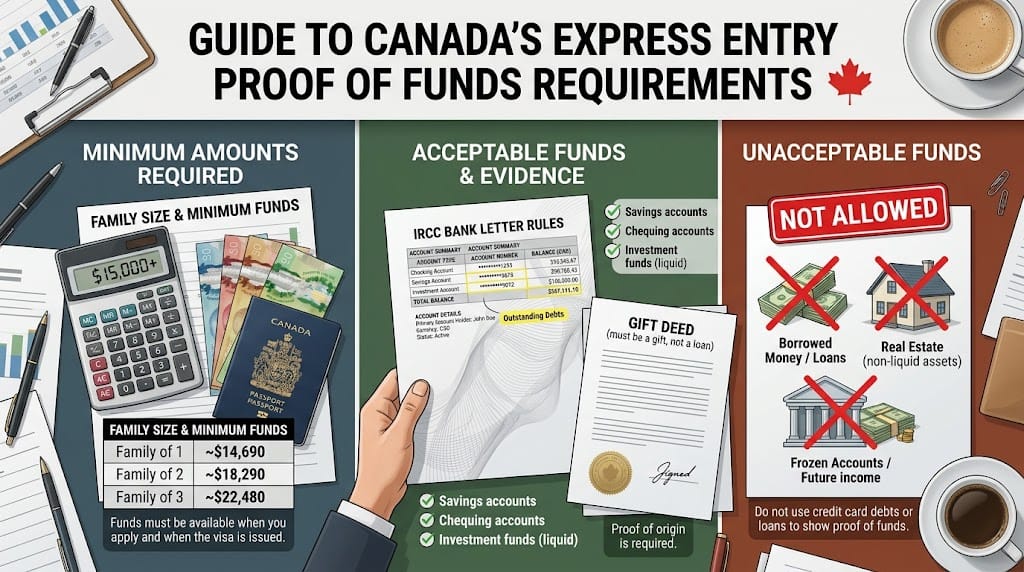
Securing an Invitation to Apply for Canadian permanent residence through Express Entry depends heavily on your Comprehensive Ranking System score, but scoring well does not guarantee approval. For applicants outside Canada, Immigration, Refugees and Citizenship Canada (IRCC), the federal department overseeing immigration, enforces an absolute financial requirement before granting permanent residence: proof of settlement funds. If your documentation falls short by even a small margin, visa officers can refuse your application outright.
The policy exists to ensure that new economic immigrants have sufficient personal capital to establish a household, secure accommodation, and cover living costs before finding work. Because Canada does not provide immediate financial assistance to arriving economic migrants, settlement funds act as a mandatory self-sufficiency buffer. Understanding which accounts qualify, how IRCC assesses family size, and how to document your assets prevents costly refusals.

Who Must Show Settlement Funds
Proof of funds is an eligibility requirement, not a points-scoring factor. It applies strictly to specific economic immigration programmes managed under the Express Entry system.
You must show settlement funds if you receive an invitation under:
- The Federal Skilled Worker Program (FSWP): Applicants evaluated on overseas work experience, education, and language skills.
- The Federal Skilled Trades Program (FSTP): Qualified tradespersons applying from abroad without a qualifying job offer.
By contrast, you do not need to provide proof of settlement funds if:
- You receive an invitation under the Canadian Experience Class (CEC).
- You are authorised to work in Canada and hold a valid job offer supported by a Labour Market Impact Assessment (LMIA) or an LMIA-exempt work permit with a specific employer.
Applicants who qualify under both the Canadian Experience Class and the Federal Skilled Worker Program should note which programme issued their Invitation to Apply. If the invitation states Federal Skilled Worker, the system automatically demands proof of funds in your electronic application.
Minimum Required Funds by Family Size
IRCC updates its settlement fund thresholds annually, pegging the amounts to 50 per cent of Statistics Canada's Low Income Cut-Off (LICO). The figures are calculated in Canadian dollars (CAD). Applicants must meet the active threshold on the day they submit their final electronic Application for Permanent Residence (e-APR).
| Number of Family Members | Minimum Funds Required (CAD) |
|---|---|
| 1 | $15,263 |
| 2 | $19,001 |
| 3 | $23,360 |
| 4 | $28,362 |
| 5 | $32,168 |
| 6 | $36,280 |
| 7 | $40,392 |
| Each additional member | $4,112 |
These amounts represent a legal minimum floor rather than an estimated realistic living cost. In major Canadian cities such as Toronto, Vancouver, or Calgary, first and last month rental deposits alone can consume a substantial portion of these funds.
How IRCC Defines Family Size
A frequent cause of application refusals is an incorrect calculation of family size. IRCC's definition of family is strict and does not depend on who is travelling with you to Canada.
To calculate your family size, you must include:
- Yourself as the primary applicant.
- Your spouse or common-law partner.
- Your dependent children up to the age of 22.
- Your spouse or partner's dependent children.
You must count your spouse and all dependent children even if they are already Canadian citizens or permanent residents. You must also count them if they are listed as non-accompanying family members on your application. For instance, a candidate immigrating alone while leaving a spouse and two children behind must demonstrate the threshold for a family of four ($28,362 CAD), not the amount for a single individual ($15,263 CAD). Omitting a family member to match a lower balance constitutes misrepresentation, which carries a five-year ban from Canada.
What Counts as Acceptable Savings
The core rule set by IRCC is that all funds must be unencumbered by debts or other obligations, readily available, and legally accessible to you at both the time of application and the time your permanent resident visa is issued.
Acceptable forms of settlement funds include:
- Chequing and savings accounts: Liquid cash held in personal bank accounts with a recognised commercial bank or financial institution.
- Term deposits and Certificates of Deposit: Fixed deposits and Guaranteed Investment Certificates (GICs), provided the bank confirms in writing that the funds can be liquidated or broken without legal barriers prior to maturity.
- Mutual funds and publicly traded shares: Liquid investments, provided you present an up-to-date brokerage portfolio statement showing their current market value, along with proof that you can liquidate the holdings at any time.
- Treasury bills and government bonds: Short-term government securities that can be cashed in immediately.
- Provident or pension funds: Retirement savings qualify only if official plan documentation proves you are permitted to withdraw the cash early, after accounting for any early-withdrawal penalties or tax deductions.
If you hold savings jointly with your spouse, those funds count toward your total. If the money sits in an account registered solely in your spouse's name, your spouse must accompany you to Canada, and you must include an official affidavit signed by your spouse granting you full, unrestricted access to the money.
What Does Not Count as Settlement Funds
Visa officers routinely reject assets that lack immediate liquidity or involve third-party liabilities.
You cannot use any of the following to satisfy IRCC requirements:
- Real estate equity: Land, residential homes, or commercial properties do not qualify, even with professional valuation appraisals. If you plan to use property wealth, you must sell the asset, complete the transaction, and hold the cleared proceeds in a bank account before applying.
- Borrowed funds: Personal loans, credit card cash advances, bank overdraft facilities, or lines of credit are strictly forbidden. Officers examine bank statements specifically to detect sudden loans.
- Cryptocurrency: Digital currencies such as Bitcoin or Ethereum are not accepted because of volatility and regulatory limits on sovereign currency conversions.
- Vehicles and jewellery: Personal physical belongings cannot serve as proof of settlement capital.
- Corporate or business accounts: Money owned by a registered company or partnership is legally distinct from personal wealth. Even if you are the sole director or shareholder of a company, corporate bank accounts cannot be submitted unless you legally disburse the capital to your personal account as dividends or salary and pay any relevant local taxes.
Requirements for the Official Bank Letter
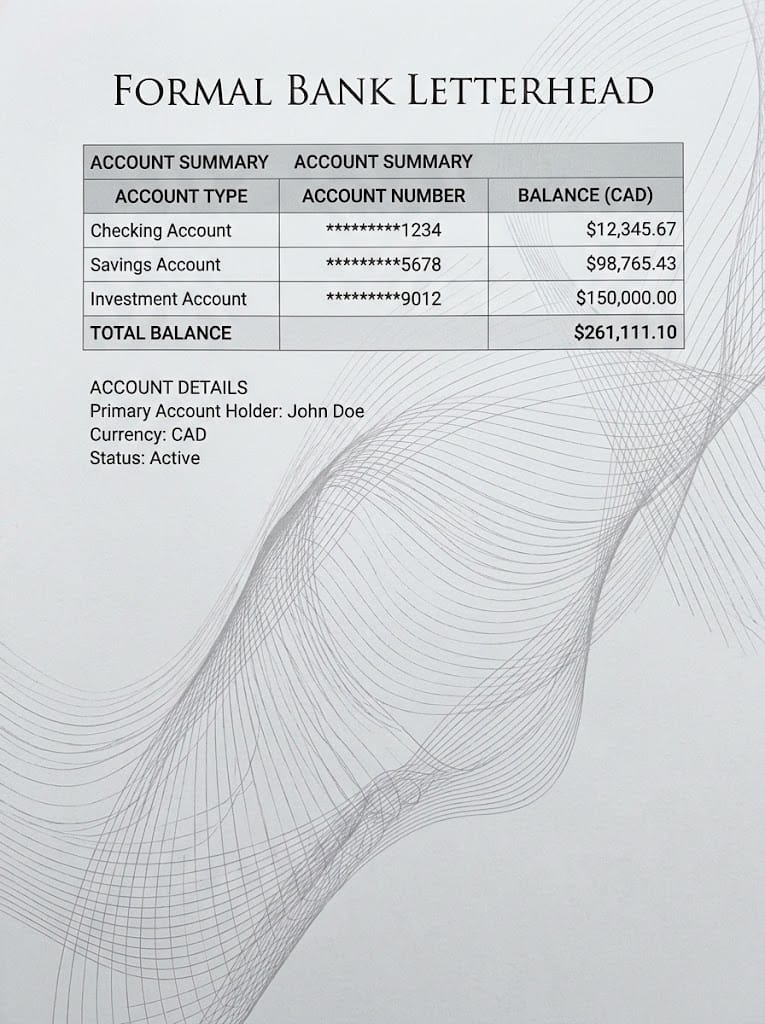
To verify your savings, IRCC does not accept standard online statement downloads on their own. You must upload official bank reference letters issued by each financial institution where you maintain accounts.
Under IRCC regulations, the letter must be printed on the institution's official letterhead and state:
- The bank's complete contact details, including postal address, telephone numbers, and email address.
- Your full legal name as it appears in your passport.
- All outstanding debts, such as credit card balances, mortgages, and personal loans.
- For each account: the account number, the date the account was opened, the current balance, and the average balance over the previous six months.
Because some banking software systems cannot calculate a six-month average balance automatically, applicants often supply the bank letter alongside six months of stamped, consecutive monthly bank statements to provide an unbroken audit trail.
Handling Sudden Deposits and Gift Deeds
Visa officers look carefully at the six-month average balance to confirm the money genuinely belongs to you. A sudden, large lump-sum deposit that appears shortly before submitting your application will trigger scrutiny, as immigration authorities will suspect borrowed capital.
If you received funds from a property sale, company dividends, an inheritance, or an investment liquidation, provide the underlying legal paperwork: a deed of sale, probate grant, or brokerage redemption receipt.
If a close family member gives you money to meet the threshold, you must document it with a formal Gift Deed. A gift deed is a sworn legal document prepared by a lawyer or notary public. It must explicitly state:
- The donor's identity and their familial relationship to you.
- The exact sum of money transferred.
- A clear declaration that the transfer is a genuine, unconditional gift and not a loan.
- Confirmation that the recipient is under no obligation to repay any part of the money.
Alongside the deed, provide bank statements showing the funds leaving the donor's account and clearing into your personal account. Transparent paper trails reassure officers that the money is genuinely yours.
Exchange Rates and Currency Fluctuations
Candidates outside Canada usually hold savings in their local currency, such as the Nigerian naira (NGN), British pound sterling (GBP), Ghanaian cedi (GHS), Kenyan shilling (KES), or US dollar (USD). IRCC evaluates your funds by converting them to Canadian dollars based on the prevailing Bank of Canada exchange rate on the day of review.
In economies experiencing currency volatility or high inflation, holding an amount barely equal to the Canadian dollar minimum creates serious risks. If your local currency depreciates against the Canadian dollar between the date of application and the date of final review, your balance may drop below the mandatory threshold. A drop below the legal minimum leads to an automatic refusal. Maintaining a cash buffer of at least 10 to 15 per cent above the official requirement protects against foreign exchange shifts.
Maintaining Funds Until Landing
Your responsibility to hold settlement funds does not end when you submit your profile. You must keep the required balance intact throughout the entire processing period, which can take several months.
IRCC reserves the right to request updated bank statements at any point prior to final approval. When your permanent resident visa and Confirmation of Permanent Residence (COPR) documents are approved, border services officers at Canadian ports of entry can request proof of funds when you land. Arriving in Canada without access to the required funds can lead to questioning and delays at border control.
Conclusion
Meeting the proof of funds requirement for Express Entry requires careful planning, accurate family accounting, and adherence to IRCC documentation rules. Settlement funds must consist of unencumbered, liquid capital that belongs directly to you and remains accessible until you arrive in Canada. By verifying your family size, avoiding prohibited assets like real estate equity or personal loans, and securing detailed bank reference letters with complete six-month histories, you can satisfy IRCC standards and protect your permanent residence application from administrative refusal.
Sources
- Immigration, Refugees and Citizenship Canada (IRCC) - Proof of Funds: Express Entry
- Bank of Canada - Daily Exchange Rates
Disclaimer: This article provides general information based on official guidelines available at the time of publication and does not constitute formal immigration or legal advice. Immigration rules, financial thresholds, and procedural guidelines can change; consult a Regulated Canadian Immigration Consultant (RCIC) or an immigration lawyer for advice regarding your specific case.
Category: Immigration