How telecom is driving Nigeria’s economy
By CelebUD Newsroom —
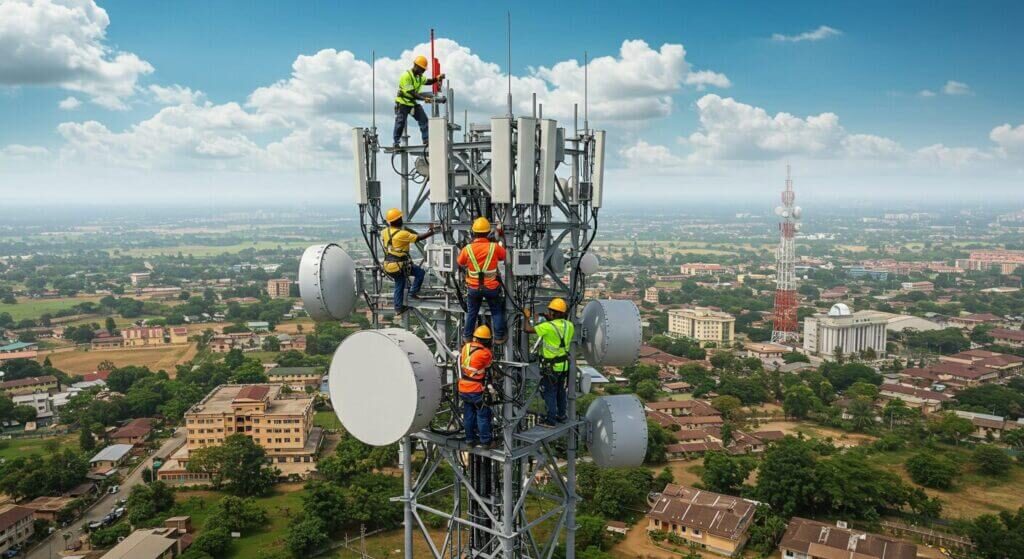
Telecommunications in Nigeria has evolved far past its origins as a basic consumer convenience, transforming into the core nervous system of the nation’s commercial engine. Today, digital connectivity underpins nearly every layer of contemporary Nigerian business, serving as the foundational rail for nationwide electronic payments, fintech platforms, cross-border digital services, micro-enterprise retail, and public administration. As the country shifts further into a digital-first operating environment, the performance and resilience of this network infrastructure have become central to broad-based economic stability.
A Cornerstone of National Output and Commerce
The telecommunications industry contributed 9.19 percent to Nigeria’s real Gross Domestic Product (GDP) during the opening quarter of 2026, based on official figures published by the National Bureau of Statistics (NBS). While this statistical contribution highlights the sector's direct weight in national output, industry analysts emphasise that the metric understates the broader ripple effect connectivity exerts on other sectors.
Chartered accountant and financial analyst Oluwatosin Olaseinde noted that resources directed into telecom physical assets effectively unlock new productive avenues throughout the domestic market. Access to stable bandwidth permits software engineers and remote knowledge workers across Nigeria to market their skills globally, lets firms finalise sales across dispersed regions, and allows educators and enterprise consultants to reach audiences well beyond physical geography.
Sustaining such nationwide productivity demands substantial capital commitments. Financial planner Kalu Aja indicated that market leader MTN Nigeria has directed over N1.62 trillion in aggregate capital expenditures into domestic network assets, paying for spectrum licenses, fibre-optic rollouts, power generation facilities, and cell site hardware. These multi-billion-naira outlays provide the digital backbone that commercial organisations now require to remain solvent.
The Fintech and Financial Inclusion Backbone
The clearest demonstration of telecommunications as economic infrastructure sits within modern financial services. Nigeria's fast-growing electronic payment system, which handles hundreds of trillions of naira in annual turnover, depends entirely on carrier networks to shuttle transaction data between retail buyers, commercial merchants, card processors, and banking switches.
The physical reach of financial services has expanded dramatically via Point-of-Sale (POS) agency networks. By providing cash-in and cash-out points in suburban and rural settlements lacking traditional branch banks, telecom links have spawned livelihoods for thousands of merchant operators while expanding national financial access. Simultaneously, direct-to-consumer wealth technology has eliminated traditional banking barriers. Platforms like Ladda, an investment portal launched by Olaseinde that counts over 75,000 active accounts, show how digital access democratizes personal wealth tools that were once out of reach for ordinary savers.
Informal and micro-scale retailers have embraced the shift as well. Millions of solo entrepreneurs and boutique retailers currently use social networking apps, digital storefronts, and instant mobile bank transfers to acquire foot traffic and clear payments without ever renting expensive physical retail space.
Infrastructure Vulnerabilities and Rising Costs
Rapid digital expansion has placed extraordinary strain on network backbones. Figures from the Nigerian Communications Commission (NCC) reveal that operators experienced over 5,000 separate fibre-optic line cuts during the initial half of 2026 alone. These severed lines directly threaten commercial trade, halting digital checkout lines, paralyzing remote workplaces, and blocking agency banking points.
Israel Ihaza, founder and chief executive officer of property technology firm Oikus, pointed out that these persistent cuts stem primarily from inadequate inter-agency coordination regarding subterranean utilities, particularly during municipal road building, drainage repairs, and private excavations.
Beside physical damages, network providers face sharp financial headwinds. Telecommunication firms must juggle substantial right-of-way fees, overlapping federal, state, and council tax demands, steep foreign exchange volatility, and escalating diesel expenditures needed to power off-grid cellular base stations. Industry leaders have voiced concern over the sustainability of capital expenditure under these margins. Karl Toriola, chief executive officer of MTN Nigeria, has cautioned that continued capital investment requires a commercial structure that delivers sustainable financial returns. Similarly, Gbenga Adebayo, chairman of the Association of Licensed Telecom Operators of Nigeria (ALTON), warned that unchecked operational costs threaten long-term capacity expansion and baseline network reliability.
Policy Shifts and National Infrastructure Protection
In response to mounting structural risks, the federal government placed telecommunications network facilities on the list of Critical National Information Infrastructure (CNII). While this federal designation offers a stronger legal shield against interference and vandalism, industry observers note that actual success requires active, ground-level collaboration among federal regulators, state administrations, municipal authorities, private construction firms, and hosting communities.
The hidden overheads of remote work
The growth of remote digital contracts with employers in Europe and North America has offered many Nigerians an escape from local wage stagnation. Yet keeping these jobs requires personal infrastructure that goes far beyond a single phone connection. Because local network coverage can fail without warning, professionals working for overseas clients routinely pay for subscriptions across two or three separate cellular providers alongside private fibre accounts.
This constant need for redundancy acts as a quiet tax on digital earnings. Beyond multiple data plans, workers must invest in uninterrupted power supplies and battery banks to keep domestic routers running during grid blackouts. For independent freelancers, a sudden drop in bandwidth can mean a missed project deadline or a dropped client call, creating professional friction that overseas clients, accustomed to stable national utilities, may struggle to understand.
Conclusion
Nigeria’s telecommunications sector is no longer an isolated consumer service; it has become an indispensable public utility that drives trade, tax revenues, and employment. The policy imperative for government and industry regulators is shifting from simply counting SIM connections and data gigabytes to creating a sustainable environment where private capital can afford to build, expand, and maintain resilient digital pipelines. Without deliberate protections for underground assets and relief from crushing operational overheads, the broader economy risks stranding the digital enterprises that now depend entirely on sustained connectivity.
Category: Business