Xi kicks off highly-anticipated U.S. visit in grand welcome
By CelebUD Newsroom —
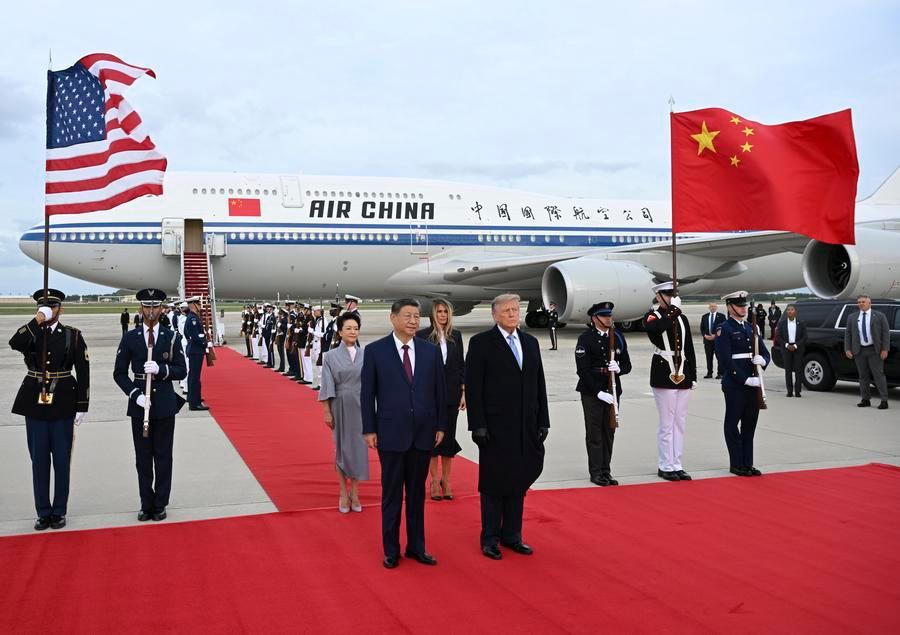
Chinese President Xi Jinping touched down at Joint Base Andrews on Wednesday afternoon to launch an official three-day state visit to the United States, greeted directly on the tarmac by U.S. President Donald Trump in an extraordinary departure from traditional diplomatic customs. The high-profile summit comes at the personal invitation of Trump, following months of efforts by the world's two largest economic powers to steady bilateral relations, manage intense economic rivalry, and seek common ground on urgent global problems.
An Unprecedented Tarmac Welcome
The arrival of the Chinese head of state was marked by exceptional ceremony. President Xi and his wife, Peng Liyuan, stepped off their aircraft to meet President Trump and First Lady Melania Trump, who waited planeside to receive them. The two presidential couples exchanged warm handshakes and greetings directly on the runway before proceeding along an expansive red carpet flanked by honour guards.
As part of the arrival formalities, two American children stepped forward to present floral bouquets to the visiting Chinese president and first lady. The welcoming military honours featured a 21-gun salute, the sounding of both national anthems, and an official military flyover overhead. The deployment of a 21-gun salute directly at an airfield represents a rare tribute, as the distinction is typically reserved for White House grounds or formal state ceremonial complexes.
Diplomatic observers and media commentators highlighted the tarmac greeting as an unconventional move. American presidents customarily await visiting dignitaries at the Executive Mansion rather than travelling to military airfields. The visible display underlined the deliberate attempt by both administrations to signal mutual respect and establish a cooperative tone from the opening moments of the visit.
Building on Consecutive Diplomatic Milestones
This week's meetings serve as the reciprocal leg of head-of-state exchanges following Trump's formal trip to China in May. A spokesperson for the Chinese Foreign Ministry described the occurrence of back-to-back leadership visits within a single six-month timeframe as an event carrying historic milestone weight, setting a determined pace for direct leader-level dialogue.
In a formal written address issued upon touchdown, Xi presented sincere greetings to the American public on behalf of China, stressing that the two populations share deep historical interactions and profoundly interwoven economic destinies. He stated that the great rejuvenation of the Chinese nation and the agenda of making America great again do not need to clash, insisting instead that the two visions can advance concurrently so both nations can help each other succeed while uplifting global welfare.
"China and the United States should work in the same direction and promote a stable relationship featuring cooperation as the mainstay, moderate competition, manageable differences and promises of peace," Xi noted in his arrival statement.
Xi reiterated the framework established during the May summit in Beijing, recalling their shared pledge to forge a constructive partnership anchored by strategic stability. Emphasising that changing geopolitical tides have not altered the essential logic of peaceful coexistence, the Chinese president expressed his desire to conduct extensive talks with Trump covering bilateral concerns, international affairs, and the steady enlargement of collaborative programs across multiple sectors.
Diplomatic Chronology and Bilateral Engagement
| Engagement Timeline | Diplomatic Event | Core Significance |
|---|---|---|
| Earlier Period | Busan Leadership Meeting | Initiated foundational high-level channels to manage geopolitical competition. |
| May | Trump State Visit to China | Established framework for constructive ties and strategic stability. |
| November (Current) | Xi State Visit to United States | Reciprocal summit within six months focusing on trade, stability, and AI. |
International Observers Weigh Strategic Implications
Foreign policy analysts worldwide are watching the summit closely, pointing out that stability between Washington and Beijing creates ripple effects across global governance, financial markets, and security architecture.
Roland Henwood, a political analyst and senior lecturer at the University of Pretoria's Department of Political Sciences, remarked that the engagement takes place against a distinctly strained international background. Henwood noted that the existing rapport between the two heads of state, reinforced by ongoing communication, remains indispensable for providing top-tier strategic orientation that safeguards systemic stability worldwide.
Former Deputy Chairperson of the African Union Commission Erastus Mwencha showed the systemic importance of ongoing dialogue, noting that the visit shows diplomacy continues to serve as the chief instrument for defusing friction and preventing dangerous strategic miscalculations. Mwencha explained that the summit should be viewed as part of an integrated diplomatic chain—stretching from an earlier encounter in Busan through Trump's May visit to Beijing and culminating in this Washington tour—generating a durable channel of personal engagement that isolated talks cannot achieve.
Core Fronts for Practical Cooperation
Outside of high-level diplomatic theatre, international specialists pointed toward specific technical and regulatory frontiers where Washington and Beijing must collaborate to deliver tangible international benefits:
- Artificial Intelligence Safety and Ethics: Pascal SeryA financial authority and former member of Cote d'Ivoire's National Assembly showed that both superpowers possess the technological capacity and systemic use needed to counter existential AI threats. Sery stressed the necessity of joint technical dialogues concerning system safety, moral boundaries, and regulatory governance to help construct balanced global standards.
- Counternarcotics Operations: Cairo-based Arab Center for Research and Studies advisor Abu Bakr al-Deeb emphasised that transnational crime and illicit drug trades respect no sovereign borders. Al-Deeb pointed out that bilateral authorities have already logged productive joint enforcement operations this year against illegal drug syndicates, particularly targets involving new psychoactive substances and cross-border chemical movements.
- Global Supply Chain Resilience: Cavince Adhere, an international relations scholar based in Kenya, asserted that the pair bear a fundamental obligation to dampen commercial friction to protect trade continuity. Adhere characterised strategic harmony between the two powers as an essential global public good, explicitly explaining that reduced economic confrontation between Washington and Beijing prevents debilitating supply chain fracturing.
Trade costs for import businesses
According to international trade analysts, shifts in commercial ties between the United States and China exert immediate influence on shipping container availability and ocean freight rates. For commercial traders in African and Caribbean trade hubs who purchase manufactured goods, machinery, and consumer electronics from China while settling contracts in US dollars, diplomatic friction often translates into volatile currency exchange rates and sudden transport surcharges.
When trade policy between Beijing and Washington stabilises, global cargo routes experience fewer emergency diversions and port bottlenecks. This predictability allows retail and wholesale businesses to plan purchasing cycles with clearer timelines, avoiding the need to absorb rapid price spikes or hold expensive buffer inventory, which helps keep shelf prices steadier for local shoppers.
Cross-border academic and visa policies
Higher education policy analysts note that bilateral summits between Washington and Beijing directly affect visa processing timelines, student mobility, and cross-border research funding. For international students and academic staff at universities across North America and Europe, leader-level agreements often dictate the stringency of background security checks and visa renewals, particularly in fields such as computer programming, data science, and advanced engineering.
Diplomatic tensions in recent years resulted in tighter administrative reviews, prolonged delays for entry clearances, and stricter oversight of joint laboratory research. A structured diplomatic channel can encourage immigration departments and research bodies to handle study and exchange permits with fewer administrative suspensions, giving overseas scholars and doctoral candidates greater certainty when planning their academic careers and international travel.
Conclusion
President Xi Jinping's high-profile arrival in the United States sets a constructive baseline for several days of critical discussions at the highest levels of government. By offering an extraordinary airport reception, the Trump administration signaled an eagerness to pursue personal leader-to-leader diplomacy despite stubborn strategic, economic, and technological rivalries. Over the coming days, the success of the summit will be measured by whether the two administrations can translate symbolic goodwill into durable mechanisms that keep economic competition moderate, differences manageable, and supply chains resilient in an unsettled global economy.
Category: Business