PNOE's new face mask wants to make lab-grade breath testing a self-serve affair
By CelebUD Newsroom —
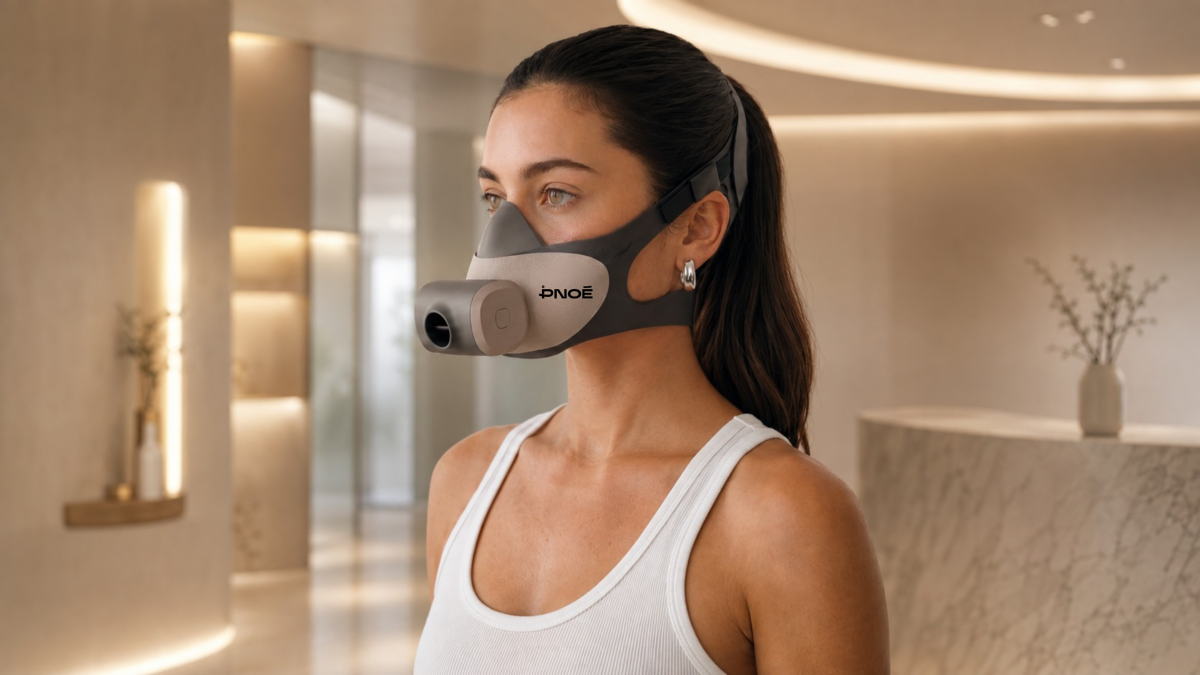
A high-tech breathing device designed to measure human metabolism in real time is poised to move from specialist sports laboratories to everyday gym floors. Malden, Massachusetts-based health technology firm PNOĒ has announced the upcoming debut of the PNOĒ 2.0, a redesigned breath-analysis system scheduled to launch on October 1. The defining breakthrough of the updated hardware is full self-administration, allowing individuals to run their own comprehensive physiological evaluations without the assistance of a certified technician.
Sporting a futuristic silhouette reminiscent of cinematic comic-book masks, the head-mounted unit fastens over the nose and mouth to track respiratory gases with precision. By capturing the volume of oxygen inhaled against the carbon dioxide exhausted during an eight-minute breathing session, the apparatus provides users with personalized intelligence covering caloric expenditure, training thresholds, and dietary requirements.
Transforming Lab-Grade Gas Analysis into a Self-Serve Experience
Metabolic analysis through indirect calorimetry has been a cornerstone of exercise physiology for more than a century. The practice provides an exact measurement of VO₂ max—the ceiling of oxygen volume an individual can use during physical exertion—as well as detailed assessments of cardiorespiratory health. Historically, obtaining these figures demanded massive, prohibitively expensive metabolic carts found exclusively in elite sports institutes, specialised performance labs, and major hospital wards.
PNOĒ spent the past decade developing miniaturized sensors capable of matching the rigor of hospital-grade machinery while fitting inside a lightweight, portable form factor. The current commercial hurdle, however, has been the operational cost: existing models rely on trained staff to set up and monitor the protocol.
The PNOĒ 2.0 fundamentally alters that operational dynamic by removing the human supervisor from the testing loop. According to co-founder and chief executive officer Apostolos Atsalakis, testing will now be as friction-free as visiting a fitness club, slipping the mask on, pressing a start button, and remaining seated for eight minutes of resting respiration. This automation paves the way for deployment in unstaffed fitness centres, boutique studios, and retail pharmacies.
“We made it accessible to everyone.”
Engineering, Hygiene, and Biomarker Tracking
To produce a self-operated device from the ground up, PNOĒ collaborated with Milan-based design firm Design Group Italia. Engineering teams worked through numerous design stages to ensure durability, intuitive self-fitting, and consistent sensor accuracy with fewer individual mechanical components.
Addressing health and cleanliness considerations—a primary concern for prospective gym users—the hardware features a modular architecture. The expensive, sensitive sensor housing and electronics detach effortlessly from the silicone face mask and head straps. This allows commercial facilities to purchase a shared core unit while individual patrons retain or purchase their personal silicone facepieces.
Rather than relying on basic heart-rate algorithms, the device monitors 23 distinct biomarkers directly from expired air. Core metrics gathered during the brief protocol include:
- VO₂ Max: The global standard for aerobic capacity and cardiovascular durability.
- Resting Metabolic Rate (RMR): The precise baseline quantity of calories expended while the body remains entirely at rest.
- Metabolic Flexibility: The biological efficiency with which cells switch between burning dietary fats and carbohydrates for fuel.
Atsalakis maintains that these real-time respiratory markers yield actionable metabolic conclusions that standard blood panels cannot reveal, specifically providing empirical data on how an individual should calibrate caloric intake and cardiovascular workouts.
The Longevity Economy and Strategic Regulatory Positioning
The updated rollout arrives as the longevity movement enters mainstream wellness culture. Medical literature has increasingly highlighted elevated cardiorespiratory fitness as a critical buffer against all-cause mortality, transforming VO₂ max into an essential metric for health-conscious consumers. Atsalakis often describes VO₂ max as the single strongest predictive marker of human lifespan, presenting metabolic testing as a quantifiable baseline for lifestyle medicine.
Despite its diagnostic accuracy, PNOĒ avoids regulatory conflict by firmly classifying its machine as a consumer wellness tool rather than a diagnostic medical device. The platform lacks medical clearance from the U.S. Food and Drug Administration (FDA).
“It’s like a body composition device, like a scale. A doctor cannot prescribe medication based on our results.”
While the company acknowledges ongoing scientific investigations into breath-based disease detection—including identifying volatile organic compounds linked to conditions like cancer—Atsalakis emphasised that formal diagnostic tools remain multiple years away due to the extensive clinical trials and regulatory pathways required.
Origin Story and Enterprise Business Model
PNOĒ originated in the academic laboratories of the University of Cambridge, where Atsalakis explored advanced sensor tech during his doctoral studies. As digital wearables gained traction, he identified a gap between basic wrist sensors and clinical metabolic measurements. He joined forces with childhood friend Panos Papadiamantis, who currently directs engineering as chief product officer.
The company gained early institutional backing through the Y Combinator Winter 2019 accelerator program. To date, PNOĒ has secured roughly $22 million in private equity, including an $11 million financing round supported by deep-tech venture fund 50 Years and early Google Maps co-founder Lars Rasmussen.
Operating out of dual headquarters in Malden and Athens, the company relies exclusively on a business-to-business (B2B) commercial framework. Enterprise clients subscribe to packages priced from $400 to upwards of $1,000 per month, which bundle the testing hardware, diagnostic software, staff education, and marketing collateral under a turnkey solution.
| Client Sector | Prominent Commercial Partners | Integration Method |
|---|---|---|
| Luxury Fitness | Equinox (widespread gym network) | Member onboarding & personalized training blueprints |
| Hospitality & Travel | Four Seasons Hotels | Executive retreats and guest wellness assessments |
| Professional Athletics | NBA franchises, Red Bull athletic rosters | Endurance testing and recovery monitoring |
| Clinical Health & Recovery | Mount Sinai Health System, Restore Hyper Wellness | Complementary clinical data and functional therapy pathways |
PNOĒ's proprietary software links breath metrics directly to the partner venue’s service catalogue, prompting fitness centres or medical spas to suggest personalized nutritional regimes, training intensity zones, or auxiliary therapies that match the member's profile.
The Market: Wearables vs. Clinical Carts
The wellness sector currently offers various tracking tools, positioning PNOĒ between retail wearables and expensive clinical infrastructure:
- Mass-Market Wearables: Smartwatches from Apple, Garmin, and Whoop estimate cardiovascular capacity using algorithms derived from optical heart-rate monitors, without directly sampling expelled air.
- Handheld Consumer Breath Devices: Products such as Lumen offer portable breath assessments focused primarily on dietary fat-versus-carbohydrate use.
- PNOĒ 2.0: Bridges the gap by providing multi-biomarker direct gas analysis in an automated, gym-ready format.
- Traditional Metabolic Carts: Heavy hospital-grade stationary carts remain the clinical gold standard, but cost tens of thousands of dollars and require specialist technicians.
Conclusion
The introduction of the PNOĒ 2.0 represents a key moment in the consumerization of advanced health metrics. By combining clinical gas analysis with automated, self-administered testing, the company effectively lowers the barriers that have long kept VO₂ max and resting metabolic measurements restricted to elite laboratories. Generating 85% of its turnover from the U.S. and rapidly widening its footprint across Europe, Latin America, and Asia, PNOĒ currently employs 110 people and has reached sustained profitability alongside year-over-year growth exceeding 100%.
Looking ahead, the startup aims to capitalize on this commercial momentum by initiating a Series B capital raise within the next six to twelve months. As fitness platforms look to move beyond basic smartwatch estimates toward empirical physiological monitoring, PNOĒ’s ability to deliver frictionless, self-serve testing will serve as a bellwether for the future of commercial longevity technology.
Reporting based on coverage by TechCrunch.
Category: Business