COP31's Final Week in Antalya: What Climate Deals Mean for Food and Fuel Prices
By Gbenga Ayandare —
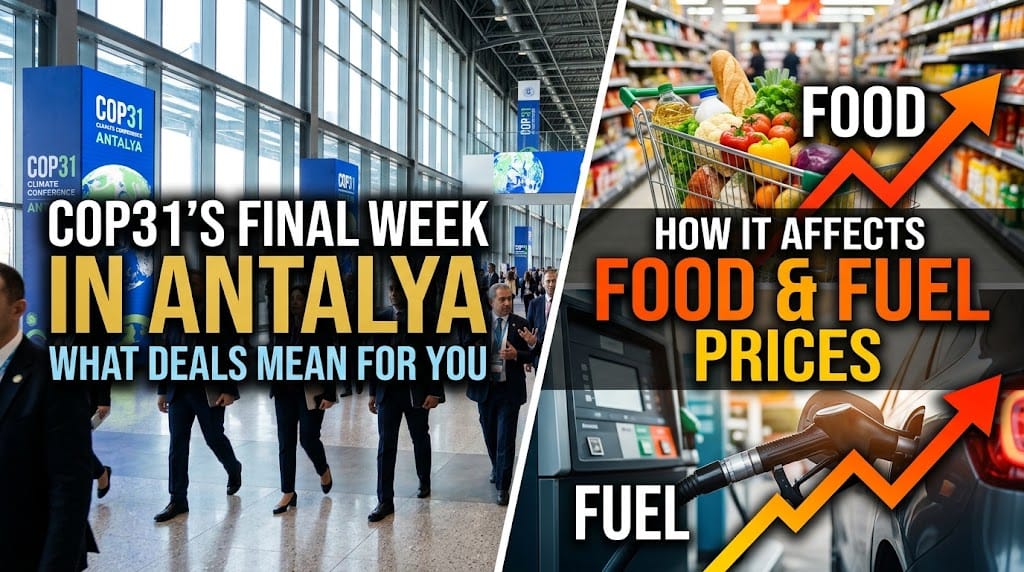
Negotiators inside the Antalya Expo Centre in southern Turkey are entering the final week of COP31 with ministerial delegations taking over the drafting rooms. The annual United Nations climate conference, scheduled to run until 20 November 2026, is chaired jointly through an unusual arrangement: Turkish Minister of Environment, Urbanisation and Climate Change Murat Kurum serves as COP31 president, while Australian Climate Change and Energy Minister Chris Bowen leads the negotiation tracks. While diplomatic statements focus on 1.5-degree temperature goals and treaty language, the texts being hammered out behind closed doors carry immediate consequences for household budgets worldwide.
Decisions made in Antalya will not remain confined to diplomatic communiqués. They directly touch international shipping levies, synthetic fertiliser guidelines, cross-border carbon pricing, and rules on sovereign fossil fuel subsidies. For families buying cooking gas in Lagos, filling a car in Manchester, or buying bread in Nairobi, the closing round of COP31 could shape the prices paid at checkouts and petrol pumps for years to come.
The Fuel Pump: Subsidies, Shipping Taxes, and Refinery Rules
The deepest divide in Antalya centres on the speed at which governments should phase out direct consumer and producer support for petroleum products. Developed economies and climate-vulnerable island states have pushed for binding timetables to dismantle fossil fuel support mechanisms. Oil-producing states and developing countries counter that sudden subsidy withdrawals shock domestic economies and trigger immediate social unrest.
In Nigeria, where the federal government removed universal petrol subsidies in mid-2023, the price of premium motor spirit jumped from roughly ₦197 per litre to well over ₦1,000 per litre by late 2024, altering domestic transport costs and feeding inflation. Nigerian delegates in Antalya have pointed out that international pressure to halt regional fuel stabilisation funds leaves low-income households exposed to global oil shocks. A strict multilateral agreement penalising producer-side fuel interventions could limit options for developing nations seeking to dampen retail fuel spikes.
In the United Kingdom, where fuel duty remains frozen at 52.95 pence per litre on petrol and diesel, discussions in Turkey threaten to raise energy distribution expenses through maritime shipping charges. Negotiators are reviewing maritime carbon tariffs designed to penalise heavy fuel oil use in bulk marine freight. Because the UK imports substantial volumes of refined transport fuels and liquefied natural gas (LNG), an international bunker fuel levy would filter straight through to wholesale import prices. British motorists paying approximately £1.40 per litre at retail forecourts could see that baseline tick upward as freight companies pass compliance costs directly down the supply chain.
In Canada, federal carbon pricing stands at $80 CAD per tonne, with statutory increases scheduled to reach $170 CAD per tonne by 2030. Negotiators from Ottawa are backing unified accounting frameworks under Article 6 of the Paris Agreement. If agreed, cross-border carbon tracking will penalise imports from jurisdictions without equivalent emissions charges, preventing businesses from moving production abroad but raising the landed cost of refined fuels and heating oil across regional markets.
Food Supply: Fertilisers, Methane Caps, and Transport Chains
Agriculture has emerged as the second major battleground of COP31's final week. Working groups are debating emission benchmarks for nitrogen-based fertilisers and livestock production. Synthetic nitrogen fertiliser relies on natural gas as its primary feedstock; its industrial production accounts for a notable share of global greenhouse gas output, while field application releases nitrous oxide.
European and North American delegations have proposed accelerated shifts toward green ammonia and organic soil amendments. Agronomists and farming federations warn that restrictions on nitrogen application lower crop yields before alternatives reach commercial scale. When yields drop, food price inflation follows.
In Kenya, where food accounts for over 40 per cent of typical household spending, smallholder farmers depend on affordable input supplies to produce staple white maize. Retail prices for a standard two-kilogram packet of maize flour have fluctuated between 150 KSh and 210 KSh depending on weather patterns and fertiliser access. If international climate compacts discourage development finance for conventional ammonia plants, African agricultural sectors that already face low fertiliser application rates will face higher import costs from foreign producers.
In Ghana, commercial poultry and grain farmers face comparable pressures. The Ghanaian cedi (GH₵) remains sensitive to import costs for animal feed and agricultural chemicals. Should the Antalya summit endorse border adjustments on agricultural inputs that carry heavy carbon footprints, West African food distributors will pay higher import charges, driving up shelf prices for basic provisions.
The Caribbean region faces exposure through bulk maritime shipping. Island nations such as Jamaica and Barbados import more than 80 per cent of their food supplies. Any emissions surcharge levied on international merchant fleets adds an inescapable freight premium to every container of wheat, rice, and cooking oil unloaded at Kingston or Bridgetown.

Comparing the Policy Measures and Their Price Consequences
The proposals under debate carry varying transmission timelines to household expenses. The table below outlines five primary policy mechanisms being negotiated during the final days in Antalya and their expected impact on daily living costs.
| Policy Proposal at COP31 | Negotiation Mechanism | Direct Fuel Price Impact | Direct Food Price Impact | Most Affected Regions |
|---|---|---|---|---|
| Fossil Fuel Subsidy Phase-Out | Binding targets to eliminate producer and retail price supports | Immediate rise in retail petrol, diesel, and kerosene where subsidies persist | Secondary increases through higher farm machinery and road freight costs | West Africa, North Africa, parts of Latin America |
| Global Maritime Carbon Levy | Per-tonne fee on heavy bunker fuel used by merchant vessels | Moderate increase in landed wholesale cost of crude oil and refined fuels | Higher ocean freight rates on imported staples, grain, and packaged goods | Caribbean islands, United Kingdom, coastal African states |
| Nitrogen Input Restrictions | Limits and reporting rules on synthetic fertiliser application | Negligible direct pump impact; potential diversion of natural gas feedstock | Higher domestic crop prices due to reduced yields and costlier green ammonia | Sub-Saharan Africa, South Asia, European Union |
| Article 6 Carbon Crediting | Standardised global trade in certified emission reduction credits | Increases compliance expenses for oil refiners and fuel distributors | Marginal impact, mainly through carbon certification costs for agribusiness | North America, European Union, Australia |
| Climate Finance Allocations | Delivery mechanisms for the post-2025 climate finance goal | Eases fiscal pressure on developing budgets, reducing currency volatility | Helps fund domestic irrigation and storage to buffer harvest losses | Low-income economies across Africa, Asia, and the Pacific |
The Climate Finance Bottleneck and National Budgets
The financial architecture behind climate action forms the friction point that could stall negotiations into overtime. Antalya is tasked with formalising delivery routes for the New Collective Quantified Goal (NCQG) on climate finance, an obligation established to succeed the outdated $100 billion annual target. Developing countries want direct public grants to fund energy transitions and climate adaptation. Donor governments in Europe, North America, and parts of East Asia are pushing for private capital mobilisations, loan guarantees, and carbon market instruments.
This funding argument links straight back to kitchen-table economics. When developing nations cannot access concessional climate finance, they borrow on commercial markets at high interest rates to rebuild roads, dams, and electrical networks wrecked by storms or prolonged droughts. Debt servicing drains state revenues that would otherwise fund food grain reserves, rural electrification, or targeted utility relief. In South Africa, where state utility Eskom continues to move away from ageing coal-fired stations, access to low-interest transition funding determines whether household electricity bills rise by single digits or double digits each year.
"If the final text in Antalya demands aggressive emission cuts without matching grant finance for infrastructure, national governments will have to fund capital projects through domestic taxation, which shows up immediately in transport tariffs and market prices."
Ministers face pressure from domestic electorates who are weary of inflation. In the United States, average pump prices near $3.20 per gallon remain politically sensitive. Any multilateral commitment perceived as increasing refinery compliance charges faces fierce domestic resistance. In Canada, voters have pushed cost-of-living questions to the front of political debate, prompting regional leaders to scrutinise every international agreement that touches fuel distribution.
The Days Ahead in Antalya
UN climate summits rarely finish on time. With Friday 20 November 2026 set as the official closing date, negotiators in Antalya are preparing for overnight sessions through the weekend. The Turkish presidency under Murat Kurum must bridge sharp differences between fossil fuel exporters and climate-vulnerable states. Chris Bowen faces the task of drafting compromise texts that preserve ambition on carbon markets without alienating developing economies terrified of immediate food price surges.
The final ministerial texts will reveal how much weight negotiators place on household affordability versus decarbonisation speed. If the summit produces broad agreements on maritime fuel levies and accelerated agricultural rules without clear financial protections, consumers worldwide could feel the economic aftershocks at grocery stores and filling stations long after the conference hall in Antalya falls dark.
Conclusion
COP31's closing week in Antalya marks a critical crossroads where global climate pledges intersect with household financial realities. While international delegations debate emission caps, subsidy phase-outs, and maritime carbon charges, these technical agreements directly influence the cost of filling a vehicle tank and buying staple foods. Finding an acceptable balance between long-term environmental targets and immediate economic stability will determine whether the summit's final agreement commands lasting international support or deepens cost-of-living strains for families across the globe.
Sources
- United Nations Framework Convention on Climate Change (UNFCCC) - COP31 Conference Documents
- International Energy Agency (IEA) - World Energy Outlook and Fossil Fuel Subsidies Database
- Food and Agriculture Organization of the United Nations (FAO) - Food Price Index and Agricultural Inputs Analysis
- The World Bank - State and Trends of Carbon Pricing Report
Disclaimer: This article reports on active international policy negotiations that are subject to change as final summit texts are completed. The details do not constitute financial, investment, or legal advice.
Category: News