New information challenges military's account of deadly Wainwright fire
By CelebUD Newsroom —
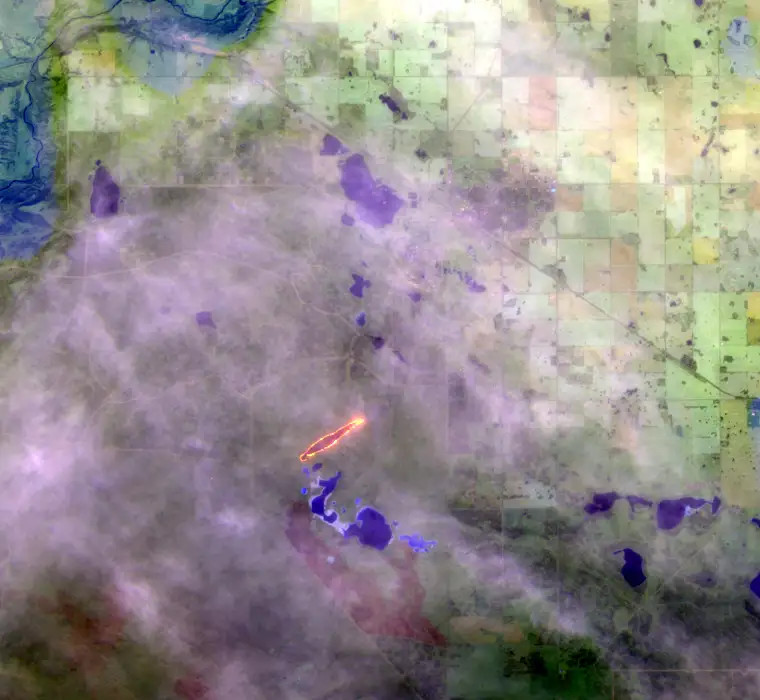
Emerging meteorological data and satellite surveillance are raising serious questions about the official narrative surrounding an October 17 training ground inferno at Canadian Forces Base Wainwright. While the Canadian Armed Forces characterised the sudden explosion of flames as an unpredictable phenomenon driven by freak weather, independent analysis by seven wildfire specialists indicates the catastrophe followed a standard, foreseeable pattern of wildland fire behavior under an incoming cold front.
The deadly disaster claimed the lives of four Canadian soldiers and injured 39 others, with 19 personnel suffering critical wounds. In the aftermath, senior military figures stated that a monitored grass fire transformed into an uncontrollable blaze when winds propelled flames forward by an entire kilometre within 30 to 60 seconds. However, orbital observations, formal meteorological advisories, and wildland fire dynamics suggest leadership had several hours of forewarning regarding extreme fire risk, powerful gusts, and a dangerous shift in wind direction.
The Official Defense Versus Satellite Reality
Addressing the press following the tragedy, Maj.-Gen. Wade Rutland maintained that troops were faced with an unprecedented operational environment. Initial military accounts placed the start of the blaze around 4:00 p.m., before officials later revised the timeline, conceding the fire had begun hours earlier on an automatic grenade launcher range. Maj.-Gen. Rutland asserted that the fire was previously deemed contained within Permanent Danger Area 2, an unexploded ordnance impact zone where direct firefighting access is heavily constrained.
However, atmospheric and orbital instruments tell a starkly different story about the timeline of the blaze:
- 12:17 p.m.: The U.S. Landsat 8 satellite captured a two-kilometre thermal scar across the Wainwright grasslands. University of Alberta wildland fire associate professor Jen Beverly estimated the blaze had already reached roughly 48 hectares—equivalent to around 50 football stadiums.
- 1:00 p.m. to 2:00 p.m.: Sustained winds at the base airfield doubled from 15 to 30 kilometres per hour as atmospheric pressure altered.
- 2:14 p.m.: Environment Canada upgraded local advisories to a yellow wind warning, alerting the Wainwright sector to hazardous winds with gusts up to 100 kilometres per hour.
- 2:49 p.m.: The NOAA-20 satellite registered heat signatures expanding outward, pointing to an active fire footprint that had nearly tripled to roughly 140 hectares.
- 3:10 p.m. to 3:30 p.m.: The GOES-18 weather satellite documented a catastrophic surge in the blaze's fire radiative power, which spiked sixteenfold from 76 megawatts to 1,215 megawatts before dropping back down.
- 3:16 p.m.: A cold front blasted across the base airfield, dropping temperatures by more than 10 degrees Celsius in less than an hour and registering a peak gust of 82 kilometres per hour.
- Around 4:00 p.m.: The advancing fire line rapidly overran military personnel conducting field training.
Fire researcher Mike Flannigan of Thompson Rivers University noted that the meteorological conditions were a textbook setup for severe grass fire behavior, emphasizing that low humidity combined with dry prairie grasses created a lethal environment.
"This was not unexpected given the forecast cold front, the actively spreading fire and the wind warnings that were issued earlier in the day."
The Physics of Fire Spread and Wind Flanking
Military leadership and Prime Minister Mark Carney have described the fire devouring a kilometre of prairie in 30 to 60 seconds, which translates to an extraordinary ground speed of 60 to 120 kilometres per hour. Wildfire experts contend that such velocities are physically improbable for a sustained grass fire front.
Marty Alexander, an authority on wildland fire dynamics who developed standard rate-of-spread models, noted that grass fires typically advance at approximately 20 percent of sustained wind speeds during severe burning windows. He pointed out that one of the most intense blazes on record—in New South Wales, Australia—spread at 27 kilometres per hour, calling a sustained run above 60 kilometres per hour improbable. Similarly, researcher Cordy Tymstra pointed to the fastest known Canadian grass blaze on record, the 1997 Granum fire in southern Alberta, which maintained speeds between 14.7 and 16.8 kilometres per hour.
While scientists acknowledge that forward spotting—where wind carries burning embers to ignite secondary fires ahead of the flame front—could have accelerated the fire's effective advance during the chaos, the primary danger stemmed from the wind shift. Environment Canada had warned of a directional swing from southwest to west. Under such conditions, what was once the long, dormant flank of a two-kilometre fire instantly rotates to become the wide head of the blaze, rapidly advancing sideways toward anyone in its vicinity.
"If a two-kilometre fire turns into a two-kilometre fire front, you can’t go sideways. You can only go directly away from it. But given the speed it was travelling and the terrain, most people couldn’t outrun it."
A History of Base Fires and Unheeded Warnings
CFB Wainwright sits on the former territory of Buffalo National Park, established in 1909 to conserve plains bison, where sweeping, open topography offers zero natural obstacles to break severe prairie gales. The region has endured destructive windstorms before; on the exact same date in 2017, wind gusts exceeding 100 kilometres per hour tipped over 13 rail cars at a trestle bridge west of the town of Wainwright.
Under base standing orders, Range Control is required to receive formal weather forecasts twice daily, at 6:00 a.m. and 6:00 p.m., with authority to suspend high-risk training and oversee emergency actions. The orders explicitly categorize August through October as high-risk periods, recommending that units stage live-fire exercises in the early morning. While the directives bar tracer ammunition, pyrotechnics, and white phosphorus during periods of extreme fire danger, they do not explicitly mention high-explosive ordnance or automatic grenade launchers. Maj.-Gen. Rutland characterised these standing safety orders as mere guidelines rather than strict mandates, noting that soldiers train across diverse operational conditions.
Escaped fires are not unprecedented on Canadian military reservations:
| Year | Location | Event Type | Area Burned |
|---|---|---|---|
| 1997 | Granum, Alberta | Historic Civilian Grass Fire Record | N/A (14.7–16.8 km/h spread) |
| 2017 | CFB Suffield, Alberta | Escaped Grass Fire in High Winds | ~36,000 hectares |
| 2024 | CFB Wainwright, Alberta | Escaped Prescribed Burn | ~600 hectares |
| Recent | CFB Wainwright, Alberta | Live-Fire Range Ignition | Fatal / 140+ hectares satellite footprint |
A recent collaborative study between the Department of National Defence and CFB Wainwright detailed how an April 2024 prescribed burn escaped control during high winds, scorching 600 hectares. Decades prior, a 2017 blaze at CFB Suffield burned through roughly 36,000 hectares. Past institutional audits revealed widespread oversights across military facilities, including uninvestigated hazardous incidents and safety risks accepted without senior management oversight.
Institutional Fallout and Unanswered Questions
Critical gaps in the chain of command remain unresolved. Maj.-Gen. Rutland declined to confirm whether an on-site meteorologist or wildland fire behaviour expert was working at Wainwright on the day of the disaster. Environment Canada subsequently confirmed that no meteorologist was stationed on site, with the Alberta base instead relying on remote weather forecasting provided from CFB Gagetown in New Brunswick.
The Department of National Defence has confirmed that no immediate alterations to safety policies have been instituted following the tragedy. The military plans to convene a formal Board of Inquiry in the near future, an administrative process that could require more than a year to complete.
"Where they find our procedures, our training, our equipment, or our policies must change, they will change."
Why institutional accountability matters for immigrants navigating Canadian workplaces
Many newcomers arrive in Canada with an implicit trust that public institutions and federally regulated bodies maintain infallible safety standards. The contrast between official military explanations—which initially labelled the Wainwright disaster an unforeseeable natural phenomenon—and the subsequent satellite evidence showing hours of visible fire progression underscores an important reality: institutional self-assessment is rarely infallible, even in developed economies.
For diaspora workers across various sectors—from logistics and heavy industry to public security—this investigation is a reminder of the vital role independent data, public inquiry, and whistleblowers play in workplace safety. It demonstrates that internal leadership can sometimes downplay systemic oversights, such as ignored advisories or delayed responses to mounting danger, until outside scrutiny compels a closer look.
Regardless of where you work in Canada, are you familiar with your legal right under labour codes to pause or refuse work in conditions you believe pose an immediate danger to life and health?
Conclusion
The tragedy at CFB Wainwright highlights a critical breakdown between available environmental intelligence and military field decisions. While defense officials initially portrayed the disaster as an unpredictable act of nature, evidence assembled from satellite data, meteorologists, and fire researchers indicates the blaze grew over several hours beneath an openly forecast weather system.
As pressure mounts from the families of the fallen soldiers and the wider public, the impending Board of Inquiry faces significant scrutiny. The investigation will need to determine why warning signals failed to halt active live-fire drills, how remote weather monitoring compromised safety protocols, and what reforms are necessary to prevent routine prairie exercises from turning into fatal catastrophes.
Reporting based on coverage by Global News Canada.
Category: News