'Debt worse than leprosy' - Obasanjo tackles Tinubu
By CelebUD Newsroom —
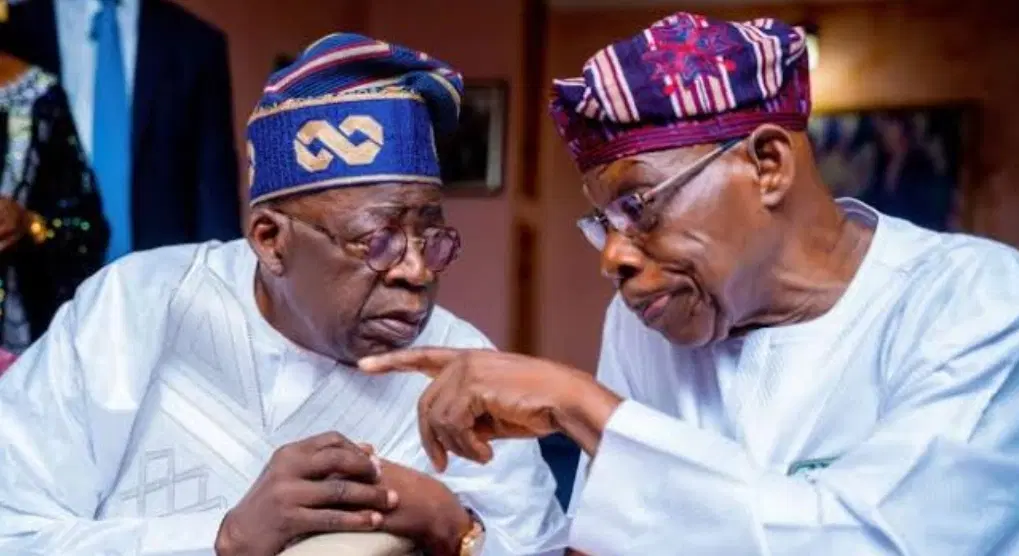
Former Nigerian President Olusegun Obasanjo has launched a direct critique against President Bola Ahmed Tinubu over the federal government's fiscal borrowing strategy, contending that unbridled public debt poses an existential hazard far more devastating than leprosy. Delivering remarks on Friday in Abeokuta, Ogun State, the elder statesman argued that uncontrolled sovereign borrowing compromises national sovereignty and threatens to bind future generations in long-term financial servitude.
The sharp intervention took place during the Ajibosin Platform, a public symposium convened under the theme, “Leveraging Artificial Intelligence to Solve Grassroots Problems and Accelerate National Development.” Beyond confronting the current administration's fiscal posture, Obasanjo and the keynote speaker, historian Dr Umar Ardo, sounded the alarm over digital imperialism, warning that Africa risks being systematically exploited once again if external corporations maintain an unhindered monopoly over artificial intelligence and sovereign data systems.
Obasanjo Rejects Tinubu's Stance on Borrowing
Obasanjo took open aim at comments made earlier this year by President Tinubu, who defended the federal government's recourse to debt. During an April gathering at the State House with Plateau State leaders—led by Governor Caleb Mutfwang alongside the National Chairman of the All Progressives Congress, Prof. Nentawe Yilwatda—Tinubu asserted that borrowing is justifiable provided a nation demonstrates the capacity to service its liabilities.
“If we have to borrow, we borrow. Borrowing is not leprosy; we just have to work hard to be able to pay for it,” Tinubu had remarked.
Vigorously dismissing that logic in Abeokuta, Obasanjo argued that public borrowing carries severe systemic ramifications that surpass any personal ailment.
“And for anybody to say debt is no leprosy, is absolute nonsense. Debt is worse than leprosy because leprosy destroys only one person. Debt destroys generations,” Obasanjo stated.
The elder statesman underscored that piling obligations onto future generations amounts to mortgaging Nigeria's sovereignty, especially at a time when the proportion of national revenues consumed by debt servicing continues to soar, choking off vital capital expenditure.
Naira Depreciation, Bretton Woods, and the Out-of-School Crisis
Reflecting on Nigeria's economic trajectory across recent decades, Obasanjo offered a sobering historical comparison drawn from his personal experience as a commercial farmer. He observed that when he established his farm 47 years ago, the domestic currency held substantial purchasing power on the world stage.
“When I started my farm, 47 years ago, naira to the dollar was one naira to $1.85. Forty-seven years ago. What has Nigeria done in 47 years that we now have 1,500 naira to a dollar? What have we done?” he asked.
He proceeded to query the competence of the ruling class, directly asking what incumbent leaders genuinely comprehend about the country's crises and what tangible solutions they can offer.
“What do our leaders know? And what do they not know? And from what they know, what can they do for us?” he queried.
The former president also cautioned policymakers against uncritically embracing reform blueprints provided by international financial institutions, such as the International Monetary Fund (IMF) and the World Bank. He pointed out that both institutions were founded prior to African nations securing independence and thus were never tailored to resolve the structural realities of developing nations.
“World Bank and IMF were not designed for us. They were not built by us. They were built before we became independent. And that’s the people who would determine what we do,” Obasanjo remarked.
He likewise highlighted the unfair dynamics of international trade, noting that advanced economies continue to heavily subsidise their own agricultural producers while international lenders demand that emerging markets eliminate farm supports. Shifting attention to domestic social emergencies, Obasanjo raised the alarm over the country's human capital deficit, pointing to an estimated 24 million children currently excluded from the formal educational system.
“We have 24 million Nigerian children who should be in school but are not. If you are looking for the disasters of tomorrow, these children represent one of them,” he said, charging innovators to use emerging technology to bridge the learning divide.
AI: From Historical Extraction to Digital Hegemony
Turning to modern technology, Obasanjo warned that Africa must not sleepwalk into a fresh era of external dominance masked as technological advancement. Acknowledging that he was not an engineer or computer scientist, he stated that fundamental principles of ownership determine whether innovation empowers or exploits a society.
“I don’t know too much technically about AI, but I know that anything that is not under your control can be abused against you. And you can see that this has already started,” Obasanjo warned.
He expressed deep skepticism regarding the conventional promises of cross-border technological transfers:
“But what exactly is technology transfer? Who transferred technology to them, and what did they pay for it?”
Delivering the keynote address, titled “From Slave Ships to Server Farms: Artificial Intelligence and Africa’s Unbroken History of Extraction,” historian Dr Umar Ardo outlined how five centuries of global economic integration have continuously extracted Africa's resources to build external wealth. He traced this continuum through discrete historical phases:
| Historical Epoch | Primary Resource Extracted | Structural Impact on Africa |
|---|---|---|
| Transatlantic Era | Human lives / Enslaved labour | Commodification of people, severe demographic depletion. |
| Colonial Regime | Solid minerals and cash crops | Infrastructure designed purely to export raw materials outward. |
| Post-Independence | Primary commodities and brain drain | Raw exports, finished imports, and flight of skilled professionals. |
| Digital Age | Mass data, indigenous knowledge, cultural assets | Unregulated extraction feeding foreign proprietary algorithms. |
“AI offers Africa important opportunities, but without ownership, safeguards and public purpose, it could extend a long history in which Africa supplies value while others control and capture it,” Ardo said.
Ardo remarked that while historical subjugation extracted labour, land, raw minerals, and subsequently skilled professionals, digital technologies are now targeting collective information.
“Five centuries ago, they came for our bodies. Then they came for our land and its riches. Then our commodities and trained minds. Today, they come for our data,” Ardo warned.
He explained that global corporate conglomerates are harvesting data generated by African hospitals, farmers, small businesses, indigenous groups, and public authorities to train foreign models without equitable compensation. Questioning who truly profits from this arrangement, Ardo asked:
“When farmers’ planting patterns are recorded, who controls that knowledge; the farmer or the platform?”
He added a poignant caution regarding user participation in online ecosystems:
“One of the most efficient systems of extraction is the one its subjects volunteer to use.”
The Blueprint for Digital and Economic Sovereignty
To avoid perpetual subjugation, Ardo insisted that Nigeria—a demographic powerhouse exceeding 230 million citizens—cannot settle for being a passive consumption market for offshore technology.
“A country of over 230 million people should be more than a market for foreign technology,” Ardo declared.
He urged the Federal Government to build a sovereign digital ecosystem through targeted interventions:
- Technological and Compute Sovereignty: Direct capital investments into indigenous server infrastructure, reliable power generation, semiconductor initiatives, and domestic computing labs.
- Strengthened Legal Protection: Expanding past the baseline of the Nigeria Data Protection Act 2023 to establish statutory ownership rights over community knowledge and ensure equitable royalty arrangements.
- Culturally Grounded Datasets: Engineering domestic artificial intelligence systems tailored to native African languages, agronomic variations, and traditional medicine.
- Grassroots Integration: Directing applied machine learning toward frontline public functions, including local governance, agricultural extension, conflict mitigation, primary healthcare, and tax administration.
- Human Capital Development: Overhauling academic curricula in universities, polytechnics, and colleges to train data curators, computer scientists, and software engineers at scale.
- Regional Collaboration: Leveraging the African Union’s 2022 Data Policy Framework to establish harmonised regulatory regimes and present a united bargaining front against multinational technology firms.
“The choice is ours. Artificial intelligence can become another instrument through which Africa is managed, or an instrument through which Africa begins to manage its own destiny,” Ardo concluded.
What rising debt and currency pressure mean for diaspora support
For Nigerians living in Canada and elsewhere abroad, the sharp clash over government borrowing is far from academic. When debt servicing swallows national revenue, public spending on hospitals, public schools, and power networks tends to dry up first. The consequence for diaspora families is direct: requests for emergency money, medical bills, and school fees do not decrease; they multiply. With the currency hovering near 1,500 naira to the dollar, foreign remittances stretch further on paper, but domestic inflation quickly erodes those gains for loved ones on the ground.
This persistent fiscal strain means that reliance on diaspora subsidies has become a permanent survival strategy rather than a temporary cushion. Those sending money home must balance their own settling-in costs, Canadian mortgages, or tuition payments against escalating family obligations back home. Long-term investments in Nigeria, such as property development or small business ventures, also face prolonged currency risk if sovereign liabilities continue to mount.
Takeaway: Review your monthly remittance commitments and consider shifting from informal, ad-hoc emergency transfers to structured family support pools or direct investments in income-generating assets back home.
Conclusion
The symposium in Abeokuta brought forward two interconnected vulnerabilities confronting modern Nigeria: mounting sovereign financial indebtedness and an accelerating technological deficit. By countering President Tinubu's borrowing philosophy, Obasanjo reframed national loans not as manageable financial instruments, but as structural threats that deplete resources across generations. Paired with Ardo's historical critique of algorithmic extraction, the forum delivered an urgent message to Abuja and other African capitals: self-reliance, rigorous financial discipline, and sovereign technological ownership represent the only reliable defenses against modern forms of economic and digital dependency.
Reporting based on coverage by Vanguard Nigeria - Politics.
Category: Politics