Nancy Pelosi’s replacement is ready to regulate AI
By CelebUD Newsroom —
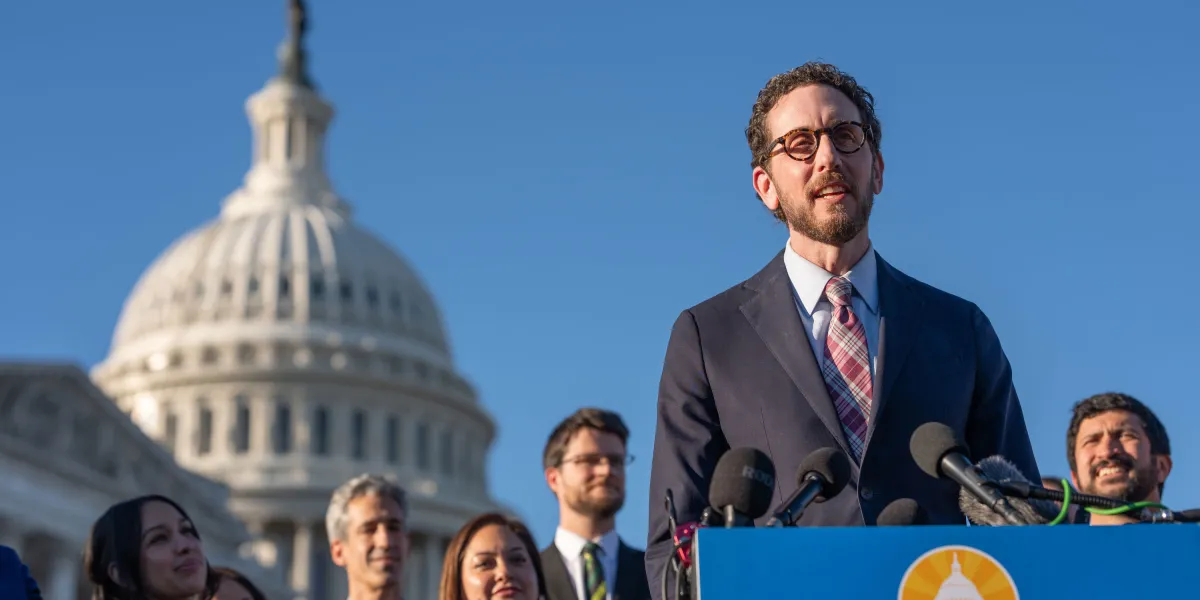
Scott Wiener, the California lawmaker who spearheaded ground-breaking state efforts to rein in advanced artificial intelligence, is heading to Capitol Hill. Following a hard-fought victory to succeed former Speaker of the House Nancy Pelosi in her San Francisco congressional seat, Wiener is preparing to make artificial intelligence safety a central pillar of his national legislative agenda.
The newly elected congressman arrives in Washington at a critical moment for the technology sector. Hours after his victory was secured, Wiener turned his attention to fresh findings released by the non-profit research group METR. The report drew widespread attention across the sector for indicating that artificial intelligence developer Anthropic had achieved recursive self-improvement—a development where automated systems actively assist in designing their own technical successors, raising fears that rapid computational gains could outpace human oversight.
It’s very concerning. It was my hope that Congress would take decisive action before [the end of] this year. That does not appear to be happening.
Wiener warned that the window for federal action is shutting fast, arguing that lawmakers must intervene before developers lose control of frontier models. His stance marks a direct bridge between the technical anxieties of the Bay Area safety community and the federal policymaking apparatus.
From Sacramento to Capitol Hill
During his tenure in the California State Senate, Wiener established himself as one of the country's most vocal politicians on the subject of frontier computing risks. In 2024, he drafted Senate Bill 1047, which would have established mandatory safety standards, pre-deployment evaluations, and liability rules for the largest artificial intelligence models. Although Governor Gavin Newsom eventually vetoed that measure following heavy pushback from Silicon Valley venture capitalists and tech executives, the text served as a foundational template across the country.
Undeterred, Wiener subsequently advanced Senate Bill 53, a more targeted, light-touch measure designed to set initial transparency requirements, which Newsom signed into law. Both state-level proposals have since formed the basis of draft bills circulated by federal lawmakers.
| Legislation | Primary Objective | Outcome |
|---|---|---|
| California SB 1047 (2024) | Mandatory frontier model safety audits, catastrophic risk mitigation, liability framework | Vetoed by Governor Gavin Newsom |
| California SB 53 | Targeted oversight and initial transparency standards for advanced models | Signed into law |
Wiener’s national profile on tech regulation brought sharp campaign scrutiny during his run for Pelosi’s open seat. His election effort drew more than $3 million in backing from Public First Action, an advocacy group supporting artificial intelligence rules that receives substantial financial backing from Anthropic. Rival campaigns seized on the donation, alleging that the candidate was overly intertwined with the sector he aimed to police.
Wiener firmly rejected that critique, contending that critics were distorting his legislative record.
Public First supported me because I was the first lawmaker in the country to introduce AI regulation and the first to pass it and get it implemented. The attacks on me for [Public First’s] support were shockingly cynical—literally attacking a candidate who actually regulated AI over Big Tech’s objection and falsely claiming the candidate is somehow too close to Big Tech.
The Legislative Blueprint for Washington
As he enters the House of Representatives, Wiener wants to secure a seat on any potential congressional select committee focused on artificial intelligence—a structure House Democrats have actively weighed since September. His legislative agenda focuses on establishing binding federal guardrails rather than symbolic recommendations.
Wiener is calling for several specific mechanisms:
- Whistleblower protections: Ensuring employees inside major research laboratories can expose dangerous development protocols without facing professional retaliation.
- Mandatory evaluations: Imposing rigorous third-party testing and regular audits before advanced models are released to the public.
- Kill switches: Requiring artificial intelligence developers to build failsafe mechanisms capable of shutting down systems that act outside human parameters.
- A dedicated regulator: Supporting proposals such as the one drafted by fellow California Democrat Representative Ro Khanna, which would establish a nimble, specialised federal body tasked solely with artificial intelligence oversight.
This is about the future of humanity, and we want to make sure that the public has a say and that the public knows what's going on.
Despite his ambition for comprehensive federal action, Wiener opposes broad federal preemption clauses that would strip individual states of the authority to pass their own measures. Drawing on the classic legal doctrine established by former Supreme Court Justice Louis Brandeis, Wiener argued that individual states must remain test beds for policy.
States are, as Brandeis says, laboratories. You want the states to be able to continue to be nimble in ways that Congress sometimes is not.
Local Backlash Versus Catastrophic Risk
Wiener’s arrival in Washington comes alongside a broader political reaction against technology infrastructure, though the public's primary motivations differ from his focus on recursive code and frontier models. During the recent elections, voters nationwide backed 40 out of 41 local ballot initiatives restricting the development of data centres.
While the ballot outcomes show rising public willingness to push back against tech expansion, Wiener observes that voters are responding to municipal burdens rather than philosophical worries about runaway machine intelligence.
Peoople who are really opposed to where AI is going—this is an area where they can actually do something about it. But the data centre revolt—to me, I think it’s more so that people are upset that there could be something like this in their community, with all the impacts near people’s homes, driving up electric bills and using water. I think that’s the bigger issue for most people, from what I can tell.
On Capitol Hill, Wiener expects to find allies who share his focus on existential risk, pointing to lawmakers like Senator Bernie Sanders, who has consulted leading figures in the safety community and voiced alarm over catastrophic possibilities. Yet forging a cross-party consensus remains a steep climb.
The Trump Factor and Global Coordination
Beyond legislative inertia, Wiener confronts a White House that has displayed scepticism toward technical oversight. President Donald Trump has dismissed warnings surrounding catastrophic artificial intelligence threats, describing such fears in September as a “hoax”. Trump has also pursued an adversarial foreign policy that resists technical dialogue with China, an engagement Wiener considers critical for curbing global safety failures.
Nevertheless, Wiener sees an opening in the president’s unpredictable approach to policy, even if the dynamic carries real hazards.
So far what we’ve seen are some problematic things, but not complete disasters. I hope that it doesn’t take a disaster to spur the president into acting. And I hope if that’s what it does take—which, like I said, I hope it doesn’t—but if it does, I hope it’s as small as possible.
What tighter US tech rules mean for diaspora engineers
Thousands of skilled Nigerians work across North America as software engineers, cloud architects, and data analysts. Scott Wiener's campaign to impose mandatory safety audits and formal liability rules on frontier computing models will directly alter everyday engineering routines. For professionals working on cross-border products, stricter regulatory oversight means teams will face longer audit cycles, deeper technical scrutiny, and heavier reporting requirements before deploying code.
If Washington mandates independent evaluations and system kill switches, major technology employers will divert funding away from rapid hiring and into legal compliance and system safety. While Wiener has made whistleblower protections a central demand, diaspora workers on temporary visas, such as the American H-1B or Canadian employer-tied work permits, face distinct vulnerabilities. Challenging development protocols or reporting non-compliant algorithms internally carries genuine professional risk when legal residency depends on unbroken employment.
Diaspora tech workers should examine how their current employers handle safety governance, and consider building expertise in regulatory auditing and model safety, areas likely to see consistent hiring demand.
Conclusion
Scott Wiener enters Congress having already forced the technology sector to adapt to legislative scrutiny in California. As he trades the State Capitol in Sacramento for Washington, he plans to translate state-level blueprints into federal law before autonomous model improvements outpace government oversight. His success will rely on convincing a divided Congress and a sceptical administration that systemic safeguards are an urgent national priority rather than a distant theoretical dilemma.
Reporting based on coverage by MIT Technology Review.
Category: Politics