Osun 2026: How 'Dancing Governor' Ademola Adeleke Secured Second Term Defying Political Gang-Ups
By Gbenga Ayandare —
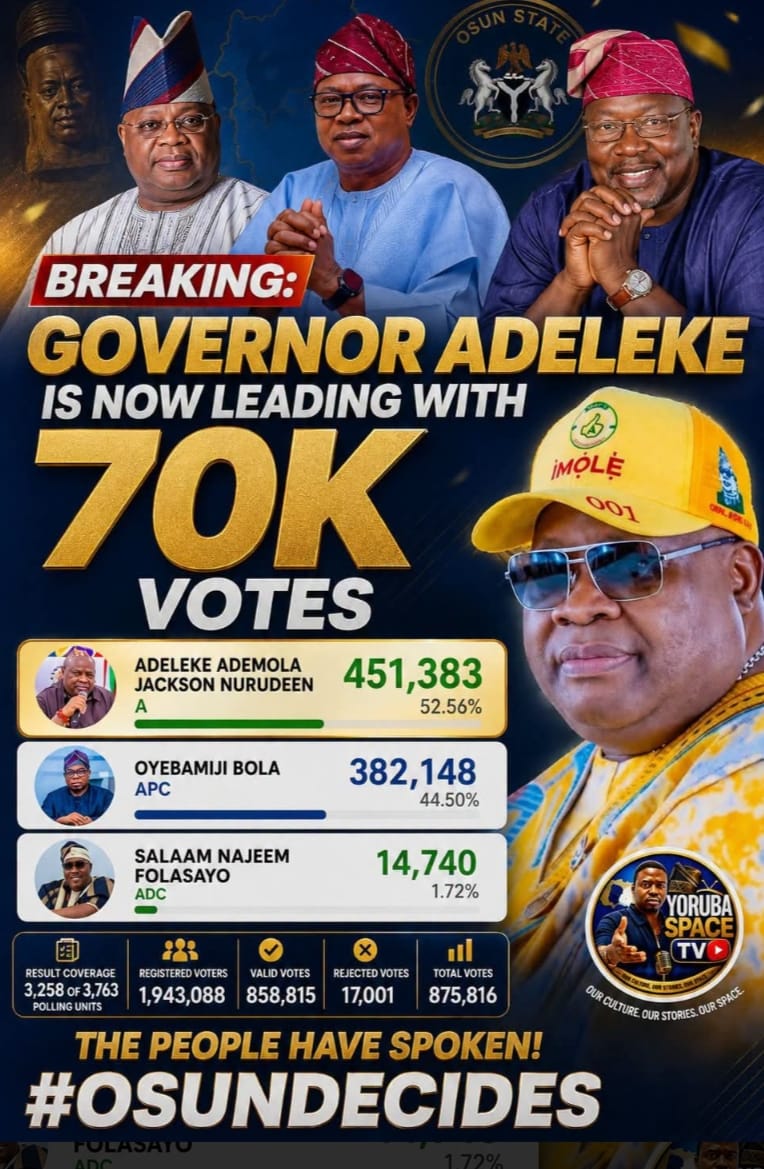
Across the towns and undulating hills of Osun State, the rhythm of victory has once again taken center stage. Senator Ademola Jackson Nurudeen Adeleke, affectionately dubbed the “Dancing Governor” across Nigeria and the global diaspora, has danced his way into a landmark second term in office. Defying a fierce coalition of political heavyweights, entrenched party machinery, and widespread anxieties surrounding the deployment of “federal might,” Adeleke demonstrated that grassroots populism, when paired with concrete delivery, remains a formidable force in Nigerian electoral politics.
The 2026 Osun State gubernatorial election was widely regarded as a litmus test for democratic resilience in Nigeria. Pundits and opposition strategists had predicted a grueling, uphill battle for the incumbent, anticipating that concerted opposition alliances and centralized influence would dismantle the People's Democratic Party (PDP) fortress in Osun. Instead, what unfolded at the polling booths across the 30 local government areas was an overwhelming reaffirmation of the popular will, executed under the watchful eyes of an energized electorate and impartial state institutions.
The Coalition Against the 'Dancing Governor'
Adeleke’s journey to reelection was far from a frictionless waltz. In the lead-up to the 2026 ballot, opposition forces mobilized aggressively to unseat the charismatic leader. Factions within the primary opposition party, the All Progressives Congress (APC), bridged longstanding internal divides to form a consolidated front. Behind closed doors, alliances were forged with smaller splinter groups and aggrieved party chieftains seeking to capitalize on any perceived governance missteps during his first term.
Critics had routinely attempted to weaponize Adeleke’s jovial persona, arguing that dancing could not substitute for administrative rigor. However, Adeleke turned his signature charisma into an unshakeable connection with the common people. By blending genuine lightheartedness with tangible public sector interventions, he systematically disarmed opposition attacks that sought to portray his leadership style as superficial.
“They thought our joy was a sign of weakness,” Adeleke remarked during a post-election address. “They failed to understand that when a leader is happy, transparent, and delivers for his people, the people will dance with him all the way to the ballot box.”
Grassroots Performance: Beyond the Spectacle
Behind the infectious music and spirited footwork was a substantive governance record that resonated with working-class citizens, market women, artisans, and civil servants. In an era where delayed salaries and unpaid pensions have plagued state administrations across the federation, Adeleke prioritised human capital development and prompt clearance of legacy debt arrears inherited from previous governments.
Key pillars that underpinned the Governor's reelection campaign included:
- Prompt Civil Service Remuneration: Ensuring regular monthly payment of civil servants' salaries and systematic liquidation of backlogged pension entitlements.
- Infrastructure and Rural Urbanization: Targeted road rehabilitation, bridge reconstruction, and rural electrification projects that linked agrarian communities to urban markets.
- Healthcare Revitalization: Overhaul and solar power installation across primary healthcare centers throughout the three senatorial districts.
- Youth and SME Empowerment: Accessible micro-credit facilities and vocational support programs designed to curb youth unemployment.
Neutrality of the Presidency and the Containment of 'Federal Might'
Historically, off-cycle gubernatorial elections in Nigeria have often been shadowed by the specter of “federal might”—the perceived weaponization of central government security and administrative apparatus to skew local outcomes. In Osun 2026, concerns were rampant among the electorate that coercive state instruments might be deployed to tip the balance against the incumbent.
However, the narrative took a radically refreshing turn. The Presidency earned widespread commendation from domestic observers and international monitoring groups for strictly maintaining neutrality. By refusing to give in to partisan pressures to tilt the playing field, the central administration allowed the election to be decided strictly on democratic merits. This principled stance fostered an atmosphere where citizens felt confident that their participation would not be overridden by executive overreach from Abuja.
The Role of Security Agencies and Neutrality on the Ground
Security experts and civil society organizations played a pivotal role in guaranteeing a peaceful and orderly electoral process. In the weeks leading to the election, intelligence-led operations thwarted potential flashpoints of thuggery and ballot box snatching. On election day, personnel from the Nigeria Police Force, the Nigeria Security and Civil Defence Corps (NSCDC), and collaborating security agencies demonstrated exemplary professionalism.
Rather than acting as partisan enforcers, security operatives maintained vigilant, unobtrusive cordons around voting centers. Rapid response teams promptly neutralized localized attempts at voter intimidation, ensuring that voters in historically contentious areas could cast their ballots without fear of violence or disenfranchisement.
INEC, Technology, and Ensuring Every Vote Counted
The Independent National Electoral Commission (INEC) delivered a masterclass in logistics and transparency during the Osun 2026 poll. Learning from the operational bottlenecks of past electoral cycles, the commission deployed optimized technological tools that bolstered the credibility of the entire process.
The Bimodal Voter Accreditation System (BVAS) functioned with remarkable speed and precision, drastically minimizing accreditation delays. Furthermore, the electronic transmission of polling unit results directly to the INEC Result Viewing (IReV) portal allowed citizens, party agents, and media organizations to track tally sheets in real time. Because results were uploaded immediately after being counted openly in full view of community members, any opportunity for manual manipulation or collation-stage doctoring was effectively eliminated.
Comparative Breakdown: Osun 2022 vs. Osun 2026 Dynamics
To understand the magnitude of Adeleke’s consolidation of power, it is essential to examine how key electoral variables shifted between his breakthrough 2022 victory and his decisive 2026 reelection.
| Electoral Factor | 2022 Gubernatorial Election | 2026 Gubernatorial Election |
|---|---|---|
| Adeleke's Political Status | Challenger relying on populist appeal and protest vote against the status quo | Incumbent defending record with established grassroots delivery |
| Opposition Posture | Fragmented ruling party grappling with internal APC factionalism | Consolidated opposition alliance seeking to reclaim state executive power |
| Technology Deployment | Early-stage nationwide rollout of BVAS and IReV systems | Refined BVAS firmware, enhanced upload speeds, and real-time portal monitoring |
| Security Agency Conduct | Effective deployment amidst heightened local political tensions | High-level synergy, proactive intelligence gathering, and non-partisan conduct |
| Voter Vigilance | High civic engagement with strong youth turnout | Multi-generational vigilance defending vote counts directly at polling units |
Defending the Mandate: Civic Vigilance at the Polling Units
While technology and institutional neutrality set the framework, the true heroes of the 2026 Osun election were the everyday citizens. From Osogbo to Ede, Ilesa to Ife, and across the agrarian settlements of Osun South and Central, voters remained steadfast at their polling stations long after marking their ballots. In accordance with the provisions of the Electoral Act, citizens watched the counting of every single ballot paper openly, recording proceedings on smartphones and cross-checking physical figures against the digital uploads on the IReV portal.
This active vigilance created an impenetrable barrier against malpractice. It underscored a mature political consciousness among the Osun electorate, who proved that sustained citizen participation is the ultimate safeguard of democratic integrity.
Conclusion
Governor Ademola Jackson Adeleke’s successful march into a second term is a multifaceted triumph. It reflects not only his enduring personal charisma and governance achievements but also a monumental victory for Nigerian electoral democracy. By resisting political gang-ups, benefiting from institutional non-interference by the Presidency, and relying on the efficiency of INEC and security personnel, the people of Osun State ensured that their votes were counted accurately. As Adeleke begins his second mandate, the celebration across the state signals a hopeful chapter where performance, accountability, and the authentic will of the electorate prevail over partisan muscle.
Sources
- Independent National Electoral Commission (INEC Nigeria) Official Portal
- Official Portal of the Government of Osun State
- The Punch Newspaper – Nigerian Political Reporting
- Premium Times – Election Monitoring & Investigative Analysis
Disclaimer: This article covers developing political events and preliminary reporting around the Osun State gubernatorial race. Statements, analyses, and figures reflect information available at the time of writing and may be subject to further updates as official bodies finalize documentation.
Category: Politics