Questions for NJC: Can a sitting President of the Court of Appeal chair a board whose legitimacy is before the courts?
By CelebUD Newsroom —
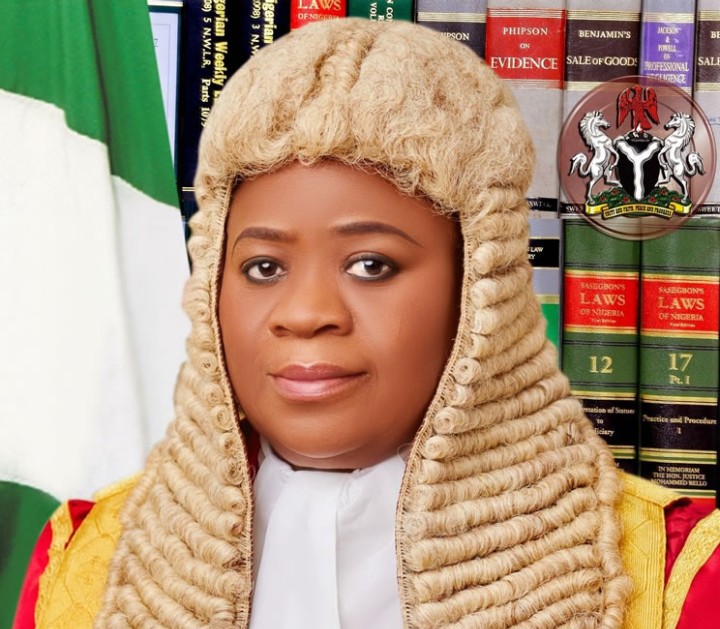
A growing ethical dilemma has emerged within Nigeria's legal system following the decision by the President of the Court of Appeal, Justice Monica Dongban-Mensem, to accept the leadership of a prominent sporting body's board while the entity itself faces extensive legal challenges. Legal observers and commentators are urging the National Judicial Council (NJC) to review the matter to safeguard the institutional integrity and public perception of the nation's appellate bench.
The controversy stems from an administrative appointment made by the Minister of the Federal Capital Territory on April 5, 2025, naming Justice Dongban-Mensem as the Chairperson of the Board of Trustees of the IBB International Golf & Country Club. Rather than serving as an uncontested honorary position, the assignment has thrust the head of Nigeria's second-highest court directly into a bitter leadership struggle, culminating in active suits across trial courts where she is directly cited as a party.
Litigation Surrounding the Golf Club Board
The governance structure of the IBB International Golf & Country Club has become the subject of multiple court battles across the Federal Capital Territory High Court and the Federal High Court. Rather than dealing with routine administrative concerns, these lawsuits challenge the very constitution and authority of the club's leadership apparatus.
At present, three notable suits form the backbone of the ongoing legal dispute:
- Dr Chukwuma Katchi v. Incorporated Trustees of IBB International Golf & Country Club & 2 Ors (Suit No: FCT/HC/CV/242/2025), filed before the High Court of the Federal Capital Territory.
- Incorporated Trustees of IBB International Golf & Country Club v. Corporate Affairs Commission & 3 Ors (Suit No: FHC/ABJ/CS/483/2025), instituted at the Federal High Court.
- Mr Ubong Esop Akpan & 2 Ors v. Incorporated Trustees of IBB International Golf & Country Club & 6 Ors (Suit No: FHC/ABJ/CS/698/2025), also pending at the Federal High Court, in which Justice Dongban-Mensem is specifically cited as a defendant due to her role leading the appointed board.
| Suit Number | Court Jurisdiction | Key Parties Involved | Core Subject Matter |
|---|---|---|---|
| FCT/HC/CV/242/2025 | FCT High Court | Dr Chukwuma Katchi v. Incorporated Trustees of IBB International Golf & Country Club & 2 Ors | Dispute challenging the club's internal governance structure |
| FHC/ABJ/CS/483/2025 | Federal High Court | Incorporated Trustees of IBB International Golf & Country Club v. Corporate Affairs Commission & 3 Ors | Regulatory and registration status of the board of trustees |
| FHC/ABJ/CS/698/2025 | Federal High Court | Mr Ubong Esop Akpan & 2 Ors v. Incorporated Trustees of IBB International Golf & Country Club & 6 Ors | Legitimacy challenge naming Justice Dongban-Mensem as a co-defendant |
Ethical Rules and the NJC Code of Conduct
While trial judges will ultimately determine the substantive merits of the pending actions, legal analysts emphasize that the ethical propriety of the arrangement falls under the purview of judicial regulators. The National Judicial Council oversees bench ethics, guided by comprehensive regulations designed to shield judicial officers from outside entanglements.
Multiple provisions within the NJC Code of Conduct for Judicial Officers speak directly to the issues raised by extra-judicial appointments:
- Rule 1.2 and Rule 1.3: Mandate that judicial officers shun impropriety and the appearance of impropriety in all activities, conducting themselves in ways that foster public confidence in the fairness and impartiality of the legal system.
- Rule 9.3: Governs participation in community, recreational, and non-profit associations. While judicial officers may affiliate with such groups, the rule cautions against involvement where an entity is regularly embroiled in litigation or exposes the judge to public dispute.
- Rule 12.1: Sets forth standards regarding recusal and disqualification in matters where a judge's objectivity could reasonably be questioned by the public.
- Rule 13.1 and Rule 13.3: Regulate non-judicial duties to ensure they do not collide with constitutional obligations. Crucially, Rule 13.3 establishes that judges should avoid serving as trustees or fiduciaries, maintaining an exception strictly for the personal affairs or estates of close family members, provided it does not disrupt judicial responsibilities.
Institutional Ramifications for the Court of Appeal
Beyond the immediate lawsuits pending before trial courts, legal commentators, including analyst Ebizie Odili, note that the most profound hazard involves future appellate proceedings. The Court of Appeal stands as the direct appellate authority over judgments delivered by both the Federal High Court and the FCT High Court.
Should any of the three current lawsuits—or potential subsequent claims—yield appeals, the disputes will inevitably proceed to the very institution over which Justice Dongban-Mensem presides. Even if the President recuses herself entirely from hearing the appeals or selecting the specific panels, the dynamic risks fueling unnecessary public cynicism regarding judicial independence.
The judiciary relies heavily on public trust, which demands not only actual fairness from judges but also the unmistakable perception that institutional procedures remain untainted by personal interests or external appointments.
How confidence in the appellate bench affects everyday justice
For citizens living in Nigeria, court proceedings are rarely an abstract exercise. Whether you are dealing with a tenancy battle, an employment termination, or a protracted family estate issue, the Court of Appeal often represents the final practical port of call. With the Supreme Court docket notoriously congested, appellate panels effectively deliver the decisive word on most civil and commercial matters.
This is why adherence to the National Judicial Council's Code of Conduct matters to regular people. Rules prohibiting judges from serving on contested boards or acting as external fiduciaries exist to preserve the appearance of total neutrality. When the leadership of an appellate court is named as a defendant in trial-level lawsuits, even a complete recusal leaves room for public cynicism. Litigants facing connected opponents worry whether their cases will be heard on pure merit without institutional hesitation.
Takeaway for active litigants: If you currently have a civil matter pending before trial courts in Abuja, ask your lawyer how conflict-of-interest and panel recusal rules work, so you understand your rights if potential administrative overlaps arise in your case.
Conclusion
The intersection of an executive board appointment and active civil litigation presents an unavoidable test for the National Judicial Council. The central question is not an assertion of actual wrongdoing, but rather whether the governance guidelines permit a senior judicial leader to head a contested board while litigation over that position proceeds through the courts.
To safeguard public confidence and eliminate potential conflicts before cases reach appellate dockets, observers argue that the NJC must provide formal guidance. Addressing the compatibility of the role with the Code of Conduct offers the most viable path to maintaining clarity, upholding institutional standards, and ensuring that public respect for the Court of Appeal remains uncompromised.
Reporting based on coverage by Blueprint Newspapers.
Category: Politics