Trump's arch is on the verge of federal approval. But a judge could block construction
By CelebUD Newsroom —
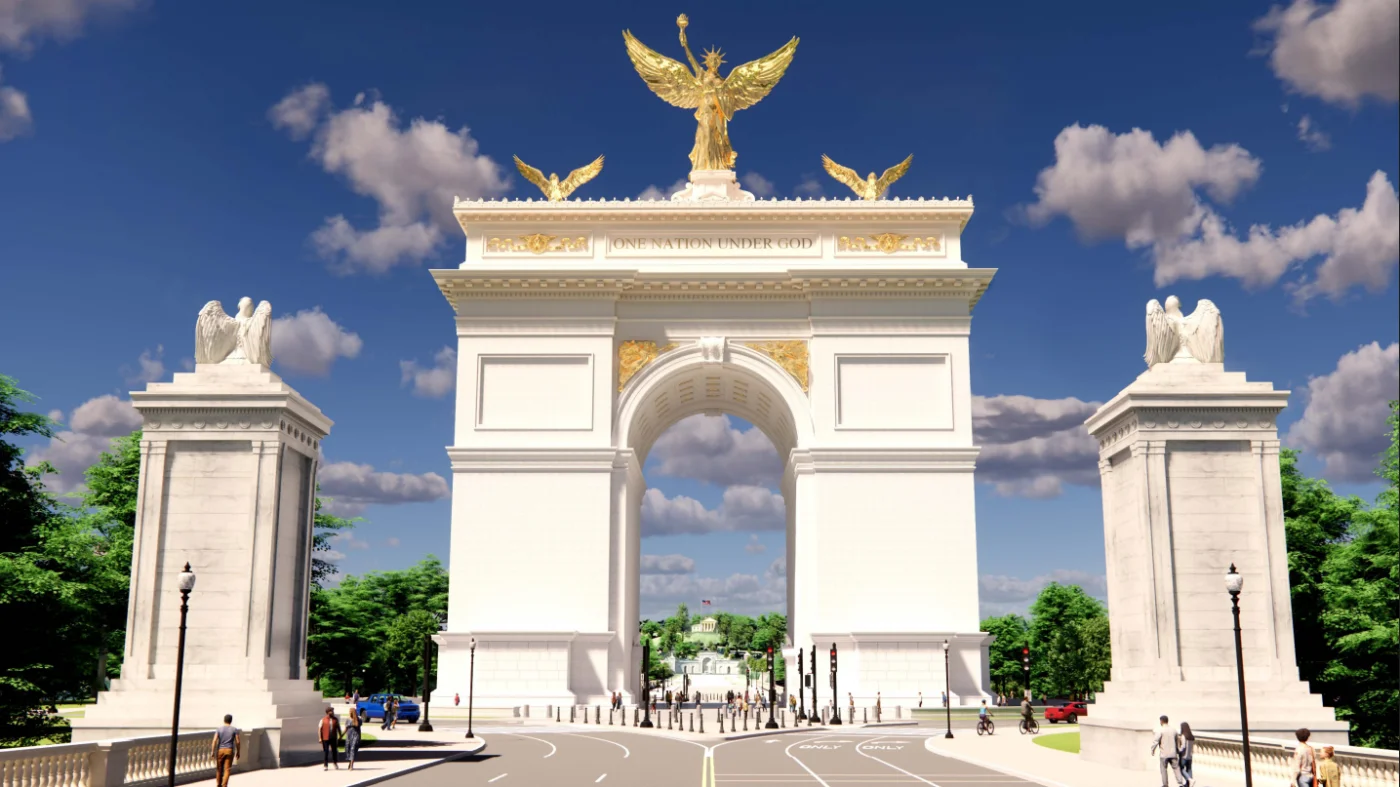
A high-stakes administrative and legal confrontation over President Donald Trump's proposed 250-foot triumphal arch reached a critical turning point this week, as federal planners prepared to deliver final design approval while a district judge weighed emergency requests to halt construction immediately. The disputed monument, intended for Memorial Circle along the Arlington Memorial Bridge between the Lincoln Memorial and Arlington National Cemetery, faces intense resistance from military veterans, local governments, and preservationists who argue the White House bypassed Congress and rushed regulatory reviews.
Federal Reviews and Mounting Administrative Pressure
The White House has moved aggressively to advance the monumental initiative, navigating through regulatory procedures at unusual speed. In May, the Commission of Fine Arts—composed entirely of Trump appointees—voted to endorse an incomplete design draft. By September, an advisory council on historic preservation, also staffed with administration allies, abruptly shut down its review process despite vocal objections from outside participants that the examination had been improperly curtailed.
Final authority rests largely with the National Capital Planning Commission (NCPC), which placed the arch as the sole agenda item for an extended five-hour virtual session. Public interest in the proposal has been exceptionally high: approximately 120 individuals registered to testify during the hearing, while federal dockets have collected over 100,000 public comments alongside demonstrations and formal opposition from congressional Democrats.
Despite widespread public outcry, the NCPC is widely anticipated to endorse the project, having already supported initial site frameworks earlier in the summer. Mark Paoletta, the commission's Trump-designated chairman, voiced strong backing for the monument in a published op-ed last month. Administration officials contend that following NCPC approval, the only remaining procedural obstacle before work begins is an operational permit from the Department of the Interior.
Architecture, Siting, and Military Assertions
Official architectural renderings submitted to the NCPC illustrate a towering white concrete structure rising 250 feet—more than double the height of the Lincoln Memorial. The summit features three gilded sculptures, notably a winged female figure holding a torch equipped with an eternal flame.
That lighting element emerged from Federal Aviation Administration evaluations conducted in September, which determined the structure would not compromise aviation pathways if operated under specific, uninterrupted lighting protocols. However, aviation safety specialists have raised alarms that these unconventional lighting conditions could create intense glare or present fire hazards within Washington's tightly restricted and crowded airspace.
The strategic justification for the monument shifted dramatically following the aviation assessment. Trump announced via social media that the structure would serve dual purposes as a fortified military installation capable of housing counter-sniper positions and munitions storage. In a formal seven-page court declaration, Defense Secretary Pete Hegseth characterized the site as a critical, generational asset for homeland defense.
Opponents view the national security justification as a procedural tactic to bypass statutory requirements, drawing parallels to arguments previously deployed to construct an expansive ballroom facility at the White House complex. Observers note that while security narratives dominate defense filings, the administration's civilian projections suggest the arch could simultaneously draw as many as 22,000 visitors per day.
Legal Showdown in District Court
Parallel to the planning hearings, the project faces a formidable legal challenge overseen by U.S. District Judge Tanya Chutkan. The lead lawsuit was initiated by architectural historians and military veterans, including Michael Lemmon, a decorated Vietnam War veteran and former diplomat. Lemmon, the named plaintiff, has stated in legal filings that he hopes to be buried in Arlington National Cemetery but objects strongly to being interred beside what he characterizes as an unauthorized vanity project.
Plaintiffs argue that the administration lacks statutory authority to construct any permanent edifice in Memorial Circle without direct congressional legislation. Government attorneys have counter-argued that authority derives from a century-old law in which Congress authorized two memorial columns that were never erected on the site.
The legal pressure surged when the District of Columbia and the Commonwealth of Virginia jointly lodged an extensive 55-page complaint, which Chutkan promptly merged with the veterans' suit. The combined legal actions challenge the project across multiple dimensions:
- Statutory Authority: Absence of explicit congressional authorization for a new grand monument.
- Municipal Regulations: Non-compliance with statutory building height limitations in the nation's capital.
- Environmental Impact: Silt runoff into the Potomac River caused by extensive excavation.
- Transportation and Safety: Impeded emergency vehicle transit, heightened traffic on critical commuter bridges, and 320-foot construction cranes protruding into aviation routes near Ronald Reagan Washington National Airport.
Intense Court Filings and Timeline Pressures
Anticipating imminent regulatory action, the government informed the court that groundbreaking could proceed as early as Thursday, indicating that round-the-clock operations spanning 20 hours per day would commence, beginning with six months of foundational digging. It later disclosed that Maryland contractor Grunley Construction Company had initiated early off-site logistical mobilization.
To prevent irreversible disruption, Judge Chutkan enacted strict reporting mandates, directing the administration to notify the bench within 60 minutes of any approval by the NCPC, National Park Service, or Department of the Interior, and within 30 minutes of any physical mobilization on Memorial Circle. When government lawyers petitioned for a 24-hour notification buffer, plaintiffs opposed the modification, citing a recent incident at East Potomac Park where federal contractors felled 430 trees over a holiday weekend on extremely short notice. The judge clarified her language but declined to extend the reporting deadlines.
| Milestone / Event | Timeline / Status | Key Significance |
|---|---|---|
| Fine Arts Commission Approval | May | Endorsed early concept drawings despite missing specifications. |
| Preservation Review Closure | September | Advisory council terminated historic impact proceedings early. |
| FAA Lighting Clearance | September | Specified illuminated torch and flame to prevent aviation collisions. |
| Joint DC & Virginia Lawsuit | Recent Weekend | 55-page complaint consolidated into ongoing veterans' legal challenge. |
| NCPC Final Review Meeting | Thursday | Five-hour online hearing reviewing final design submissions. |
During oral arguments, Chutkan repeatedly challenged the government's dual rationales and sense of extreme urgency, pointing out inconsistencies between long-range national defense claims and a structure that would take three years to build while inviting tens of thousands of tourists.
What the monument showdown reveals about executive power and judicial checks
For readers in Nigeria and across Africa, seeing a political leader justify a grand monument by rebranding it as a fortified military asset will feel distinctly familiar. Across our continent, successive administrations have frequently invoked state security or national defense to fast-track vanity infrastructure, bypass parliamentary spending approvals, and sidestep environmental regulations. Watching the White House use that exact playbook to erect a 250-foot arch in Washington proves that institutional shortcuts are a universal political temptation.
The crucial difference lies in how institutional guardrails respond. The resistance mounted by local authorities in D.C. and Virginia, combined with federal court hearings where Judge Tanya Chutkan openly questioned the contradiction between national defense claims and a tourist attraction, provides a clear study in accountability. For African observers following debates about judicial independence back home, the case illustrates how administrative procedures and assertive court oversight can challenge executive unilateralism.
As this legal battle moves toward a ruling, it serves as a timely case study: can independent court systems remain an effective check against executive overreach when statutory lines are crossed?
Conclusion
The convergence of the NCPC's final vote and Judge Chutkan's impending injunction ruling marks a decisive crossroad for President Trump's proposed monument. While federal advisory panels are positioned to grant administrative clearance, judicial scrutiny over executive power, congressional prerogatives, and environmental safeguards poses a substantial barrier. If the court grants a preliminary injunction, work on Memorial Circle will freeze indefinitely pending a full trial, shifting the monument's ultimate fate back toward Congress and the higher federal courts.
Reporting based on coverage by NPR News.
Category: Politics