OPINION: 24 States, and the Questions that Outlast the Vote
By CelebUD Newsroom —
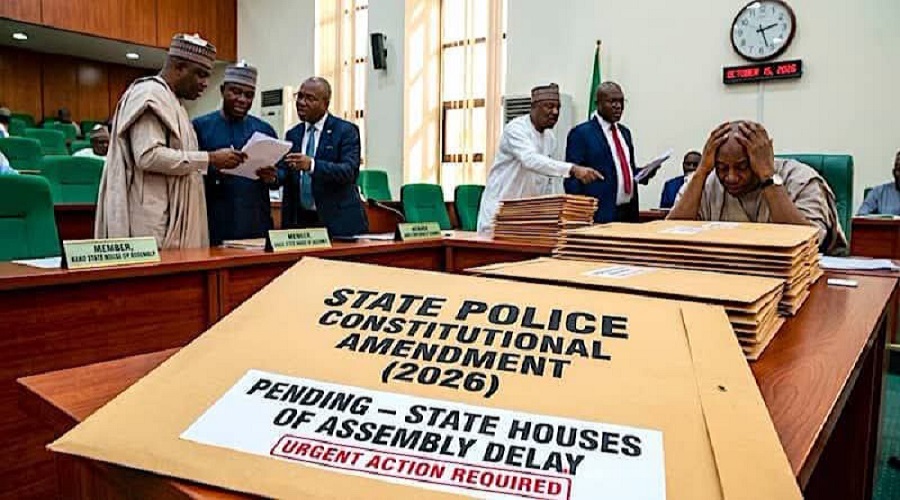
A decisive milestone in Nigeria's longstanding push toward internal security decentralisation was reached on 24 October, as the constitutional amendment bill seeking to establish state police secured the endorsement of 24 subnational parliaments. Recent passage by lawmakers in Bayelsa, Gombe, and Kaduna pushed the endorsement count across the two-thirds threshold mandated by Section 9(2) of the 1999 Constitution. While clearing this benchmark satisfies a major procedural requirement to shift policing from the exclusive legislative list to the concurrent list, the extraordinary haste of the ratification process leaves fundamental operational, fiscal, and institutional dilemmas unresolved.
A Rapid Shift Across State Parliaments
The progression of the amendment experienced a dramatic acceleration within just over a week. When the National Assembly’s designated 30-day deliberation window expired on 16 October, only five state Houses of Assembly had ratified the document. Momentum surged abruptly across 20 and 21 October, when a flurry of coordinated sessions added 12 states to the tally, bringing it to 17. The remaining clearances arrived in rapid succession over the following days, culminating in the 24th approval, with not a single state assembly voting down the proposal in its entirety.
| Milestone Date | Ratification Progress | Contextual Details |
|---|---|---|
| 16 October | 5 State Assemblies | Expiration of National Assembly's initial 30-day consideration window |
| 20–21 October | 17 State Assemblies | Intense wave of voting yielding 12 additional endorsements |
| 24 October | 24 State Assemblies | Bayelsa, Gombe, and Kaduna push approvals past the Section 9(2) threshold |
Despite this parliamentary victory, state lawmakers have endorsed an overarching constitutional premise rather than an operational apparatus. The mechanics that will govern subnational law enforcement reside within the National Policing Bill alongside 29 corresponding statutory drafts. Those supplementary texts were submitted to the Ministry of Justice during the week of 19 October and are scheduled for formal return by 30 October. Consequently, state legislatures across the federation have ratified an amendment before examining the underlying statutes that outline how these local police units will run.
Historical Precedents and the Centralised Policing Dilemma
Proponents of subnational policing frequently cite the historical evolution of law enforcement in Nigeria as well as contemporary operational strain. Prior to 1930, the territory comprised four separate regional forces. A pivotal rupture occurred during the 1929 Aba Women’s War, when regional constabulary personnel hesitated to use deadly force against demonstrating women. The colonial administration responded by deploying officers from Lagos, who shot and killed more than 50 women.
Rather than designing a security service answerable to local populations, British administrators concluded that personnel drawn from their immediate communities could not be relied upon to suppress civil dissent. In 1930, the separate units were amalgamated into a monolithic command, establishing the convention of deploying officers outside their home regions and quartering them in isolated barracks.
The legacy of that structure continues to complicate day-to-day operations. Field dynamics frequently illustrate the intelligence deficit caused by linguistic and geographic estrangement:
- In Nteje, Anambra State, a divisional police officer served for several years without learning the local Igbo language.
- In Itu, along the borderline between Akwa Ibom and Cross River, Hausa-speaking personnel deployed during a violent boundary dispute never engaged directly with the resident populations, requiring a local civilian committee to mediate their introduction.
Modern capacity deficits exacerbate these structural friction points. The Nigeria Police Force maintains roughly 371,000 personnel serving a populace exceeding 200 million people—a ratio of approximately one officer to every 600 citizens, falling short of the United Nations recommended ratio of one to 450. The deficit is sharpened by the reality that more than 100,000 officers are allocated to personal protection details for politicians and dignitaries. Security analysis firm SBM Intelligence has consistently highlighted that this extreme centralisation in Abuja hinders crisis response times, leaving state governors without operational control over the federal personnel assigned to their territories.
Three Looming Structural Dilemmas
Beyond the celebratory momentum surrounding the threshold, three critical challenges threaten the implementation of the reform:
1. Constitutional and Procedural Vulnerabilities
The validity of several state votes remains legally questionable. Under Section 9(2) of the 1999 Constitution, state parliaments are empowered only to approve or reject proposed constitutional alterations as presented. Nevertheless, Adamawa State approved 24 clauses while rejecting two, and Ekiti State conditioned its approval upon an amendment to Section 317A(5). How the National Assembly resolves these conditional votes remains to be seen, leaving the process open to potential judicial review.
2. Prohibitive Fiscal Demands
The economic burden of establishing competent subnational forces is immense. Lawmakers in Benue State raised pointed questions about how a state apparatus would be sustained when existing federal commands are chronically under-resourced. Projections show that for an average state of five million residents, recruiting, training, and outfitting 15,000 personnel according to United Nations standards requires nearly ₦50 billion, excluding investments in barracks, fleets, and armouries. Nationally, the reform committee estimates that implementation across five years will exceed ₦5 trillion.
States attempting to foot this bill risk redirecting vital allocations away from primary healthcare, basic education, and critical infrastructure. Conversely, states with restricted revenues risk producing poorly funded, underpaid forces susceptible to the extortion that has undermined the federal force.
3. The Threat of Political Capture and Blurred Command
Concerns over political weaponisation loom large. In Nigeria's current political landscape, governors exercise immense authority over state institutions, and incumbent parties routinely dominate local council polls. The bill offers an internal check by permitting a state police commissioner to appeal unlawful orders to the Nigeria Police Council, but this relies on an appointee openly defying the executive governor responsible for their office.
These anxieties are amplified by the upcoming January 2027 general elections. A sitting senator has raised public concern over whether the fast-tracked push represents genuine structural reform or an attempt to build partisan security levers ahead of the polls. Compounding this is the absence of distinct jurisdictional lines for cross-border incidents, raising the prospect of territorial friction alongside existing sub-regional outfits such as Amotekun in the South-West and Hisbah in Kano.
What state policing means for diaspora visits and investments
For Nigerians in Canada and across the diaspora, personal safety back home is a constant calculation when booking flights, sending remittances, or managing landed property. The move toward state-level policing addresses a long-standing grievance: federal officers posted to communities where they do not speak the local dialect or understand regional disputes. In theory, officers recruited within their home states could drastically improve crisis response along transit corridors and in rural hometowns where diaspora families reside.
However, the operational rollout brings immediate practical concerns. The projected national price tag exceeds ₦5 trillion over five years, with an average state needing roughly ₦50 billion just to recruit and equip personnel to standard. If home-state administrations fail to fund these units properly, travelers could face underpaid local officers who resort to extortion at state borders. Furthermore, navigating overlapping authorities—from existing regional groups like Amotekun to newly empowered state forces—could make road trips between states far more complicated.
As legislative details take shape, what specific accountability measures will your home state introduce to protect returning travelers and community investments from arbitrary enforcement?
Conclusion
Surpassing the Section 9(2) requirement marks an undeniable turning point for a constitutional reform initiative that seemed stalled just days prior. Yet, formal ratification remains only the first step. The process has transferred coercive policing authority to the state level without building robust accountability mechanisms, independent legislative ombudsmen, or community-based governance.
As federal authorities prepare to review the accompanying statutory texts on 30 October, the National Assembly and Nigeria's policy makers face the delicate task of clarifying command overlaps, establishing steady funding mechanisms, and ensuring that newly authorised state forces serve public security rather than narrow partisan interests.
Reporting based on coverage by The Will Nigeria.
Category: Politics