Lagos Beyond 2027: Gbenga Ayandare Warns Hamzat of Seyi Tinubu Power Tussle
By Gbenga Ayandare —
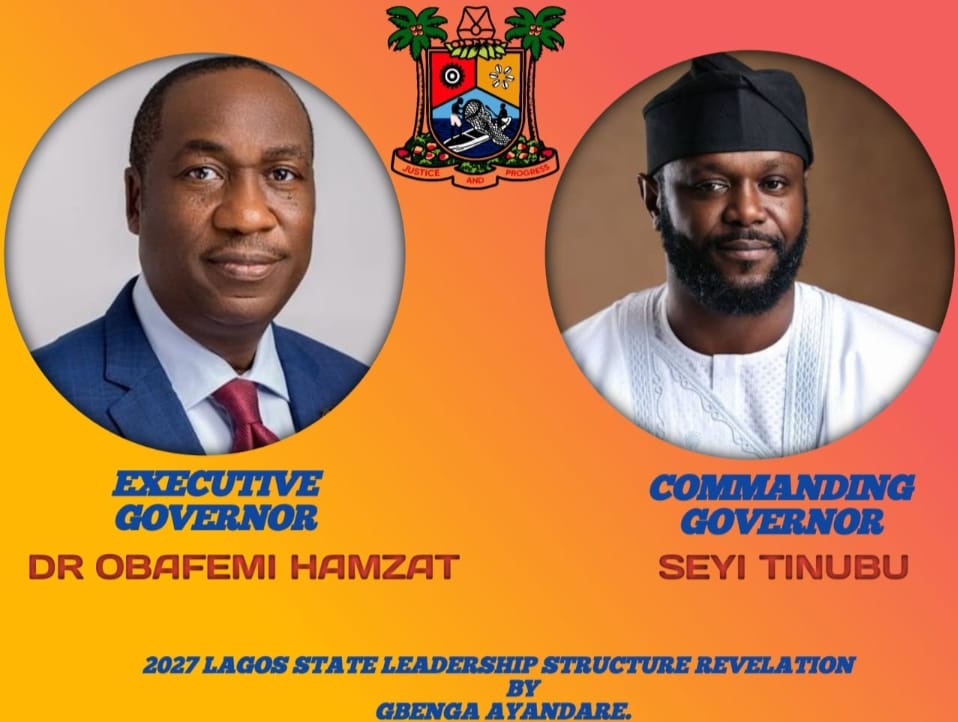
As the political calendar inches closer to Nigeria's pivotal 2027 general elections, the battle for the administrative soul of Lagos State has already begun to generate intense intrigue, whisper campaigns, and profound spiritual commentaries. Lagos, widely regarded as Nigeria's economic engine and the fifth-largest economy on the African continent if measured as an independent nation, remains the crown jewel of southwestern politics. While formal declarations and party machinery are steadily taking shape, a chilling prophetic warning from religious observer and commentator Gbenga Ayandare has captured the attention of political strategists, clerics, and grassroots chieftains across the state.
In a detailed spiritual disclosure dating back to May 2026, Ayandare sounded an urgent alarm regarding what he describes as an impending backstage collision between two central political figures: the current Deputy Governor and leading gubernatorial aspirant, Dr. Kadri Obafemi Hamzat, and the influential media executive, youth mobilizer, and son of the President, Mr. Seyi Tinubu. The vision paints a striking and unsettling picture of governance beyond May 2027, warning that constitutional authority in Lagos could soon be fractured into two competing poles: an office-holding executive governor and an unseen commanding governor.
The Revelation: Executive Governor vs. Commanding Governor
Spiritual prognostications have long walked hand-in-hand with Nigerian democratic transitions, but Ayandare's warning stands out for its specificity and sharp characterization of executive dynamics. According to Ayandare, what unfolded before him was not a dispute over party tickets, but a substantive, grinding struggle over the levers of daily administrative control and political patronage in Lagos State once the current tenure of Governor Babajide Sanwo-Olu concludes.
In Ayandare's telling, Dr. Hamzat successfully navigates the electoral cycle to assume the office of the governor, yet finds himself occupying a position stripped of true autonomy. Seyi Tinubu, meanwhile, is depicted as an overwhelming extra-constitutional force whose directives carry paramount weight across key sectors of state decision-making. Ayandare described this dynamic as an administrative trap, wherein Hamzat could end up regretting his elevation to the governorship if he fails to anticipate the pressure.
"I saw a revelation of power tussles between Dr. Obafemi Hamzat and Mr. Seyi Tinubu over the control of Lagos State. The incoming governor in the person of Obafemi Hamzat should be extremely careful in order not to regret ever being a governor because of Seyi Tinubu. I saw Seyi Tinubu as a Commanding Governor, while Obafemi Hamzat was a powerless Executive Governor due to the overbearing commanding power weighed and used by Seyi Tinubu." — Gbenga Ayandare
Ayandare added an explicit biblical admonition to the incoming executive, stating that Dr. Hamzat must become "to be wise as a serpent and gentle as a dove" if he hopes to complete his tenure without enduring total administrative neutralization or explosive institutional gridlock.
Contextualizing Hamzat: The Technocrat's Long Road to Alausa
To fully understand why Ayandare's warning has generated such intense conversation in political circles, one must examine the institutional weight of Dr. Kadri Obafemi Hamzat. A seasoned operations researcher and information technology specialist, Hamzat is far from a newcomer to the labyrinth of Lagos governance. The son of the revered late politician Oba Olatunji Hamzat, a founding patriarch of the progressive movement in Lagos, the younger Hamzat has spent more than two decades shaping state policy.
Having served as Commissioner for Science and Technology under Bola Ahmed Tinubu, and later as Commissioner for Works and Infrastructure under Babatunde Raji Fashola, Hamzat gained a reputation as an exceptionally methodical technocrat. Since 2019, he has served as the loyal, calm counterweight alongside Governor Babajide Sanwo-Olu. Endorsements from the Governance Advisory Council (GAC) and President Bola Tinubu cementing Hamzat as the consensus continuity candidate for the All Progressives Congress (APC) ahead of 2027 appeared to set him on a frictionless course to the seat of power at Alausa.
However, technocratic brilliance often collides violently with raw political power. As Ayandare's revelation hints, running an efficient ministry is fundamentally different from managing powerful non-state stakeholders who command direct channels to the federal presidency.
The Ascendant Footprint of Seyi Tinubu
On the other side of this spiritual warning is Mr. Seyi Tinubu, a corporate strategist and Chief Executive Officer of Loatsad Promomedia, who has evolved into one of the most visible and influential figures among Nigeria's younger political elite. During the 2023 presidential campaign, Seyi played a crucial grassroots mobilization role through the City Boy Movement and diverse youth outreach initiatives across the federation.
Since his father's assumption of the presidency, Seyi Tinubu's stature within southwest political corridors has magnified considerably. While he does not hold an official cabinet post, his proximity to the highest seat of national authority, combined with his extensive commercial interests in outdoor advertising, digital media, and social investments, affords him immense informal influence. Within Lagos, many party functionaries, local government chairpersons, and business contractors actively court his goodwill.
This growing influence has sparked recurring debates across political forums in Ikeja and Victoria Island regarding what role Seyi will play in post-Sanwo-Olu Lagos. Will he function as an informal kingmaker, a bridge between the presidency and the state, or an active overseer of state affairs? Ayandare's warning points directly to this ambiguity, suggesting that informal power, if unrestrained, could overshadow formal constitutional processes.
Comparing the Two Power Centers
The core tension highlighted in the revelation reflects an institutional divide between formal constitutional mandate and informal hereditary or political influence. The table below illustrates the distinct platforms and power bases that Ayandare warns could generate friction in Lagos State beyond 2027:
| Metric | Dr. Kadri Obafemi Hamzat | Mr. Seyi Tinubu |
|---|---|---|
| Constitutional Role | Consensus Gubernatorial Choice / Executive Governor | Private Citizen, Political Strategist, Commercial Leader |
| Primary Power Base | State Civil Service, GAC Technocrats, Governance Records | Youth Organizations, Media Networks, Presidential Proximity |
| Governance Experience | Over 20 years in Lagos Cabinet & Executive Council | High-level Campaign Mobilization, Commercial Enterprise |
| Institutional Channel | Official State Ministries, Departments, and Agencies (MDAs) | Informal Political Alliances, National Party Networks |
| Ayandare's Designation | "The Powerless Executive Governor" | "The Commanding Governor" |
| Strategic Imperative | Preserve constitutional autonomy without alienating the center | Maintain family political legacy while expanding youth influence |
Historical Precedents: Lagos and the Shadow of Shadow Governance
Ayandare's divine warning does not exist in an ideological vacuum; it taps directly into the deep, turbulent history of succession politics in Lagos State. Ever since 1999, the state's chief executives have had to strike an extraordinarily delicate balance between constitutional prerogatives and deference to the party's godfather structure.
- The Fashola Era (2007–2015): Babatunde Fashola frequently navigated tensions between his technocratic drive to reform urban infrastructure and the demands of party stalwarts who felt marginalized by rigid administrative procedures. While Fashola secured a second term due to undeniable public goodwill, the friction behind closed doors was widely documented.
- The Ambode Precedent (2015–2019): Former Governor Akinwunmi Ambode's breakdown of relations with the Lagos political establishment remains the ultimate cautionary tale. When Ambode attempted to alter waste management concessions and party patronage systems, the political machinery withdrew its support, leading to his defeat in the party primary.
- The Sanwo-Olu Compromise (2019–2027): Governor Sanwo-Olu avoided Ambode's fate by maintaining strict alignment with the Governance Advisory Council and prioritizing collective party interests alongside developmental milestones.
Ayandare's prophecy cautions that beyond 2027, the challenge facing Dr. Hamzat may not merely be managing traditional party elders in the GAC, but managing a younger, highly ambitious informal authority represented by Seyi Tinubu. If the boundaries of administrative discretion are not settled before inauguration, the resulting friction could derail policy implementation.
Decoding the Warning: "Wise as Serpents, Gentle as Doves"
Ayandare's prescription for Dr. Hamzat—to adopt the biblical wisdom of serpents while retaining the gentle posture of doves—serves as a masterclass in survival politics. In the volatile world of statehouse politics, confrontation is often suicidal, but total capitulation renders an elected leader completely ineffective.
Political analysts who study southwest regional dynamics note that an incoming governor in Hamzat's position must execute a multi-layered diplomatic strategy. First, he must uphold absolute loyalty to President Bola Tinubu while insulating daily state operations from external meddling. Second, he must cultivate independent credibility with the Lagos populace through visible social welfare, urban renewal, and infrastructure delivery. Third, he must build open, transparent channels with Seyi Tinubu and youth stakeholders, turning potential friction points into collaborative partnerships rather than turf wars.
Should Hamzat fail to strike this delicate equilibrium, Ayandare's prediction of deep personal regret could become reality. A state governor who cannot assign portfolios, award contracts, or direct his commissioners without prior clearance from external power figures inevitably suffers a loss of moral and constitutional authority.
Conclusion
Gbenga Ayandare's spiritual warning serves as a profound analytical mirror held up to the future of Lagos governance beyond 2027. While formal politics often projects unity, consensus endorsements, and seamless continuity, the human and structural realities beneath the surface are fraught with competing ambitions. Dr. Kadri Obafemi Hamzat stands on the threshold of fulfilling a lifelong ambition to lead Nigeria's most vibrant state. Whether his tenure will be marked by purposeful executive leadership or paralyzed by the shadow of a commanding non-state authority will depend entirely on how astutely he navigates the complex web of family, party, and constitutional expectations. Ayandare's prophecy has laid down the marker; the unfolding drama in Alausa will determine the outcome.
Disclaimer: This article reports on spiritual revelations and political commentary circulating ahead of the 2027 elections. Political developments reflect opinions and information available at the time of writing and may evolve significantly.
Category: Politics