IBEJU-LEKKI: BILLIONS IN INVESTMENT, 15+ YEARS IN DARKNESS - WHO IS ACCOUNTABLE FOR THE ABSENCE OF ELECTRICITY?
By Tunde Ibrahim Amusa —
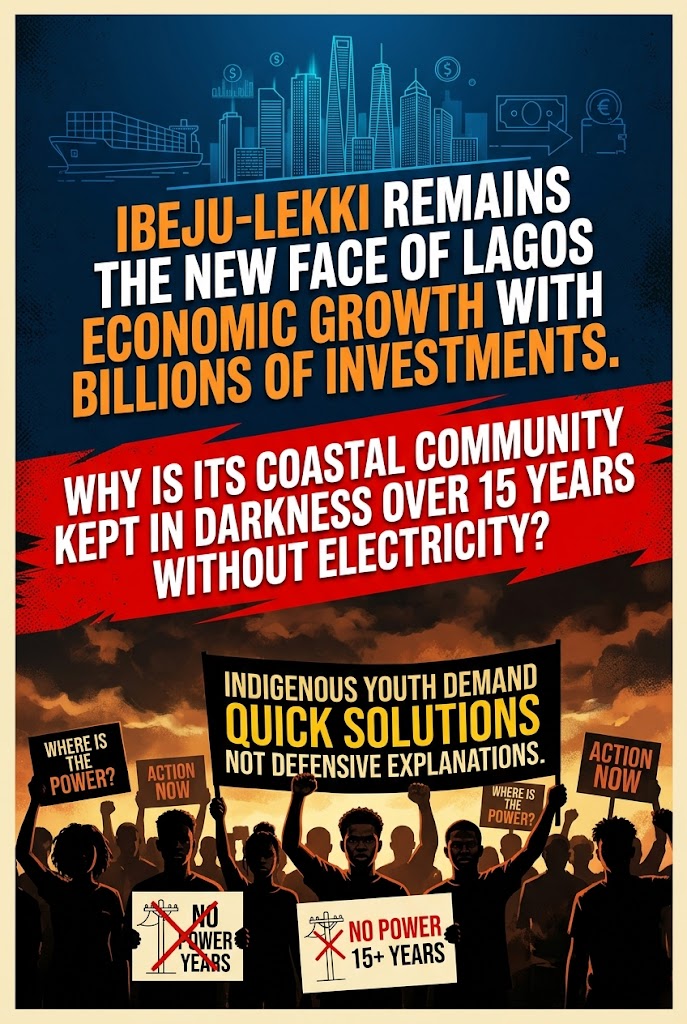
I write this not as an outsider looking into Ibeju-Lekki, but as an indigenous youth from this land and part of a generation living through the transformation of our communities.
Ibeju-Lekki is changing rapidly. What was once largely known for its coastal communities, fishing, farming and traditional settlements is now emerging as one of the most important investment and industrial corridors in Lagos State.
The Lekki Deep Sea Port, Lagos Free Zone, Lekki Free Zone, Dangote Refinery and Petrochemical complex, Dangote Fertilizer project, manufacturing companies, logistics businesses, industrial facilities and other developments have placed Ibeju-Lekki firmly on the map of major investment destinations.
The Lagos Free Zone itself states that it has attracted more than US$2.7 billion in committed foreign direct investment projects and hosts global companies including BASF, Kellogg's, Colgate, Arla and Dufil, alongside its integration with Lekki Port. (Lagos Free Zone)
The Nigerian Ports Authority states that the Lekki Deep Sea Port project has an approved total project cost of about US$1.34 billion, with the Federal Government, Lagos State Government and private investors participating in the project structure. (Nigerian Ports Authority)
The Dangote Refinery and Petrochemicals complex is also located within the Lekki Free Trade Zone in Ibeju-Lekki and represents one of the most significant industrial developments in the country. (Dangote Refinery)
We therefore have every reason to be proud that our home has become an important economic destination.
But there is a painful contradiction that we cannot continue to ignore.
BILLIONS AROUND US, BUT DARKNESS IN OUR COMMUNITIES
While massive investments continue to transform the landscape around us, some of our coastal communities have endured prolonged electricity problems.
This is not merely a claim made today.
In July 2023, The PUNCH reported that residents of at least 25 communities in Ibeju-Lekki were experiencing a blackout that residents said had lasted about 13 years, with some communities reportedly without electricity since 2010. The report included communities such as Eleko Inu, Museyo, Lootu, Iberekodo, Badore, Magbon Alade, Magbon Ilado, Orimedu, Orofu, Akodo, Imobido, Idaso and Elemoro. (Punch Newspapers)
Earlier, in 2021, The PUNCH also reported that Magbon Alade and seven surrounding communities had complained of being without electricity for six years. (Punch Newspapers)
These reports demonstrate that the electricity problem is not a new political argument invented yesterday.
It has been a persistent community issue for years.
And today, from the perspective of those of us who live here, the question has become even more urgent:
HOW CAN AN AREA BECOMING ONE OF THE NEW ECONOMIC FACES OF LAGOS CONTINUE TO HAVE COASTAL COMMUNITIES LIVING WITH PROLONGED ELECTRICITY CHALLENGES?
WE ARE NOT AGAINST INVESTMENT
Let me make one thing clear.
We are not against investment.
We are not against the refinery.
We are not against the seaport.
We are not against the free zones.
We are not against factories, manufacturing companies, logistics companies or international investors.
On the contrary, we welcome development.
We understand that investment can create employment, improve infrastructure, generate government revenue, develop skills, stimulate businesses and strengthen the Nigerian economy.
Our question is different.
Where are the benefits reaching the indigenous communities?
If billions of dollars can be invested in industrial and maritime infrastructure in our area, why should basic electricity remain such a prolonged challenge for communities around the same economic corridor?
We are asking for inclusive development.
THE STORY IS BIGGER THAN ELECTRICITY
This issue should not be reduced to the statement:
“Ibeju-Lekki has no light.”
The story is much bigger.
Electricity is only one part of the larger conversation about how development is affecting indigenous communities.
We must also talk about:
· Employment opportunities for indigenous youths
· Skills development and technical training
· Participation of indigenous businesses in industrial supply chains
· Roads and transportation
· Water supply
· Healthcare
· Education
· Security
· Environmental concerns
· Fishing and farming livelihoods
· Acquisition of ancestral lands
· Compensation and resettlement where applicable
· Community development agreements
· Access to contracts and economic opportunities
· The long-term social impact of rapid industrialisation
These are legitimate development questions.
OUR ANCESTRAL LAND AND THE QUESTION OF DISPLACEMENT
For generations, our people have lived, farmed, fished and conducted businesses across these coastal communities.
The transformation of Ibeju-Lekki has brought major land acquisition and development.
Academic research examining the Lekki Free Trade Zone found that nine coastal communities were affected during the development of the first phase of the zone, including Tiye, Ilege, Imagbon Segun, Imobido, Itoke, Okunraiye, Idotun, Ilekuru and Idasho. The research examined the effects of land acquisition on livelihoods that included farming, fishing, home-based enterprises and petty trading. (Sage Journals)
This history means that the conversation about development cannot focus only on investors and infrastructure.
The people who were already here must also be part of the conversation.
Whenever ancestral land is acquired for development, important questions arise:
Were affected families properly informed?
Were compensation processes transparent?
Were affected livelihoods adequately considered?
What commitments were made to host communities?
Which commitments have been fulfilled?
Which commitments remain outstanding?
These questions should not automatically be interpreted as opposition to development.
They are questions about fairness, transparency and responsible development.
THE REFINERY AND THE SEAPORT: WHAT DO THEY MEAN FOR US?
The Dangote Refinery is one of the most prominent industrial projects associated with the Ibeju-Lekki corridor.
The Lekki Deep Sea Port is another major transformation.
The Nigerian Ports Authority describes Lekki Port as a major deep-sea port developed through a public-private partnership, with a 45-year concession structure and an approved project cost of approximately US$1.34 billion. (Nigerian Ports Authority)
The Lagos Free Zone describes itself as an 860-hectare port-based industrial zone with more than US$2.7 billion in committed FDI projects. It identifies companies including BASF, Kellogg's, Colgate, Arla and Dufil among its tenants or clients. (Lagos Free Zone)
Lagos Free Zone has also publicly stated that it has created thousands of direct jobs and that a portion of those jobs are held by people from host communities. That information is important because it shows that there are already attempts to connect investment with local employment. At the same time, it makes it reasonable for indigenous youths to ask for transparent information about the scale, quality and accessibility of these opportunities. (Lagos Free Zone)
Our demand is therefore not that companies should employ people simply because they are indigenous.
Our demand is that qualified indigenous youths should have fair access to information, training, recruitment opportunities and business participation.
WE WANT TO BE PART OF THE ECONOMIC TRANSFORMATION
We do not want to watch our communities transform from the roadside.
We want to participate.
We want our youths to acquire the technical skills required by these industries.
We want indigenous contractors and businesses to understand how to access legitimate opportunities within the growing industrial ecosystem.
We want young people from Ibeju-Lekki to become engineers, technicians, logistics professionals, maritime workers, safety officers, administrators, entrepreneurs and skilled tradespeople.
We want our communities to produce the workforce that will sustain the industries developing around us.
We want development to create opportunities for us, not simply happen around us.
WHAT ABOUT ELECTRICITY?
This remains the most immediate question.
In 2023, EKEDC acknowledged the electricity challenges affecting the Lekki-Ibeju-Lekki axis and told The PUNCH that the area required significant investment in injection substations. The company said discussions involving EKEDC, the Transmission Company of Nigeria and the Federal Government were underway and that construction of injection substations had been approved. (Punch Newspapers)
Lagos State has also previously announced electricity-related interventions covering communities including Ajah, Eleko, Magbon and Ibeju-Lekki under its Light Up Lagos Community Electrification Programme. (Punch Newspapers)
These are important developments.
But for residents who continue to experience inadequate electricity, the central question is no longer simply:
“What is the plan?”
The question is:
WHEN WILL THE PLAN PRODUCE A SUSTAINABLE RESULT ON THE GROUND?
We need timelines.
We need responsible institutions.
We need measurable milestones.
We need communication with the communities.
And ultimately, we need electricity.
THE PRESS MUST GO BEYOND THE BLACKOUT STORY
As an indigenous person from this area, I believe the media should not report this issue only when residents complain about darkness.
The story deserves a much deeper investigation.
The press should ask:
How much investment has entered Ibeju-Lekki?
What companies are operating here?
How many indigenous people are employed?
How many indigenous businesses are participating in the supply chain?
What training programmes are available to indigenous youths?
How many communities have been affected by land acquisition?
What compensation arrangements exist?
What community development agreements exist?
What infrastructure commitments were made?
What has been delivered?
What remains outstanding?
What is the electricity situation in each affected coastal community?
Which government agency is responsible for each part of the electricity solution?
What is the timeline for resolving the problem?
That is the story we need.
The darkness is only the starting point.
The larger story is about who benefits when an indigenous community becomes a major economic zone.
A QUESTION FOR THE LOCAL GOVERNMENT
To the Ibeju-Lekki Local Government:
What is the council's current position on the prolonged electricity challenges affecting our communities?
What concrete steps is the council taking with the electricity distribution company, Lagos State Government and Federal Government?
What commitments have been made to the affected communities?
And when should residents expect measurable improvement?
A QUESTION FOR THE LAGOS STATE GOVERNMENT
To the Lagos State Government:
Ibeju-Lekki has become one of the state's most important investment corridors.
The state has been a participant in major developments and has also announced electricity interventions covering parts of the area.
So we respectfully ask:
What is the state's comprehensive plan to ensure that the indigenous coastal communities hosting and surrounding these developments are not left behind?
We need more than investment figures.
We need development indicators that ordinary residents can feel.
A QUESTION FOR THE FEDERAL GOVERNMENT
To the Federal Government and relevant agencies:
The Federal Government has strategic interests in the refinery corridor, the free zones, maritime infrastructure, electricity transmission and the Lekki Deep Sea Port.
Therefore:
What is the Federal Government's long-term infrastructure plan for the communities surrounding this strategic economic corridor?
How will electricity, transportation, employment, environmental management and community inclusion be coordinated?
If Ibeju-Lekki is strategically important to Nigeria's economy, then the communities around these investments should also be strategically important.
A MESSAGE TO INVESTORS
To the investors coming into Ibeju-Lekki:
We welcome you.
We understand the economic value of your investments.
We know that businesses need a stable environment in which to operate.
We also believe that strong relationships with host communities are essential for sustainable development.
We are therefore asking investors to look beyond the boundaries of their factories and facilities.
Look at the communities around you.
Look at the youths.
Look at the families.
Look at the small businesses.
Look at the fishermen.
Look at the farmers.
Look at the people whose ancestral communities surround these projects.
Where possible, create pathways through which qualified local people can participate meaningfully in the economic opportunities your investments create.
OUR MESSAGE AS INDIGENOUS YOUTHS
We are not asking for charity.
We are asking for inclusion.
We are not asking investors to abandon their businesses.
We are asking for responsible relationships with host communities.
We are not rejecting development.
We are demanding development that reaches the people.
We want electricity.
We want employment opportunities.
We want technical and vocational training.
We want opportunities for indigenous businesses.
We want transparent engagement on ancestral land and affected properties.
We want roads, water, healthcare and other basic infrastructure.
We want our youths to be equipped to compete for opportunities created by the industries around us.
And where commitments have been made to communities, we want those commitments tracked, measured and fulfilled.
WE ARE PART OF THIS STORY
Ibeju-Lekki is no longer an ordinary development corridor.
It is becoming a major economic centre.
The refinery is here.
The port is here.
The free zones are here.
Manufacturing and logistics companies are here.
Global investment is here.
The economic transformation is happening.
And we are here too.
We are the indigenous people of these communities.
We are the youths growing up here.
We are the families whose histories are connected to this land.
We are the people living alongside the infrastructure that is transforming this part of Lagos.
Therefore, we believe that we deserve to experience the benefits of the transformation taking place around us.
THE QUESTION WE ARE ASKING
This is not a call to stop development.
It is a call to make development more inclusive.
It is a call for government to coordinate.
It is a call for investors to engage.
It is a call for the media to investigate beyond the headlines.
It is a call for community leaders and youths to remain constructive but persistent.
And it is a call for measurable action.
After years of prolonged electricity challenges in parts of Ibeju-Lekki, while billions of dollars of investment have flowed into the wider economic corridor, we believe the people deserve clear answers.
WHO IS ACCOUNTABLE FOR THE ABSENCE OF ELECTRICITY, AND WHEN WILL A PERMANENT SOLUTION REACH THE AFFECTED COASTAL COMMUNITIES?
We are not asking for another explanation without an endpoint.
We are asking for a plan, a timeline and a result.
We welcome investment.
We welcome development.
We welcome the economic transformation of Ibeju-Lekki.
But we want to be part of that transformation.
Because Ibeju-Lekki is not only a destination for billions in investment.
It is our home.
And our home deserves light.
We want electricity.
We want opportunity.
We want inclusion.
We want development.
And we want action.
Category: News