Sending Christmas Gifts Home: Shipping Costs and Customs Rules to Nigeria
By Matthew Ayandare —
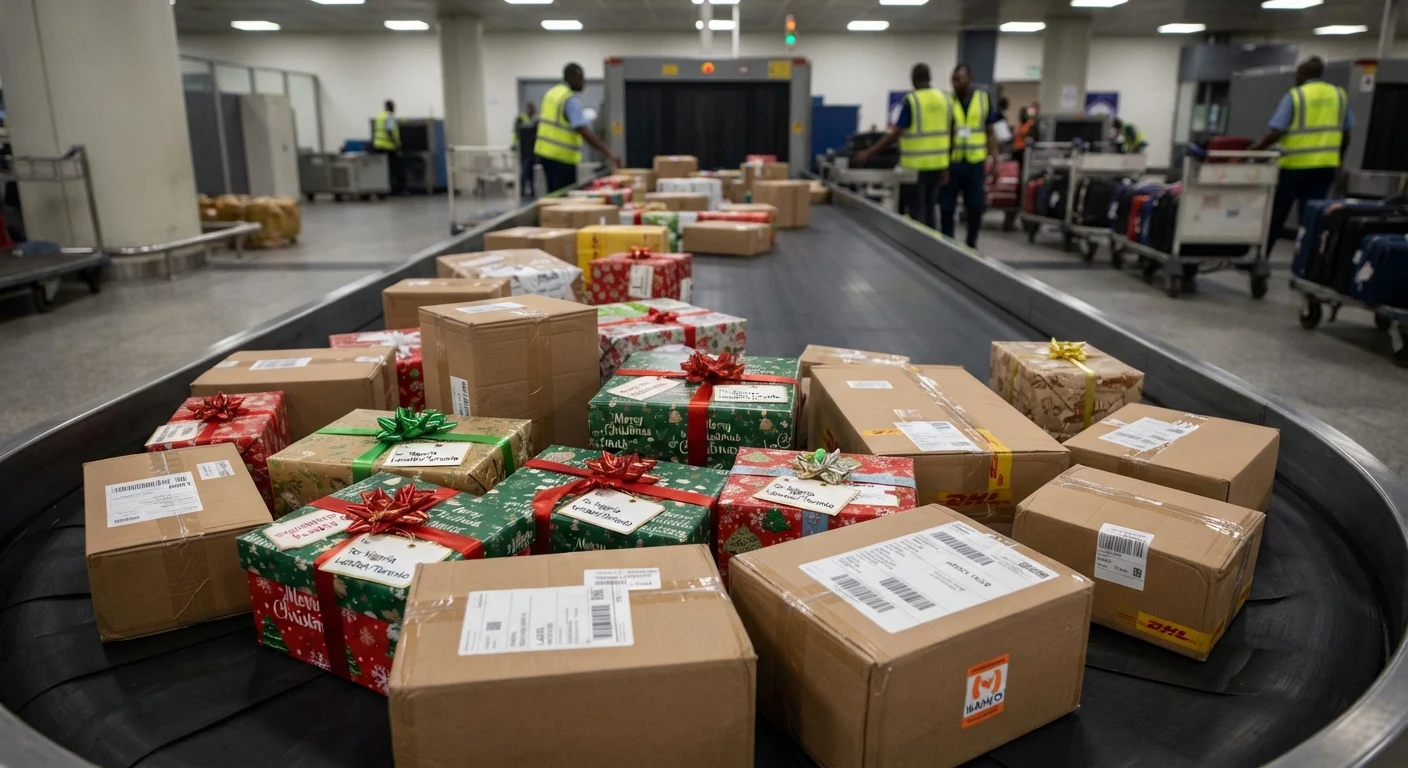
A boxed consignment of perfumes, smart watches and designer clothes sent from London, Toronto or Atlanta to relatives in Lagos can bring holiday joy, but an unexpected clearance demand can sour the celebration. Senders abroad regularly discover that their recipient in Nigeria must pay tens of thousands of naira before customs officials release the parcel. In other cases, parcels are impounded because the contents breach national import bans that senders did not know existed.
Sending presents across borders involves freight tariffs, local taxes, weight formulas and administrative fees. Understanding how courier firms calculate freight rates and how the Nigeria Customs Service assesses duties prevents unpleasant financial surprises in December.
Courier Services Versus Freight Forwarders: Choosing How to Send
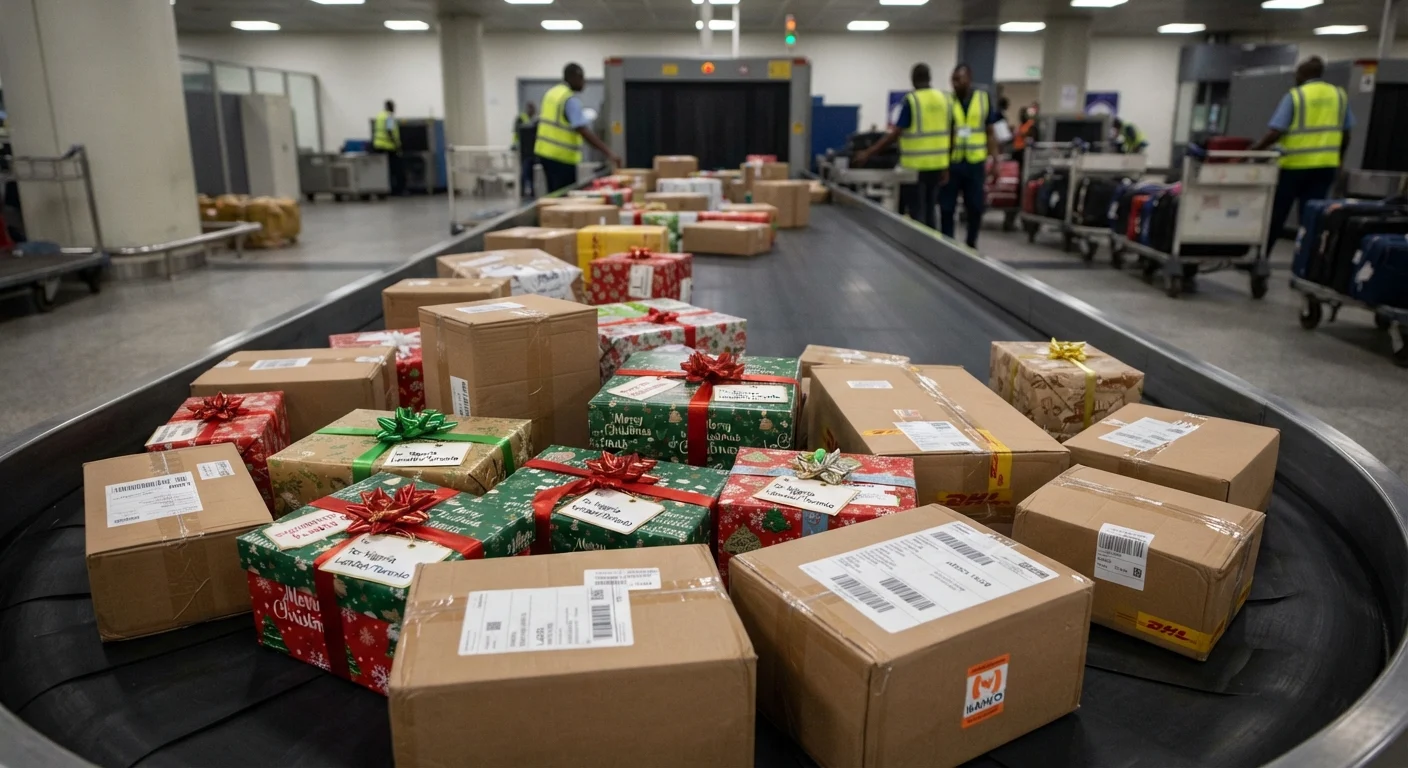
Senders generally select from three channels: premium express couriers, national postal networks, and diaspora-focused air freight forwarders. Each model uses different pricing mechanisms and clearance procedures.
Express couriers, including DHL Express, FedEx, and UPS, offer the fastest transit. A parcel dispatched from the UK, the US, or Canada reaches major Nigerian cities within three to five business days. These companies operate their own customs clearance divisions at Murtala Muhammed International Airport in Ikeja and Nnamdi Azikiwe International Airport in Abuja. However, premium delivery carries high prices. A five-kilogram package sent through an express carrier typically costs between £75 and £115 from the UK, $110 and $180 from the US, or CAD 140 and CAD 210 from Canada.
National postal agencies, such as Royal Mail in the UK, the United States Postal Service (USPS), and Canada Post, offer lower base rates. These services hand packages over to NIPOST, the Nigerian Postal Service, once the aircraft lands. While standard post costs roughly half the price of express couriers, transit times stretch between two and five weeks during December. Tracking visibility drops once goods enter local postal sorting offices, and recipients must collect parcels in person from district depots.
Specialised air cargo agents offer a popular middle path for heavy shipments. Companies based in diaspora hubs like London, Houston, and Toronto consolidate cargo on scheduled weekly flights to Lagos. Most cargo forwarders charge a flat rate per kilogram plus a fixed documentation fee. UK forwarders charge between £5.00 and £7.50 per kilogram with a handling fee of £15 to £20. US forwarders charge between $5.00 and $8.50 per pound, while Canadian agents charge CAD 12 to CAD 15 per kilogram. These operators usually bundle basic clearance into their per-kilogram price, sparing the receiver direct clearance contact at the airport.
All carriers calculate shipping costs on either physical weight or volumetric weight, whichever is larger. Volumetric weight measures the space a parcel occupies using the formula: length multiplied by width multiplied by height in centimetres, divided by 5,000. Senders posting light, bulky items like puffer coats or decorative gift baskets often pay double what the bathroom scale suggested.
| Shipping Option | Average Transit Time | Estimated 5 kg Freight Cost | Customs Clearance Process | Best Suited For |
|---|---|---|---|---|
| Express Courier (DHL, FedEx, UPS) | 3 to 5 business days | £85 / $130 / CAD 160 | Processed directly; duty billed on arrival | High-value gifts, legal papers, urgent items |
| Specialised Air Cargo Forwarder | 7 to 12 business days | £45 / $65 / CAD 85 | Clearance included in freight fees | Bulky gift boxes, clothes, multiple parcels |
| National Postal Service (to NIPOST) | 15 to 30 business days | £30 / $45 / CAD 55 | Evaluated at NIPOST parcel exchange | Low-value presents without strict deadlines |
What the Nigeria Customs Service Charges
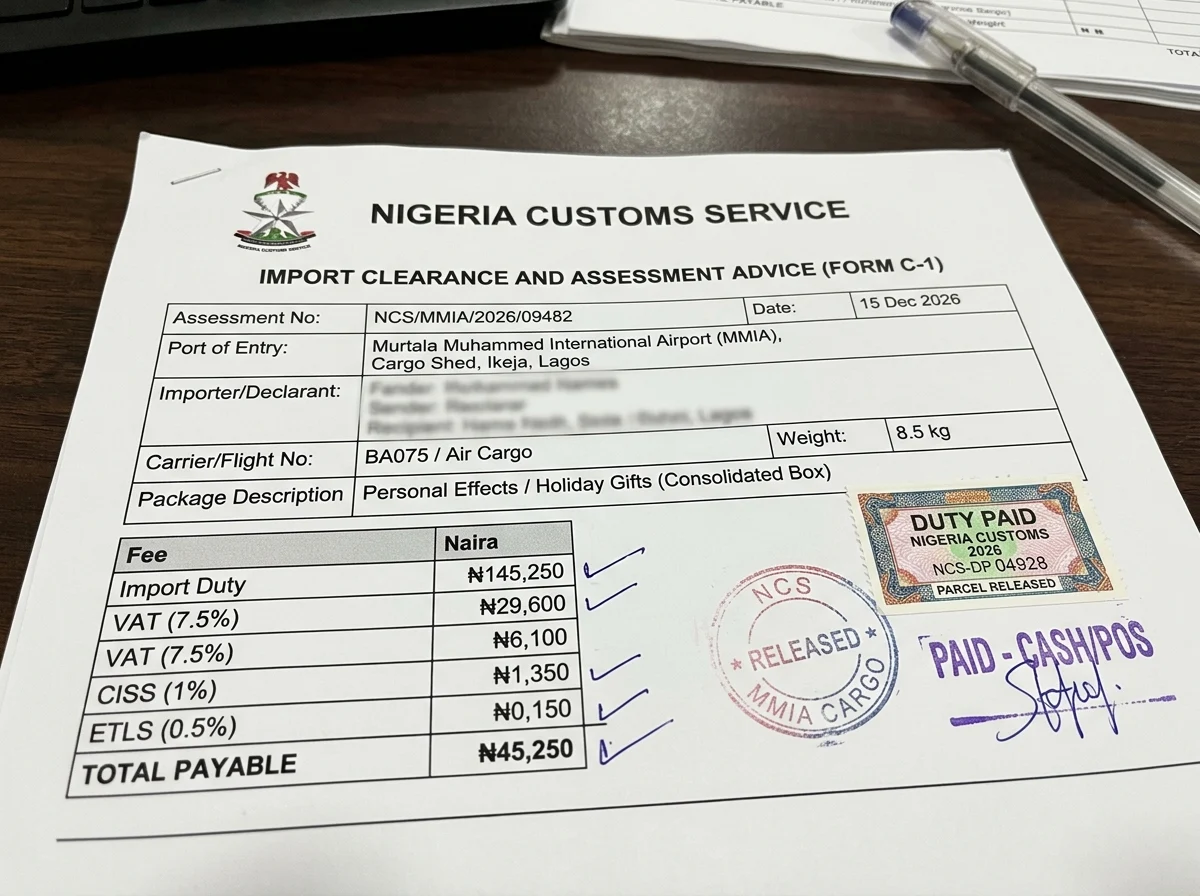
The Nigeria Customs Service (NCS) treats parcels entering the country as commercial imports unless they qualify under specific duty-free rules. Nigeria has no broad de minimis threshold comparable to the US $800 exemption. While small non-commercial items of nominal value occasionally pass through postal depots without assessment, parcels moving via commercial couriers undergo formal valuation.
Customs officers calculate taxes based on the Cost, Insurance, and Freight (CIF) value of the shipment. This means the duty applies to the purchase value of the gift added to the shipping charge and any insurance fee paid. Tariffs follow the ECOWAS Common External Tariff schedule, with rates determined by item classification:
- Smartphones, laptops, and tablets: 5 per cent to 10 per cent import duty.
- Brand new apparel and shoes: 20 per cent import duty.
- Cosmetics, toiletries, and fragrances: 20 per cent import duty.
- Watches and costume jewellery: 20 per cent import duty.
- Packaged sweets and non-restricted chocolates: 20 per cent import duty.
Duty represents only the first line of the customs calculation. Every shipment attracts supplementary charges:
- Value Added Tax (VAT): A standard rate of 7.5 per cent, calculated on the total CIF value plus the import duty.
- ECOWAS Trade Liberalization Scheme (ETLS): A 0.5 per cent levy applied to all goods imported from non-ECOWAS countries.
- Comprehensive Import Supervision Scheme (CISS): A 1 per cent administrative fee assessed on imports.
Express couriers also charge administrative disbursement fees, often between ₦15,000 and ₦35,000, for clearing the consignment through customs and prepaying the state on the client's behalf. If the sender selects Delivered Duty Unpaid (DDU), the courier contacts the recipient in Nigeria by SMS or phone call, demanding settlement before delivery vans leave the depot. Senders who want the gift to remain entirely free for the recipient should book Delivered Duty Paid (DDP) at checkout, accepting all duty liabilities onto their personal debit card.
Items Prohibited on the Nigerian Customs Import List
Nigeria enforces an absolute import prohibition list designed to protect domestic manufacturers and maintain public health. Present-givers often purchase items abroad that customs officers must seize immediately upon inspection at airport border posts.
Second-hand clothing, known locally as okrika, is banned under federal import regulations. Senders packing lightly used designer coats, worn trainers, or pre-owned baby garments risk total consignment confiscation. All clothing items sent to Nigeria must be new, with tags attached.
Certain food items are excluded from entry. Prohibited goods include beef, pork, bird eggs, refined vegetable oils, and spaghetti or noodles. Senders must also avoid retail packs of fruit juice and mineral waters. While canned chocolate spreads, dry biscuits, and factory-sealed confectionery pass clearance, home-cooked food items, fresh produce, and unsealed provisions face instant confiscation.
Pharmaceuticals represent another common point of friction. The National Agency for Food and Drug Administration and Control (NAFDAC) restricts the private importation of common over-the-counter drugs. Senders must not pack retail packs of paracetamol tablets, multivitamin syrups, cotrimoxazole, or aspirin into gift parcels. Senders can ship prescription medications only when backed by registered import documentation and medical licences.
Carriers enforce airline safety regulations alongside customs law. Perfumes with high alcohol content, aerosol deodorants, nail varnishes, and loose power banks are classed as dangerous goods under International Air Transport Association (IATA) rules. Most air couriers will either reject boxes containing these liquids or charge hazardous-materials surcharges running from £40 to £70 ($50 to $90).
Christmas Shipping Deadlines and Cargo Cut-Off Dates
The cargo sheds at Lagos airport experience severe congestion starting in late November. Processing times that take forty-eight hours in August can take seven to ten days in December. To ensure gifts arrive before 25 December, senders must follow strict seasonal cut-off schedules.
Sea freight containers require dispatch long before holiday planning begins. Sea cargo takes between five and eight weeks from European and North American ports to Tin Can Island or Onne Port; sea shipments dispatched after 20 October rarely arrive before Boxing Day.
Consolidated air freight operators publish their holiday deadlines between 28 November and 5 December. Packages handed to agents past these dates travel on supplementary charter flights, which face higher airport holding fees and erratic flight allocations.
National postal systems require dispatch by 25 November for untracked items and 2 December for tracked parcels. With NIPOST handling massive Christmas mail volumes, postal delays inside Nigeria run longer than international transit times.
Premium express carriers offer the latest dispatch options. Major carriers maintain a standard cut-off between 15 December and 18 December for arrival in Lagos and Abuja. Deliveries to outlying states require an additional two to four business days.
Packaging Traps That Inflate Bills
Senders often make five operational miscalculations that lead to delays or increased charges:
- Removing price tags while leaving commercial invoices blank: Senders often clip price tags to make gifts presentable, then declare an arbitrary low value on the shipping manifest. Customs valuation officers who inspect the box will look up current retail prices and apply duties to the higher market value, adding administrative penalties for inaccurate declaration.
- Boxing light items in oversized cartons: Packing toys or clothes inside loose boxes stuffed with bubble wrap triggers the volumetric weight trap. Senders pay for dead air rather than actual mass.
- Shipping uncertified batteries: Toys containing rechargeable lithium-ion cells require built-in installation. Packing spare lithium cells loose in the box causes airlines to pull the parcel from the flight for security returns.
- Relying on vague delivery addresses: Nigerian urban postal numbering varies widely. Parcels addressed without specific local landmarks, local government areas, and working Nigerian mobile numbers end up stranded at sorting hubs. Couriers will not attempt delivery without calling the recipient first.
- Splitting consignments across multiple bookings: Booking three separate two-kilogram boxes across consecutive days incurs three separate administrative clearance fees. Consolidating items into a single durable container saves paperwork costs.
Conclusion
Shipping gifts to family in Nigeria requires balancing delivery speed with clearance formalities. While express carriers deliver packages within days, the duty, tax, and handling charges can equal the initial cost of the items. Diaspora air cargo forwarders offer reliable all-inclusive alternatives for larger family parcels, provided goods are dispatched during early December. Checking the prohibited goods register, calculating volumetric dimensions in advance, and paying import duties at checkout keep holiday gifts moving smoothly through customs to their destination.
Sources
- Nigeria Customs Service
- International Trade Administration: Nigeria Country Commercial Guide
- Nigerian Postal Service (NIPOST)
- National Agency for Food and Drug Administration and Control (NAFDAC)
Disclaimer: This article provides general shipping and customs guidance based on published tariff schedules and carrier data at the time of writing. Import duties and carrier policies change regularly, so check with the Nigeria Customs Service or a licensed shipping agent before dispatching goods.
Category: Fin-Advisor