Paused Ontario Private College OSAP Funding to Resume by New Year, Minister Pledges
By CelebUD Newsroom —
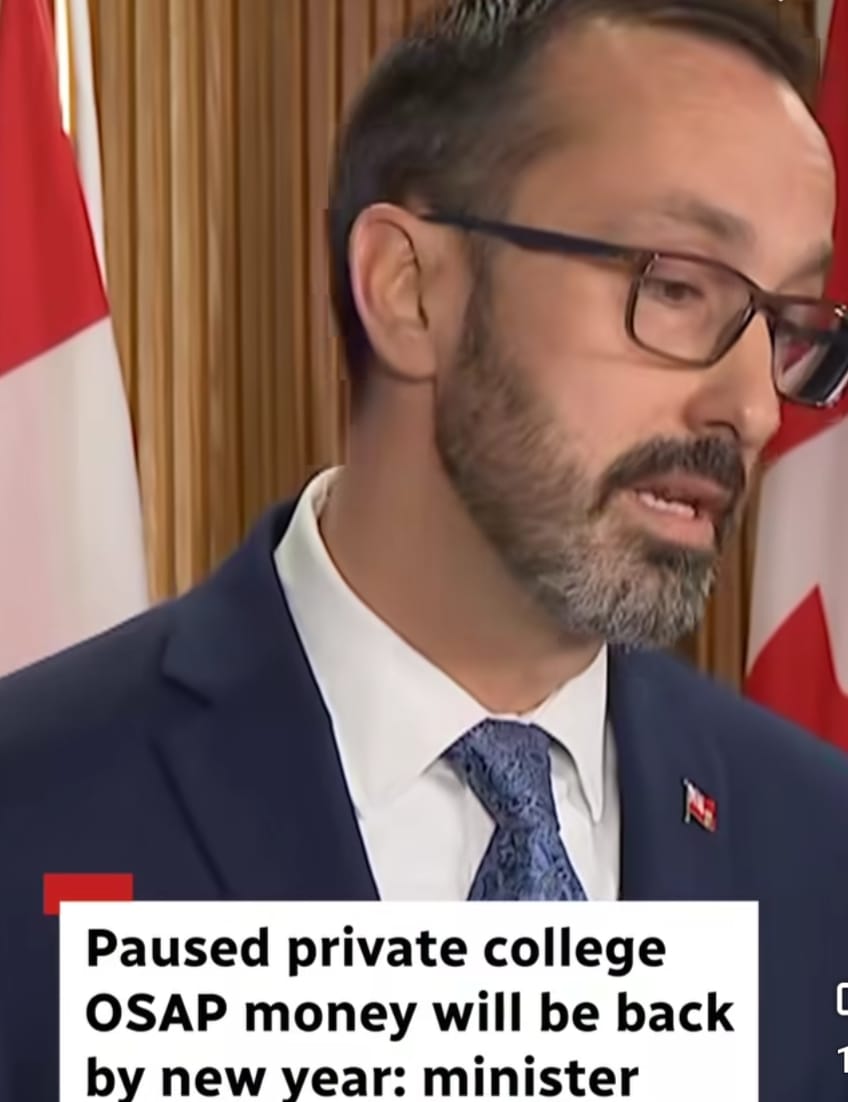
Ontario students attending private career colleges will see provincial financial assistance restored by early next year, following an abrupt blanket freeze that has left thousands of learners without tuition or living support.
Nolan Quinn, Ontario's Minister of Colleges, Universities, Research Excellence and Security, announced that provincial funding through the Ontario Student Assistance Program (OSAP)—the primary student loan and grant system in Canada's most populous province—will flow again to eligible institutions once a strict oversight package passes the provincial legislature. The Progressive Conservative government introduced the sweeping legislative measures after an audit by accounting firm KPMG and ongoing investigations uncovered widespread abuse, suspected fraud, and exponential enrolment increases across parts of the private vocational sector.
While the freeze halted disbursements to bad actors, it simultaneously blocked funding for legitimate vocational students, forcing some trainees into food banks and putting long-standing training academies at risk of immediate insolvency. Quinn confirmed that the province aims to end the financial impasse before the start of the winter term, provided Queen's Park approves tighter rules governing student verification, physical attendance, and enrolment caps.
The Freeze and the Explosive Rise in Claims
The ministry took the unprecedented step of pausing all OSAP funding to private career colleges across Ontario in early October. That ban applied to both newly submitted applications for the 2025–26 and 2026–27 academic cycles and pending payments on files approved earlier in the year.
Provincial data revealed that government spending on private career college grants had grown dramatically over a very short period. Between the 2023–24 and 2024–25 financial years, provincial OSAP grants paid out to students at private vocational institutions nearly doubled, reaching roughly 1 billion Canadian dollars ($1 billion CAD). Much of that money concentrated inside a tiny fraction of institutions. In 2024–25, just seven private colleges accounted for 385 million Canadian dollars ($385 million CAD) in provincial grants—matching the grant total distributed across all 24 of Ontario's publicly funded community colleges combined.
A freedom-of-information disclosure obtained by Canadian media illustrated the speed of that expansion. At the Canadian College of Business, Science and Technology, an institution with four campuses across the Greater Toronto Area, OSAP-assisted enrolment expanded from 562 students in 2021–22 to 17,157 students in 2024–25—a jump of almost 3,000 per cent. A single campus in Scarborough saw its OSAP recipient roll skyrocket by 5,955 per cent over the same three-year period, climbing from 74 students to 4,481, with provincial grants at that one site alone surging to 39 million Canadian dollars ($39 million CAD).
Provincial investigators also reported evidence suggesting systemic operational problems. Officials inspecting several institutions alleged that third-party operators were logging in to complete coursework on behalf of individuals, with complete courses being finished in single days. In several instances, individuals listed as full-time students could not name the programme or the institution in which they were ostensibly enrolled. Cases involving suspected criminal activity have been referred to the Ontario Provincial Police.
Proposed Rules: Ending Online OSAP and Capping Growth
The draft legislation tabled by the government establishes structural boundaries intended to prevent institutions from treating student loans as rapid revenue engines. Rather than allowing unconstrained class sizes, the province will introduce strict enrolment caps on OSAP-funded seats, bringing Ontario into line with regulatory models already operating in provinces such as Alberta.
One of the most consequential changes ends OSAP eligibility for vocational programmes delivered predominantly online. Data gathered during ministry audits showed that rapid enrolment growth was heavily driven by remote learning. At the Canadian College of Business, Science and Technology, more than 97 per cent of students receiving OSAP aid during 2024–25 were enrolled in virtual classes, compared to just 6 per cent three years earlier. Under the new package, private colleges must operate from permanent physical campuses and conduct in-person instruction to qualify for provincial student assistance.
The draft statute also targets the ties between vocational colleges and external recruitment businesses. Private colleges will be barred from permitting third-party student recruiters and immigration consultancies to operate on school grounds. Provincial regulators will gain broad statutory powers to carry out unannounced audits, inspect attendance databases, and suspend institution credentials when irregularities appear.
| Policy Area | Previous OSAP Framework | Proposed Government Legislation |
|---|---|---|
| Enrolment Limits | Open-ended private college recruitment without provincial caps | Annual caps imposed on the number of OSAP-funded seats per institution |
| Online Course Delivery | Full OSAP eligibility for virtual and hybrid programmes | Exclusion of predominantly online programmes from OSAP support |
| Campus Requirements | Flexible space standards; heavy reliance on remote teaching | Mandatory registered physical locations with in-person attendance |
| Recruiter Arrangements | Third-party agencies and visa advisers permitted on site | Strict prohibition of third-party immigration recruiters on campuses |
| Attendance Tracking | Internal self-reporting by individual colleges | Standardised electronic identity and attendance verification checks |
Hardship for Trainees and Compliant Schools
While the government targets systemic misconduct, the timing and universality of the funding halt have triggered acute distress across the sector. Tens of thousands of legitimate students rely on OSAP disbursements not merely for tuition remittances, but to cover rent, groceries, public transport, and nursery costs.
Because the October pause suspended second instalments on previously approved applications, students deep into practical studies found themselves cut off midway through their courses. At institutions like the Southern Ontario Dental College in Hamilton, which has trained dental hygienists and assistants for more than two decades, students faced immediate shortfalls on tuition fees approaching 52,000 Canadian dollars ($52,000 CAD). College administrators reported that students established an emergency food bank on campus to help single parents keep food on the table after living allowances ceased. School leaders warned that without an immediate cash influx, the facility would be forced to close its doors before the end of the calendar year.
Compliant institutions that offer in-person vocational training in healthcare, skilled trades, technology, and the arts have been hit equally hard. Computek College, which has operated in Toronto, Ajax, and Markham for 35 years, announced its first staff layoffs after student loan proceeds froze. Even non-commercial academies that depend on OSAP accreditation, including divinity colleges and Canada's National Ballet School, found their students caught in the broad suspension.
To ease the pressure, Minister Quinn stated that his ministry has been in discussions with commercial banks to create low-interest bridge loans for affected students. The ministry has not yet disclosed terms, qualification standards, or a specific start date for that private credit bridge, leaving students to carry costs on credit cards or face commercial eviction.
Sector Reaction and Parliamentary Debate
The industry association Career Colleges Ontario (CCO), which provides financial aid processing services for member institutions, has supported the cleanup while condemning the blanket freeze. CCO revealed that it had formally warned provincial authorities as early as January 2023 about suspicious enrolment activity at a cluster of institutions. In recent weeks, CCO expelled 24 campuses from its membership, placed 13 more under active review, and flagged 33 locations for alleged backdating of student enrolments.
The association has repeatedly urged the government to adopt a surgical approach rather than penalising the entire vocational ecosystem. Industry leaders argue that closing down viable vocational schools directly undermines Ontario's labour force, particularly in high-demand positions such as early childhood educators, personal support workers, and dental assistants.
At Queen's Park, opposition parties accused the government of reacting late to a crisis that developed in plain view. Peggy Sattler, the Ontario New Democratic Party critic for colleges and universities, argued that the administration allowed hundreds of millions of public dollars to be misallocated before imposing an emergency measure that punished innocent students. Critics noted that while the ministry stripped OSAP eligibility from six specific campuses in May 2026, other schools demonstrating astronomical enrolment spikes continued drawing public money unchecked until October.
For international observers and prospective students living abroad, the policy shift represents another significant contraction in Canada's private education sector. Over the past two years, federal immigration authorities have capped study permits and curtailed post-graduation work opportunities, reducing international student numbers. The Ontario government's domestic crackdown now targets predatory schemes inside the provincially funded student assistance pipeline itself.
Conclusion
Minister Nolan Quinn's commitment to restore OSAP funding to private colleges by the new year offers a clear path toward stability for thousands of students and vocational academies caught in the freeze. By tying the resumption of funds to stringent legislative reforms—including the removal of online programmes, strict enrolment limits, and severe penalties for fraudulent admissions—the government hopes to rebuild public trust in post-secondary financial assistance. The coming weeks will determine whether the administration can enact these rules quickly enough to save compliant schools from insolvency and restore financial security to students working toward essential careers.
Sources
- Ontario Ministry of Colleges, Universities, Research Excellence and Security
- Government of Ontario: OSAP Pause for Private Postsecondary Institutions
- CBC News: Reporting on Ontario Student Assistance Program Investigations and Sector Reforms
- Global News: Private Career College Enrolment and Loan Suspensions
- CP24: Coverage of Queen's Park Post-Secondary Education Overhaul
Disclaimer: This article reports on proposed government legislation and administrative policies subject to parliamentary debate and regulatory change. Students and institutions should verify current grant and loan eligibility requirements directly through official Ontario Student Assistance Program and ministry portals.
Category: Education