Anti-party claims:Wike, Soludo, Adeleke fight back
By CelebUD Newsroom —
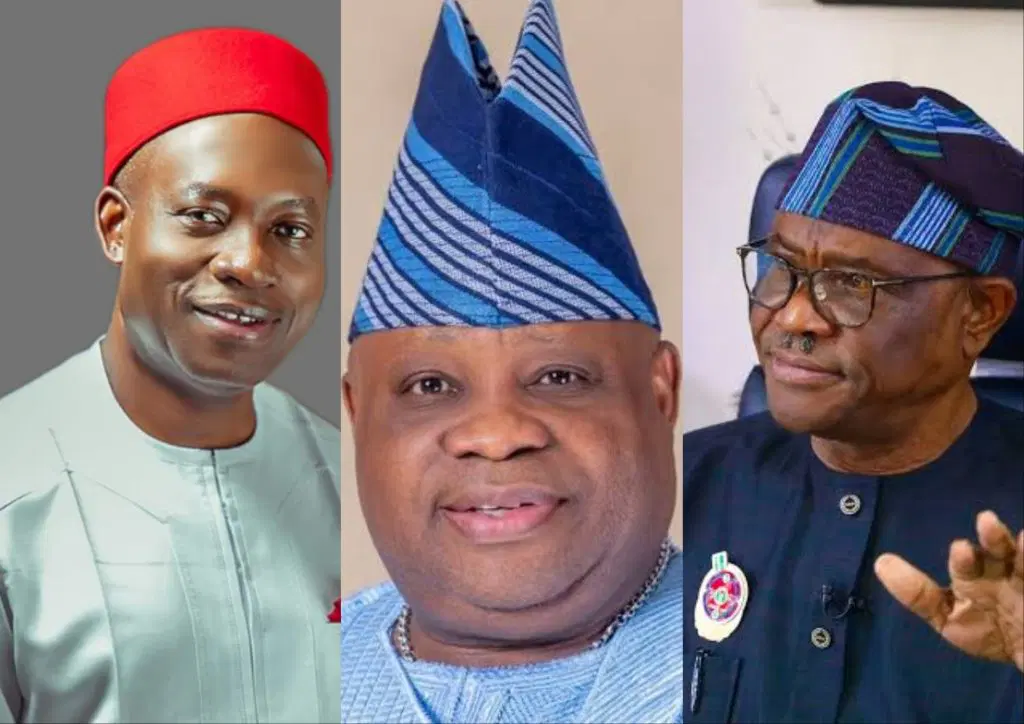
A high-stakes political storm is brewing across Nigeria’s opposition landscape following the formal enlistment of prominent opposition figures into President Bola Tinubu’s re-election campaign apparatus. At the centre of the widening controversy are the Minister of the Federal Capital Territory (FCT), Nyesom Wike, who remains a chieftain of the Peoples Democratic Party (PDP); Anambra State Governor, Prof. Chukwuma Soludo of the All Progressives Grand Alliance (APGA); and Osun State Governor, Ademola Adeleke of the Accord Party. Their open alignments with the governing All Progressives Congress (APC) have ignited fierce debates over party loyalty, constitutional discipline, and the survival of a credible opposition ahead of the 2027 general election.
Cross-Party Alliances Unveiled at Campaign Launch
The simmering tensions spilled into the open on October 14, 2026, during the inauguration of the APC Presidential Campaign Council held at the State House Conference Centre in Abuja. In an extraordinary display of cross-party accommodation, all three leaders formally identified with the APC-led campaign machinery, receiving crucial leadership portfolios for their respective home bases.
Wike, who has consistently rationalised his backing for the administration as part of what he terms a “National Rainbow Coalition,” was designated coordinator of the Tinubu presidential push across Rivers State and the Federal Capital Territory. The former Rivers governor reaffirmed his commitment to the President’s agenda, pointing to Tinubu’s handling of national affairs. Wike also disclosed that back in September, he had personally urged Adeleke to publicly endorse Tinubu's continuity after securing his own state mandate.
For his part, Governor Adeleke embraced the national campaign stage enthusiastically, declaring his total readiness to mobilise Osun State for the President's return to the presidency. Addressing attendees at the State House launch, Adeleke stated:
“I am here to throw my weight behind Tinubu’s return to Aso Rock. Let us rise from every nook and corner to support the President. Let him come and complete the good work he has begun.”
The Osun governor, widely recognised for his animated public dancing, shared a dance on stage with President Tinubu to the applause of party loyalists, sealing his appointment as the coordinator of Tinubu’s re-election organisation in Osun. Backing his move, the Imole Campaign Council (TICC) in Osun announced via its Director-General, Olalere Oyewumi, that it intends to deliver 1.5 million ballots for the President, insisting that the Accord Party’s complete local structure will be mobilised to ensure victory.
Governor Soludo similarly confirmed that APGA will stay out of the upcoming presidential contest entirely. Announcing that his party will not field a presidential candidate in 2027, Soludo referred to Tinubu as a personal friend deserving of another term, formally stepping into the position of Anambra State coordinator for the APC campaign effort.
Constitutional Prohibitions Against Anti-Party Activities
The open partnership between these prominent officeholders and the ruling party appears to run directly counter to internal statutory provisions governing the PDP, APGA, and the Accord Party. Across Nigeria's political history, participating in the campaign operations of rival groups has stood as the classic definition of anti-party conduct.
The foundational documents of each affected organisation contain explicit restrictions regarding cross-party loyalty:
- Peoples Democratic Party (PDP): Section 10(6) of the PDP Constitution bars members from forming alliances with outside factions or political parties to undermine the party or any elected administration on its ticket. In August 2025, the PDP National Working Committee explicitly leaned on this clause and Section 59(1) to caution against promoting Tinubu's re-election. Party spokesman Debo Ologunagba underscored at the time that the NWC was examining internal breaches, noting that members endorsing Tinubu were violating basic organisational discipline.
- All Progressives Grand Alliance (APGA): Article 21 mandates rigid personal and political discipline, stipulating severe penalties for behaviour that drags the party into contempt or disrepute. Reinforcing this rule, APGA’s Anambra State chapter issued a directive in August 2022 warning members that soliciting votes, campaigning on behalf of, or promoting rival candidates across digital media constituted clear anti-party offences.
- Accord Party: Under Article 20(A)(vi), anti-party participation is singled out as an actionable offence, while Article 14(3) empowers competent organs to expel any member who violates foundational statutes through gross misconduct. Spokesperson for Governor Adeleke, Olawale Rasheed, previously remarked that party faithful must strictly steer clear of anti-party actions, cautioning that harsh penalties await any dissident who sabotages nominated candidates.
Comparative Overview of Leaders and Campaign Appointments
| Politician | Substantive Political Party | Current Public Office | APC Campaign Council Role Assigned |
|---|---|---|---|
| Nyesom Wike | Peoples Democratic Party (PDP) | Minister of the Federal Capital Territory | Campaign Coordinator, Rivers State & FCT |
| Chukwuma Soludo | All Progressives Grand Alliance (APGA) | Governor of Anambra State | Campaign Coordinator, Anambra State |
| Ademola Adeleke | Accord Party | Governor of Osun State | Campaign Coordinator, Osun State |
Party Secretariats Defend Their Politicians Amid Outrage
Confronted with the spectacle of their frontline politicians leading the charge for a rival ticket, national party secretariats have offered nuanced defences that attempt to reconcile party supremacy with individual political survival.
Defending Wike’s conduct, PDP spokesperson Jungudo Haruna Mohammed argued that the minister was not joining the APC’s operational command, but merely supporting an administration he was officially approved to assist during the leadership of former acting National Chairman Umar Damagum.
“Wike has every constitutional and democratic right to decide whom he supports politically. His support for President Tinubu is legitimate, and as a serving appointee of the President, there is nothing contradictory about supporting the President while maintaining his political identity and relationships within the PDP,” Mohammed maintained. “He is working for President Tinubu and not for APC.”
However, this justification is not universally accepted within the party. PDP stalwart Chief Emmanuel Ogidi offered a sharp rebuke, accusing Wike of operating as a Trojan horse. “You can’t serve two masters. He (Wike) is supposed to be serving us in PDP, but he is serving APC. This is a threat to democracy,” Ogidi remarked, warning that the party would soon react decisively to what he termed a plot to destabilise the opposition.
APGA National Chairman, Sly Ezeokenwa, likewise defended Soludo’s posture, insisting it represents a broad strategic calculation agreed upon by the National Working Committee rather than a unilateral defection.
“The All Progressives Grand Alliance (APGA), the National Working Committee, had already taken the decision that we will stay aligned and we will still share the same accord with the All Progressives Congress (APC) and accept the idea of adopting Mr President as our presidential candidate,” Ezeokenwa said, adding that the political pact ensures the South-East maintains direct access to the centre.
In the Accord Party camp, internal sentiment appears mixed. Ogun State Chairman Michael Oke urged caution, noting that the national organ only learnt of Adeleke’s campaign appointment via media reports. Citing Articles 13, 14, and 20 of their constitution, Oke emphasised that disciplinary conclusions must wait until party investigators formally review the case. Conversely, Bamidele Salam, an Accord member representing Ede South/Ede North/Ejigbo/Egbedore Federal Constituency, openly applauded the appointment as a constructive step for Osun State.
Civil Society Voices Alarm Over Erosion of Democratic Pluralism
While party spokespersons scrambled to contextualise the arrangements, pro-democracy watchdogs and civil society organisations have roundly condemned the development, warning that turning a blind eye to anti-party offences threatens Nigeria’s multi-party structure.
Dr Fredrick Manaseh, Country Lead for the Society for Promotion of Democratic Values and Ethos, argued that bending constitutional rules to accommodate incumbent power serves an agenda that cripples viable alternatives:
“Since the APC came to power, we have witnessed a systematic erosion of democratic values. The party, with its one-party-state agenda, has ensured that the growth of other parties is stunted. Regrettably, they have the likes of Wike and other politicians to promote that agenda. Therefore, let nobody deceive Nigerians, they are working against their parties and should receive disciplinary action.”
Adding his voice to the criticism, Prof. Usman Monde, Executive Director of the Centre for Accountability and Good Governance, accused political leaders of selectively applying their party statutes, exempting heavyweights while punishing ordinary members.
“Parties are governed by constitutions. When a party abandons its constitution because of the ambition of certain individuals within its fold, how can such a party grow and become competitive? Political parties cannot claim to be serious about democracy if they fail to enforce their own rules,” Monde observed. “Without discipline, internal democracy and respect for party rules, political parties will struggle to build public confidence and remain competitive.”
How blurred party lines affect accountability and household costs
For families coping with rising transport fares, food prices, and utility tariffs, state governors are supposed to act as an independent buffer between federal policy and local welfare. When opposition governors take up leadership roles in the federal administration's re-election effort, that adversarial check largely dissolves. Instead of challenging federal policies that place heavy burdens on citizens, state executives often shift their focus toward maintaining favor with the central government.
This dynamic threatens grassroots accountability. When party secretariats excuse cross-party campaigning to maintain access to federal power, ordinary voters lose their clearest tool for enforcing performance: credible competition at the ballot box. Without the pressure of a disciplined rival party holding elected officials to account, the urgency to deliver clean tap water, well-maintained primary clinics, and dependable public schools inevitably weakens.
Question to ponder: As your state leadership formally embraces the central government, what measurable relief or infrastructure commitments is your community receiving in return to justify that political partnership?
Conclusion
The willingness of Nyesom Wike, Chukwuma Soludo, and Ademola Adeleke to openly steer the re-election machinery of an incumbent APC president while retaining their identities in opposing camps exposes profound institutional weaknesses in Nigeria's party system. By prioritising tactical access to central state authority over cohesive opposition platforms, these leaders have effectively blurred the boundary between genuine political alliance and standard anti-party activity.
Whether the national executives of the PDP, APGA, and the Accord Party can eventually enforce their internal constitutions remains to be seen. If these arrangements go unpunished, they risk transforming opposition platforms into regional appendages of the ruling party, significantly raising the barriers to presenting a united democratic alternative ahead of the 2027 general election.
Reporting based on coverage by Vanguard Nigeria - Politics.
Category: Politics