October Inflation: What Nigeria's Latest Figures Mean for Food Prices
By Victoria Odunola —
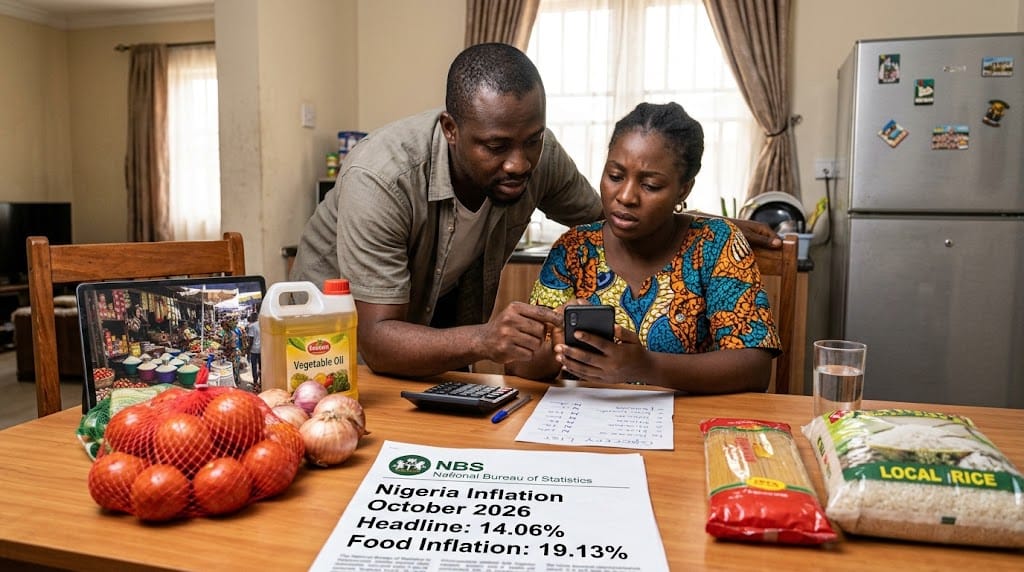
Nigeria's headline inflation rate eased to 14.06 per cent in October 2026, down from 14.63 per cent in September, marking a second straight month of annual moderation. Data released on 16 November 2026 by the National Bureau of Statistics (NBS), the country's official statistical agency, attributes much of the slowdown to harvest-period grain arrivals that dampened select staple prices. Annual food inflation remained sticky at 19.13 per cent, leaving household grocery bills elevated across urban and rural markets alike.
While the broader deceleration gives policymakers brief breathing space, month-on-month headline inflation climbed from 0.06 per cent in September to 0.43 per cent in October. That monthly acceleration shows prices did not fall across the board; rather, the pace of overall increases quickened during the month. For consumers, food remains the single largest expense category, consuming more than half of average household earnings in Africa's most populous nation.
The October Consumer Price Index Breakdown
The Consumer Price Index (CPI), which tracks changes in the retail prices of goods and services, rose by 0.6 points to 147.0 in October from 146.4 in September. Under the rebased framework introduced by the NBS using 2024 as the base year, food and non-alcoholic beverages contributed 5.63 percentage points to the annual headline number, continuing their position as the primary driver of domestic price shifts. Transport contributed 1.50 percentage points, followed by restaurants and accommodation services at 1.83 percentage points.
Core inflation, which removes volatile agricultural produce and energy from the index, slowed to 10.78 per cent year-on-year. On a month-on-month comparison, core inflation dropped by 0.53 per cent, down from an expansion of 1.11 per cent in September. The core deceleration suggests that non-food commercial sectors experienced softer consumer demand and relative exchange-rate stability during the month.
Urban and rural centres recorded divergent pressures. Urban inflation stood at 14.84 per cent year-on-year, while rural inflation measured 12.17 per cent. On a monthly basis, urban price growth slowed to 0.43 per cent from 0.53 per cent in September, whereas rural month-on-month inflation climbed out of negative territory to 0.18 per cent. High transport costs between farming belts and distribution hubs continue to prevent farm-gate price reductions from translating into equal savings in major cities.
How Harvest Supplies Shifted Food Prices
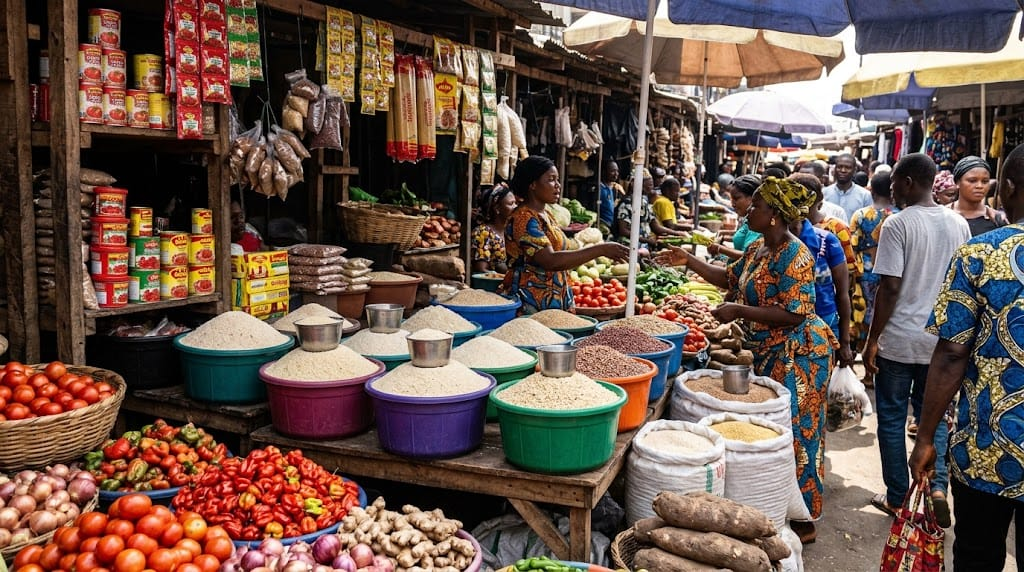
The monthly food index contracted by 0.75 per cent in October, following a 1.55 per cent drop in September. This negative month-on-month movement confirms that the peak harvest season lowered the average cost of raw staples compared with preceding weeks. Farmers brought freshly cropped tubers, maize, and local rice into market squares, easing immediate shortages.
However, the monthly drop was less steep than the decline registered in September. Several processed and imported food categories moved in the opposite direction. The NBS highlighted price increases in vegetable oil (75cl bottles), canned sardines, pre-packed green peas, frozen mackerel, croaker fish, fresh catfish, and beef tripe. For consumers attempting to balance fresh carbohydrates with protein and cooking oils, savings achieved on raw grains were absorbed by costlier imported protein and factory-processed pantry goods.
| Inflation Metric | October 2026 (Year-on-Year) | September 2026 (Year-on-Year) | October 2026 (Month-on-Month) | September 2026 (Month-on-Month) |
|---|---|---|---|---|
| Headline All-Items | 14.06% | 14.63% | 0.43% | 0.06% |
| Food Inflation | 19.13% | 19.59% | -0.75% | -1.55% |
| Core (Excl. Farm Produce & Energy) | 10.78% | 12.95% | -0.53% | 1.11% |
| Urban Areas | 14.84% | 15.22% | 0.43% | 0.53% |
| Rural Areas | 12.17% | 12.80% | 0.18% | -0.89% |
Regional Disparities Across Nigerian States
National averages conceal substantial cost variations across Nigeria's 36 states and the Federal Capital Territory. Southern consumption centres faced distinctly higher price levels than northern grain-producing states, reflecting haulage costs, local security dynamics, and informal transit fees.
Ondo State recorded the highest annual food inflation at 31.74 per cent, followed by heavy consumer centres in Lagos and Imo. For all-items headline inflation, Imo led nationwide at 28.66 per cent, with Enugu registering 22.81 per cent and Kaduna posting 21.55 per cent. By contrast, Taraba State recorded the lowest all-items rate at 6.12 per cent, with Sokoto at 6.68 per cent and Ekiti at 7.64 per cent. The wide gap shows that while agrarian communities in the north benefited directly from harvest supplies, consumers in southern distribution hubs paid heavy logistics premiums.
Impact on Household Budgets and Remittance Flows
With annual food inflation at 19.13 per cent, ordinary wages continue to lose purchasing power against weekly shopping baskets. A household in Ibadan or Port Harcourt spending ₦70,000 on monthly food staples a year ago faces substantially higher expenses for identical volumes of palm oil, fish, and dairy, even as raw yam and corn stabilise.
This dynamic extends directly to international remittance corridors. Relatives living in the United Kingdom, the United States, and Canada frequently send funds home earmarked for grocery and household sustenance. While exchange rates provide strong conversion power—with one British pound (£) trading above ₦2,000 and one US dollar ($) clearing around ₦1,650—the actual volume of goods those transfers purchase inside Nigeria has shrunk steadily over the past two years. Diaspora senders often find that monthly stipends intended to cover full family provisions must be increased to match local retail price levels.
Central Bank Policy Ahead of the November Meeting
The October price report lands days before the Central Bank of Nigeria (CBN) convenes its 308th Monetary Policy Committee (MPC) meeting on 23 and 24 November 2026. The committee, led by Governor Olayemi Cardoso, has maintained tight monetary policy throughout 2025 and 2026 to curb money supply expansion and attract foreign capital inflows.
The committee faces contradictory indicators. The deceleration in annual headline inflation to 14.06 per cent and the second consecutive monthly food price contraction support the argument that earlier interest rate increases have begun filtering into broader markets. Conversely, the rebound in month-on-month headline inflation to 0.43 per cent demonstrates that underlying pressure persists. Premature policy easing risks reigniting monthly price growth, particularly as end-of-year holiday demand approaches in December.
Conclusion
Nigeria's October inflation figures present a nuanced picture of an economy emerging from acute price shocks while still burdened by high baseline living expenses. The drop in headline inflation to 14.06 per cent and monthly food price contractions reflect tangible harvest benefits for primary crops. Persistent annual food inflation above 19 per cent, driven by transport costs and imported commodities, means everyday grocery bills remain a heavy strain for Nigerian households and the global diaspora supporting them.
Sources
- National Bureau of Statistics (NBS) - Consumer Price Index and Inflation Report
- Central Bank of Nigeria (CBN) - Inflation and Monetary Policy Data
- BusinessDay Nigeria - Food Inflation and Market Coverage
- Premium Times Nigeria - October Economic and NBS Reports
Disclaimer: This article provides economic news and financial market analysis for informational purposes and does not constitute financial, investment, or legal advice. Economic conditions and official statistical data may change as later reports are issued.
Category: Finance