Where Savings Earn Most With the Policy Rate at 23 Per Cent
By Matthew Ayandare —
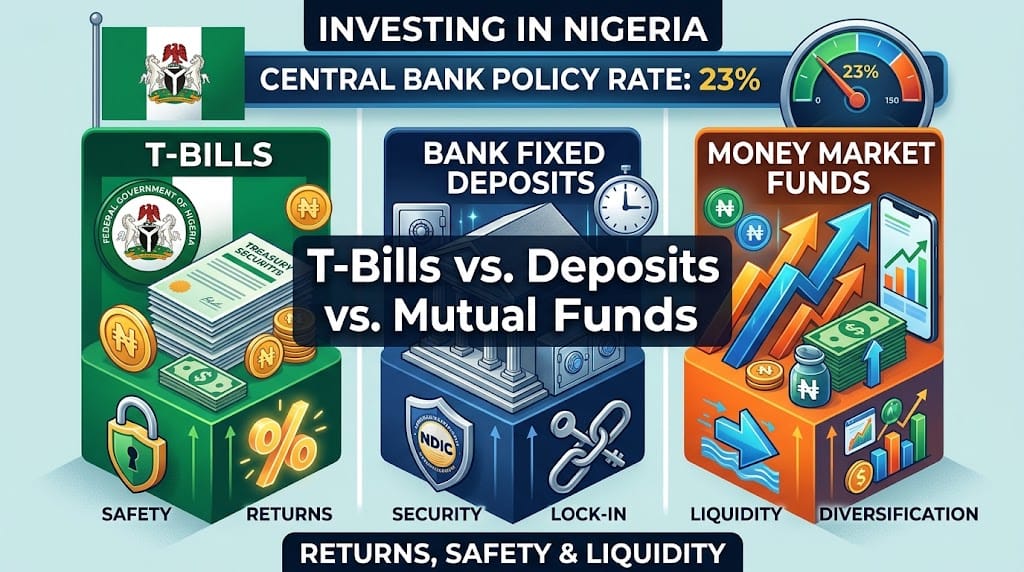
When a central bank sets its benchmark interest rate at 23 per cent, the mathematics of personal savings changes overnight. In Nigeria, where the Central Bank of Nigeria (CBN) reset its Monetary Policy Rate (MPR) to 23 per cent at its 307th Monetary Policy Committee meeting, cash is no longer an idle asset. For households, diaspora remitters and corporate treasurers, high nominal interest rates present a rare chance to earn double-digit yields on liquid capital.
Yet a high policy rate does not distribute returns evenly across the financial system. Commercial banks reprice borrowing costs swiftly, but deposit rates move at a different pace. Meanwhile, government debt auctions and open-ended collective investment schemes adjust on their own cycles. Savers deciding where to put their money face three main vehicles: sovereign Treasury bills, bank fixed deposits and mutual fund money market instruments. Each carries distinct rules on lock-in periods, minimum deposits, taxation and actual take-home yield.
The Mechanics of a 23 Per Cent Policy Rate
The Monetary Policy Rate acts as the base price of credit across the Nigerian economy. When the CBN sets the benchmark at 23 per cent, it also establishes the standing facilities corridor. This corridor defines the interest rate at which commercial banks can place excess liquidity with the central bank overnight through the Standing Deposit Facility (SDF), set at 20 per cent, and borrow cash through the Standing Lending Facility (SLF), set at 23.5 per cent.
Because deposit money banks face an elevated Cash Reserve Requirement (CRR) of 45 per cent—the portion of customer deposits they must keep sterilised at the central bank without earning interest—their willingness to pay for retail deposits varies widely. Banks do not automatically hand retail savers 23 per cent. By CBN regulation, standard savings accounts pay a mandatory floor of 30 per cent of the MPR, which equals 6.9 per cent per annum when the rate sits at 23 per cent. Leaving surplus cash in an ordinary bank account therefore guarantees wealth erosion when headline inflation hovers near 15 per cent.
To outpace rising consumer prices and secure positive real returns, savers must step beyond ordinary savings accounts into dedicated fixed-income instruments.
Nigerian Treasury Bills: Locking In Sovereign Yields
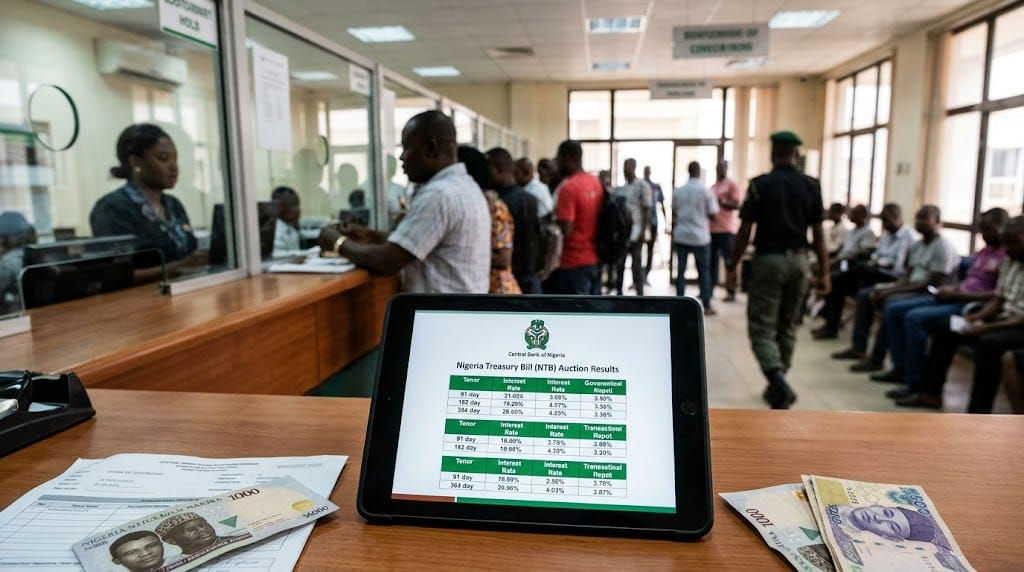
Nigerian Treasury Bills (NTBs) are short-term debt instruments issued by the CBN on behalf of the Debt Management Office (DMO) to finance federal spending. They are auctioned fortnightly in three standard maturities: 91 days, 182 days and 364 days.
Treasury bills are backed by the full taxing power of the Federal Government of Nigeria, eliminating default risk in local currency terms. Unlike conventional interest-bearing bonds, Treasury bills sell at a discount to face value. An investor pays less than par value at purchase and receives the full face value at maturity, with the difference representing the interest earned. This structure means the saver collects their return upfront.
Following the policy rate reduction to 23 per cent, primary market auction stop rates have settled into narrower ranges. At recent primary market auctions, the 364-day bill cleared around 15.89 per cent, while the 182-day bill settled near 15.79 per cent and the 91-day paper at 15.40 per cent. These figures represent the discount rate. When converted to a true annualised yield, a 364-day bill at a 15.89 per cent discount produces an effective return of roughly 18.89 per cent.
Direct entry into CBN primary auctions requires an official minimum bid of 50 million naira, placing direct participation out of reach for many individual savers. Retail investors typically gain access through bank treasury desks or licenced stockbroking houses, which pool client bids or sell bills from their proprietary trading books in secondary market tranches as small as 100,000 naira. The primary drawback of Treasury bills is rigidity: selling before maturity requires a secondary market transaction through a bank, exposing the seller to prevailing market prices that can inflict capital loss if yields have climbed since the purchase date.
Fixed Deposits: Institutional Negotiation and Rate Caps
A bank fixed deposit is a bilateral contract between an account holder and a commercial or merchant bank, agreeing to hold a specific sum for a set duration in exchange for a fixed interest rate. Common tenors range from 30 days to 365 days.
With the MPR at 23 per cent, the deposit market is heavily tiered. Tier-one commercial banks, flush with low-cost current accounts from retail transactions, rarely compete aggressively for small deposits. Standard retail fixed deposits of between 500,000 and 10 million naira at major lenders often yield between 12 per cent and 15 per cent per annum. Mid-tier lenders and merchant banks with tighter liquidity profiles tend to quote higher rates, offering between 16 per cent and 18 per cent for larger corporate balances.
Digital lenders and licenced microfinance banks frequently advertise fixed rates reaching 18 to 20 per cent to draw deposits. While attractive, these returns require careful examination of safety limits. The Nigeria Deposit Insurance Corporation (NDIC) guarantees deposits up to 5 million naira per depositor in commercial banks, and up to 2 million naira in primary mortgage banks and microfinance institutions. Any deposit beyond those statutory thresholds relies solely on the balance sheet health of the issuing institution.
Fixed deposits offer predictable, cash-flow certainty, but they penalise early withdrawals. Liquidating a term deposit ahead of maturity often leads to forfeiture of all or a significant portion of accrued interest, reducing the realised return to the base savings rate.
Money Market Funds: Pooled Scale and Daily Liquidity
Money market funds (MMFs) are open-ended collective investment schemes registered and regulated by the Securities and Exchange Commission (SEC). These mutual funds pool savings from millions of individuals and institutions to buy short-term, low-risk debt instruments, including Treasury bills, bank placements and investment-grade commercial paper issued by corporations.
By regulation, SEC-approved money market funds must invest only in instruments with maturities under 365 days, maintaining an average portfolio maturity of no more than 90 days. This limitation shields the fund from interest rate shocks. When policy rates change, the yield on a money market fund does not shift instantly. Instead, it updates gradually as older securities mature and portfolio managers replace them with higher- or lower-yielding paper.
Under the 23 per cent MPR environment, leading Nigerian money market funds report net yields between 16 per cent and 18 per cent. Their distinct advantage is accessibility and flexible liquidity. Most funds permit initial investments as low as 5,000 or 10,000 naira, with continuous top-up options. Interest accrues daily and compounds monthly.
Redemptions carry minimal friction. Investors can withdraw their money on short notice, usually within 24 to 48 hours, without forfeiting previously earned interest. However, fund managers charge management and administrative fees, usually between 1.0 and 1.5 per cent per annum, deducted from gross asset yields before net earnings reach client dashboards.
Comparing Returns, Access and Rules
Evaluating fixed-income options requires balancing headline yield against ease of access, regulatory protection and tax exposure. The following table compares how these three options perform under the 23 per cent policy benchmark.
| Feature | Treasury Bills (NTBs) | Bank Fixed Deposits | Money Market Funds |
|---|---|---|---|
| Typical Annual Return | 15.40% to 15.89% discount rate (approx. 17.5%–18.9% true yield) | 12.00% to 17.50% (varies by bank tier and balance) | 16.00% to 18.00% (net annualised yield) |
| Minimum Investment | ₦50m at auction; ₦100,000 via secondary brokers | ₦50,000 to ₦1m depending on bank | ₦1,000 to ₦10,000 via digital platforms |
| Maturity Horizons | 91, 182, or 364 days | 30, 60, 90, 180, or 365 days | Open-ended (no fixed maturity) |
| Liquidity Terms | Locked until maturity; tradable on secondary market | Locked; early liquidation incurs interest penalties | High; redeemable in 24–48 hours with earned interest intact |
| Risk Level | Sovereign backing; zero nominal credit risk | Bank credit risk; NDIC-insured up to ₦5m | Low; diversified short-term corporate and sovereign debt |
| Tax Exposure | Statutory withholding tax rules apply per asset class | 10% Withholding Tax (WHT) on interest earnings | Tax deducted at distribution or fund level per regulation |
The Tax Equation and True Net Earnings
Nominal interest figures do not match actual bank deposits. In Nigeria, tax rules govern passive investment income. Interest earned on commercial bank fixed deposits is subject to a 10 per cent Withholding Tax (WHT), which the bank deducts at source before crediting the investor's balance. A quoted fixed deposit rate of 16 per cent therefore produces a net return of 14.4 per cent.
Government securities and collective investment schemes carry specific fiscal arrangements. Treasury bills have historically enjoyed exemptions intended to spur sovereign debt financing, though corporate participants face regular tax reviews on non-exempt investment streams. Money market fund distributions are reported net of allowable management charges, giving savers a clear reading of net yields on their account statements. Factoring in fees and taxes prevents savers from discovering unexpected shortfalls upon settlement.
Inflation and Real Purchasing Power
Nominal gains mean little if prices in the shops rise faster than interest accumulates. With Nigeria's headline inflation tracking at approximately 15.39 per cent, an investment earning 18 per cent delivers a modest positive real return of around 2.6 percentage points.
This positive real return represents a substantial turnaround from periods when inflation exceeded 30 per cent while Treasury yields lagged in the mid-teens. In a positive real rate setting, locking in long maturities preserves wealth. A saver securing a 364-day Treasury bill at an effective yield near 18.8 per cent guarantees that return for a full year, even if later MPC sessions reduce the policy rate further as disinflation gains ground.
Floating instruments, such as money market funds, offer less duration protection. If the central bank cuts the policy rate lower during the next calendar year, fund managers must buy newly issued securities that pay less. As a result, money market fund yields will fall gradually, whereas existing one-year Treasury bills hold their contracted payment intact.
Allocating Across Cash, Term and Market Vehicles
No single savings vehicle serves every financial need. Matching financial assets to upcoming expenditure schedules avoids early redemption penalties and unexpected liquidity crunches.
Operating cash, emergency buffers and payments required within 30 to 60 days find a sensible home in money market funds. The daily liquidity permits transfers back to transactional bank accounts without destroying past earnings. This removes the friction of term contracts while keeping money earning well above regular bank savings minimums.
Known future obligations with fixed deadlines—such as annual rent, business tax liabilities or school tuition due in six to twelve months—suit direct Treasury bills. By picking a maturity date that mirrors the payment deadline, the investor locks in an 18 per cent true yield, insulates the capital from commercial bank insolvency, and prevents the yield dilution that occurs when central banks lower rates.
Fixed deposits remain suitable for institutional funds negotiating customised, over-the-counter rates above the primary market stop rate, or for retail depositors seeking simple administrative integration within their primary banking app. For balances under 5 million naira, full NDIC coverage keeps the placement secure.
Conclusion
A benchmark policy rate of 23 per cent gives Nigerian savers a genuine opportunity to protect capital against inflation. Choosing the highest return requires weighing headline yield against access, duration and tax. One-year Treasury bills offer the highest guaranteed effective yield and sovereign safety, locking in returns if policy rates fall. Money market funds provide unmatched day-to-day liquidity with strong double-digit yields for emergency reserves. Fixed deposits deliver predictable outcomes when negotiated above standard board rates and held below statutory insurance ceilings. Spreading savings across these instruments captures competitive yields while keeping money available when needed.
Sources
- Central Bank of Nigeria: Monetary Policy Decisions and Communiqués
- Debt Management Office Nigeria: Treasury Bills Issuance and Results
- Securities and Exchange Commission Nigeria: Mutual Fund Summaries
- Nigeria Deposit Insurance Corporation: Maximum Deposit Insurance Coverage Framework
Disclaimer: This article is for informational purposes only and does not constitute financial, investment or tax advice. Consult a licenced financial adviser or registered investment professional before making personal financial commitments.
Category: Finance