UK Mortgage Rates After the Budget: Where They Are Heading and Whether to Fix Now
By King Matthew —
Chancellor Rachel Reeves delivered the Labour government's first Budget in fourteen years on 30 October 2024, setting off swift movements in the financial markets that reached home loans within days. While the Bank of England cut the official base rate a week later from 5.0 per cent to 4.75 per cent, mortgage lenders responded in the opposite direction by pulling cheap fixed deals and edging rates higher.
For millions of households across the United Kingdom, as well as overseas investors and expatriates holding UK property debt, the divergence between official interest rates and commercial mortgage pricing caused immediate confusion. Understanding why mortgage rates moved up rather than down requires looking at government debt markets, inflation expectations, and the mechanism banks use to price fixed loans.
How the Budget Altered the Path of Interest Rates
The Budget outlined £40 billion in annual tax increases alongside approximately £142 billion in additional government borrowing over five years. The scale of borrowing startled government bond markets. Investors demanded higher yields to hold UK government debt, known as gilts. The yield on ten-year gilts rose toward 4.5 per cent in the days following the announcement.
Mortgage providers do not price fixed-rate deals directly from the Bank of England's base rate. Instead, they price them against "swap rates" — financial contracts that reflect what commercial banks expect the base rate to average over two, three, or five years. Because higher government spending and increased borrowing are expected to stimulate economic activity and keep price pressures alive for longer, financial markets revised their predictions for future rate cuts.
Prior to the fiscal announcement, traders expected the Bank of England to lower the base rate to around 3.5 per cent by late 2025. Following the spending plans and the revised forecasts from the Office for Budget Responsibility (OBR), the UK's official fiscal watchdog, markets priced in a shallower descent, projecting rates to settle closer to 4.0 per cent. That change pushed two-year and five-year swap rates upward by 0.2 to 0.3 percentage points, forcing high-street lenders including Santander, HSBC, Virgin Money, and Nationwide to reprice their fixed-rate ranges.
The Bank of England's Balancing Act
The Bank of England's Monetary Policy Committee (MPC) did cut the base rate by 0.25 percentage points on 7 November 2024, voting 8-1 in favour of a reduction to 4.75 per cent. However, the tone from Bank Governor Andrew Bailey was cautious.
The central bank estimated that the Budget's measures — particularly the increase in employer National Insurance contributions from 13.8 per cent to 15.0 per cent — could add nearly half a percentage point to headline inflation at its peak. The Bank reiterated that future reductions would be "gradual", signalling to borrowers that the rapid run of cheap credit seen in the 2010s will not return in the foreseeable future.
For homeowners, this creates an unusual friction: the central bank is cutting the base rate, but fixed-rate mortgages are pricing in persistent inflation that limits how far those cuts can go.
Current Mortgage Pricing Across the Market
Average mortgage pricing remains well below the peaks of summer 2023, when five-year fixes touched 6.0 per cent, but the days of sub-4.0 per cent deals have temporarily receded. The best rates are reserved for borrowers with substantial equity, typically a deposit or equity stake of 40 per cent (a 60 per cent loan-to-value ratio, or LTV).
The table below outlines typical interest rate bands available in the UK residential market following the Budget and the November rate cut, based on data compiled from major high-street lenders and broker networks.
| Mortgage Product | Typical Rate (60% LTV) | Typical Rate (75%–80% LTV) | Typical Rate (90% LTV) |
|---|---|---|---|
| 2-Year Fixed | 4.25% – 4.55% | 4.60% – 4.85% | 5.15% – 5.45% |
| 5-Year Fixed | 4.10% – 4.35% | 4.40% – 4.65% | 4.85% – 5.15% |
| Base Rate Tracker | 5.00% – 5.25% | 5.30% – 5.55% | 5.75% – 6.10% |
| Standard Variable Rate (SVR) | 7.25% – 7.75% | 7.25% – 7.75% | 7.25% – 7.75% |
Five-year fixed deals continue to price slightly lower than two-year products. This "inverted" pricing structure shows that lenders still anticipate the Bank of England's base rate will be lower in three to five years than it is today, even if the short-term drop takes longer to materialise.
The Dilemma: Fix Now or Wait?
Borrowers nearing the end of an existing deal or buying a property face three broad choices: a two-year fix, a five-year fix, or a tracker loan that moves with the Bank of England base rate.
The Case for a Five-Year Fix
A five-year fixed mortgage offers stability and the lowest initial rate among standard products. Borrowers locking in around 4.10 per cent to 4.40 per cent gain complete certainty over their largest monthly household outlay until late 2029.
The trade-off is inflexibility. If inflation drops faster than anticipated and the Bank of England cuts the base rate toward 3.0 per cent in 2026, borrowers on a five-year fix will be unable to switch without paying substantial Early Repayment Charges (ERCs), which often run between 2 per cent and 5 per cent of the outstanding loan balance.
The Case for a Two-Year Fix
A two-year fix acts as a bridge. It costs slightly more each month than a five-year deal, but it binds the borrower for a much shorter window. If market forecasts prove accurate and mortgage rates drift down toward the mid-3 per cent range over the coming twenty-four months, borrowers can refinance at that point without penalties.
The risk with this strategy lies in product arrangement fees. Most competitive fixed mortgages carry an arrangement fee of around £999. Paying that fee every two years adds to the real borrowing cost, eroding the margin of any small rate decrease achieved on the next deal.
The Tracker Option
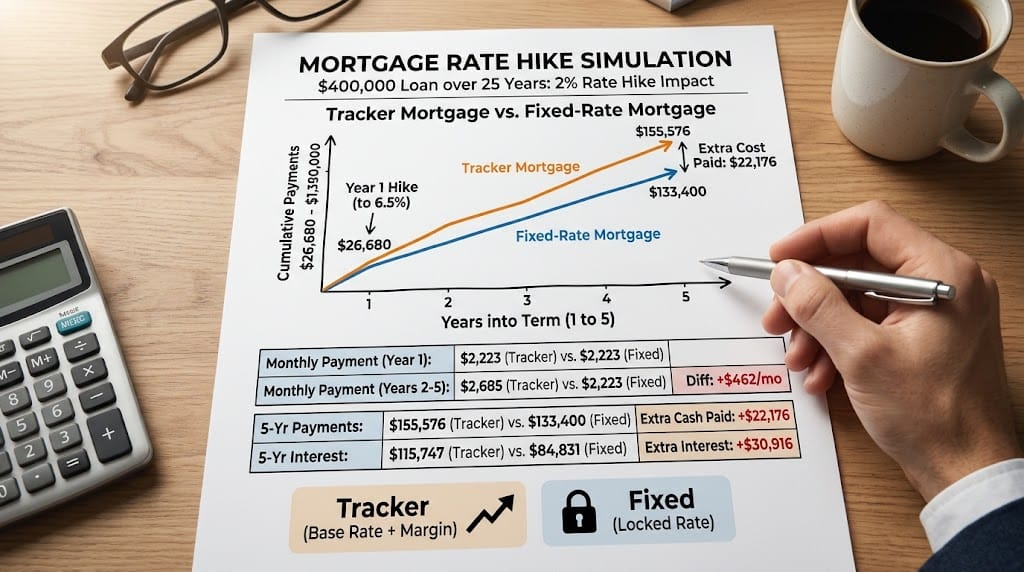
Tracker mortgages move in direct tandem with the Bank of England base rate. Following the cut to 4.75 per cent, a tracker priced at 0.50 per cent over base charges 5.25 per cent — noticeably higher than a five-year fix. Most tracker products do not carry early exit penalties, allowing borrowers to move to a fixed product whenever pricing appears favourable.
This path suits borrowers who have surplus monthly income to absorb unexpected rate increases and who believe the central bank will cut borrowing costs faster than the swap markets currently expect.
Pressure on the Buy-to-Let Market and International Buyers
The Budget included an immediate change for property investors. The stamp duty land tax (SDLT) surcharge on additional dwellings — which applies to second homes and buy-to-let investments in England and Northern Ireland — rose from 3 per cent to 5 per cent on 31 October 2024.
This directly affects landlords based in the UK, as well as expatriates and foreign nationals investing from hubs such as Nigeria, Kenya, the United Arab Emirates, and Canada. For an overseas investor buying an additional residential property in London or Manchester for £300,000, the SDLT surcharge alone rose by £6,000 overnight, alongside the existing 2 per cent non-resident surcharge that applies to foreign buyers.
Combined with buy-to-let mortgage interest rates averaging between 4.75 per cent and 5.50 per cent, rental yields face renewed compression. Lenders apply stringent "interest coverage ratios" (ICRs) to landlords, requiring rental income to cover between 125 per cent and 145 per cent of the mortgage payment calculated at a stressed interest rate. Higher mortgage rates limit the maximum borrowing amount available to landlords unless they inject larger cash deposits.
First-Time Buyers and the Upcoming Stamp Duty Cliff
Buyers entering the market face a separate deadline. The temporary increases to nil-rate stamp duty thresholds introduced in 2022 are due to expire on 31 March 2025.
At that point, the threshold for home movers drops from £250,000 back to £125,000. For first-time buyers, the nil-rate band drops from £425,000 to £300,000, while the maximum property value eligible for first-time buyer relief falls from £625,000 to £500,000. These scheduled reversions mean that buyers purchasing a first home for £400,000 after March 2025 will face a tax bill of £5,000, compared with zero prior to the deadline.
Because mortgage underwriting takes several weeks and conveyancing in England and Wales takes an average of twelve to sixteen weeks, buyers seeking to complete purchases before the threshold drops must secure financing promptly.
Conclusion
The UK mortgage market has entered a period of recalibration following the Autumn Budget. While the Bank of England's base rate is on a downward path, the velocity of cuts will be restrained by fiscal expansion, increased public borrowing, and stubborn service-sector inflation. Fixed mortgage rates have settled into a new normal between 4.0 per cent and 5.0 per cent for standard deposits, dispelling hopes of a swift return to ultra-cheap credit.
Choosing between fixing for two years, five years, or tracking the base rate depends on individual tolerance for risk and personal time horizons. Borrowers who value stability over prospective savings lean toward five-year deals, while those banking on gradual market improvements over the medium term may prefer the flexibility of a shorter fix.
Sources
- Bank of England: Monetary Policy Summary, November 2024
- Office for Budget Responsibility: Economic and Fiscal Outlook, October 2024
- HM Treasury: Autumn Budget 2024
- Moneyfacts: UK Mortgage Rate Averages and Market Monitoring
- UK Finance: Household Borrowing and Lending Data
Disclaimer: This article provides general financial news and analysis and does not constitute financial or mortgage advice. Borrowers should consult an independent, FCA-regulated mortgage broker or financial adviser before entering into any borrowing agreement.
Category: Finance