2026 Tax Changes Explained: What Changes on Your Payslips
By Matthew Ayandare —
A new payroll year brings immediate revisions to the gross-to-net calculations on regular pay statements. For Canadian salaried employees, earnings entering a bank account in 2026 reflect statutory indexation, altered contribution thresholds for public pensions, and revised premiums for Employment Insurance. While headline salary figures agreed with employers remain unchanged, the net sum deposited on alternate Fridays or at month-end shifts as automated payroll systems implement updated federal and provincial tables.
Three primary statutory deductions govern the gap between gross earnings and net pay across Canada: personal income tax withholdings, Canada Pension Plan contributions, and Employment Insurance premiums. Each statutory item adjusts on 1 January each year. In 2026, the combined impact of indexing tax thresholds to inflation and expanding the upper ceiling of pensionable earnings reshapes deduction patterns across the calendar year, particularly for middle and upper-income households.

Federal Income Tax Brackets and the Basic Personal Amount
Canada applies an annual indexation adjustment to federal tax brackets, non-refundable tax credits, and deduction thresholds to prevent bracket creep, the mechanism where wage growth merely tracking inflation pushes workers into higher tax bands. For the 2026 tax year, the Canada Revenue Agency applied an indexation factor of 2.0 per cent. This adjustment expands the width of each federal tax bracket before higher marginal percentages take effect.
The lowest federal bracket taxes income up to $58,523 at 14 per cent, maintaining the reduced bottom-tier rate implemented as part of recent affordability reforms. Income exceeding $58,523 up to $117,045 is subject to a 20.5 per cent federal rate. The third tier applies 26 per cent to earnings between $117,045 and $181,440, while the fourth tier levies 29 per cent on earnings between $181,440 and $258,482. Income surpassing $258,482 faces the top federal marginal bracket of 33 per cent. Provincial tax brackets adjust simultaneously according to respective provincial consumer price index formulas, except in jurisdictions that freeze their thresholds.
Alongside bracket thresholds, the federal Basic Personal Amount rose to $16,452 for 2026. This non-refundable credit ensures that workers pay zero federal income tax on the first slice of annual earnings up to that ceiling. For employees whose net income sits below the top tax bracket, payroll withholding algorithms divide this basic tax-free allowance evenly across pay cycles, reducing the income tax deducted on every individual payslip.
Statutory Payroll Deductions at a Glance
The table below sets out the official statutory payroll figures for the 2026 tax year compared to 2025, detailing thresholds for pensionable earnings, insurance caps, and federal tax bands.
| Payroll Component | 2025 Threshold | 2026 Threshold | Maximum Employee Contribution (2026) |
|---|---|---|---|
| Basic Personal Amount (Federal) | $15,705 (approx. base) | $16,452 | N/A (Tax credit value: $2,303.28) |
| CPP Maximum Pensionable Earnings (YMPE) | $71,300 | $74,600 | $4,230.45 (at 5.95%) |
| CPP2 Additional Ceiling (YAMPE) | $81,200 | $85,000 | $416.00 (at 4.00%) |
| EI Maximum Insurable Earnings (MIE) | $65,700 | $68,900 | $1,123.07 (at 1.63%) |
| Combined Max Pension & EI Withholding | $5,499.58 | $5,769.52 | $5,769.52 |
Canada Pension Plan and the Second-Tier Deductions
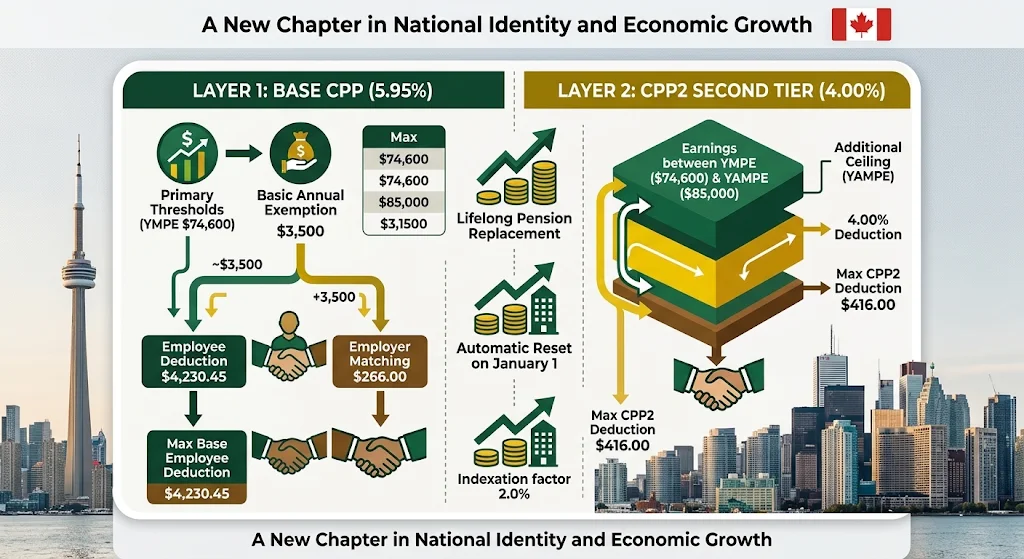
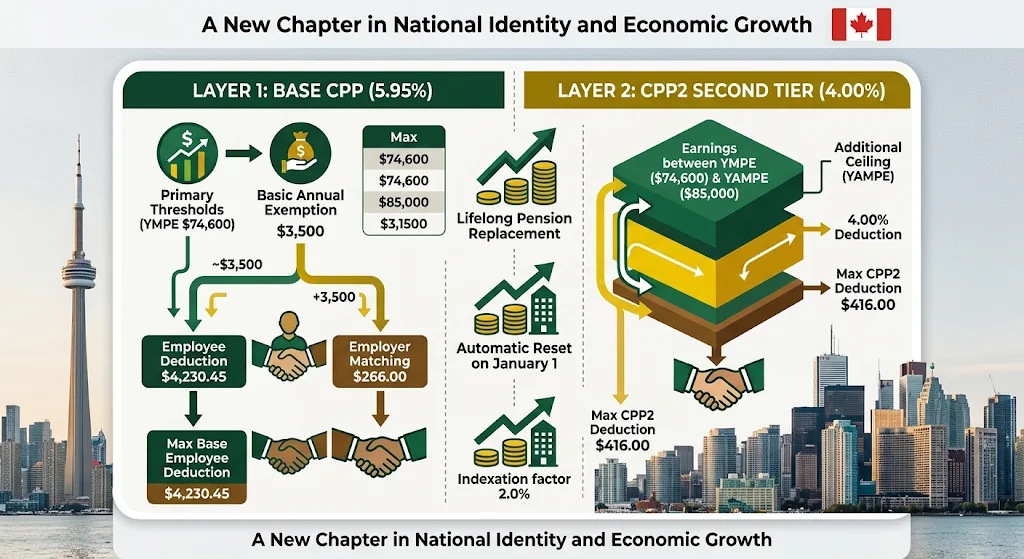
The Canada Pension Plan framework includes two separate contribution layers on payslips. The primary tier applies to income above the unchanged $3,500 basic annual exemption up to the Year's Maximum Pensionable Earnings, set at $74,600 for 2026. Employees and employers each contribute 5.95 per cent on earnings within this range, resulting in a maximum base employee deduction of $4,230.45 across the year.
Above the primary threshold, the second-tier contribution, labelled CPP2 on pay stubs, applies to earnings between $74,600 and the Year's Additional Maximum Pensionable Earnings of $85,000. The employee contribution rate for this band is 4.00 per cent, matched by the employer. For a worker earning at or above $85,000, the annual CPP2 deduction reaches an absolute maximum of $416.00. Workers in Quebec pay into the Quebec Pension Plan, which applies an equivalent second-tier ceiling alongside its own provincial base contribution percentage of 6.30 per cent.
The expansion of pensionable earnings means that higher-salaried staff experience pension withholdings deeper into the autumn. The combined annual employee deduction for CPP and CPP2 reaches $4,646.45 in 2026, representing an increase over prior years designed to lift long-term pension income replacement from one-quarter to one-third of average work earnings.
Employment Insurance Premiums and Insurable Limits
Employment Insurance deductions changed through an adjusted premium rate combined with a higher earnings ceiling. For 2026, the federal employee EI premium rate dropped slightly to 1.63 per cent of insurable earnings, down from 1.64 per cent. In Quebec, where parental benefits operate separately under the Quebec Parental Insurance Plan, the employee EI rate sits at 1.30 per cent.
Despite the marginal decline in the rate outside Quebec, total annual premiums increased because the Maximum Insurable Earnings limit rose to $68,900. An employee earning at or above this cap pays up to $1,123.07 in EI premiums during 2026, compared to $1,077.48 in 2025. Employers continue to pay 1.4 times the employee rate, reaching a maximum annual employer remittance of $1,572.30 per staff member.
Because EI premiums lack a basic income exemption, deductions apply from the first dollar earned in January. Every payslip carries this percentage until cumulative year-to-date gross earnings hit $68,900, at which point the automated payroll software stops withholding EI premiums for the remainder of the calendar year.
How Net Pay Shifts Across the Calendar Year
The interplay of annual deduction maximums produces noticeable swings in net earnings between early January and late December. Early in the year, salaried workers experience their lowest monthly net pay because income tax, primary CPP, and EI premiums deduct simultaneously. For a professional earning $100,000 annually, statutory deductions can claim more than thirty per cent of each bi-weekly cheque during the initial six months.
As the year advances, individual statutory ceilings take effect at staggered intervals:
- EI deductions conclude first: A worker earning $100,000 passes the $68,900 EI limit around early September, suddenly adding roughly 1.63 per cent back into each paycheque.
- Base CPP deductions cease: The primary pension cap of $74,600 is reached shortly thereafter, freeing the 5.95 per cent base deduction.
- CPP2 deductions activate: Once earnings exceed $74,600, the 4.00 per cent second tier begins and continues until total earnings reach $85,000, usually within three to four additional pay cycles.
- Full cap relief arrives: Once all CPP and EI obligations are satisfied, the employee receives their maximum take-home pay for the final months of the year, facing only income tax withholdings.
Understanding this pattern prevents confusion when take-home pay abruptly increases late in the year and drops back down on the first paycheque of January, when contribution counters reset to zero.
Payroll Withholding Adjustments and TD1 Forms
The accurate calculation of income tax on salary relies on the federal and provincial TD1 forms completed at the start of employment or whenever personal circumstances alter. When tax brackets index upward by 2.0 per cent, payroll systems automatically factor the increased exemptions into the mathematical formulas published by the Canada Revenue Agency, known as the payroll deductions formulas guide.
Workers who experience life changes, such as gaining eligible dependants, enrolling in post-secondary courses, or beginning to care for an infirm relative, can submit revised TD1 forms to their employer's finance department. Increasing total claim codes reduces statutory tax withholdings at source, delivering tax relief across regular pay cycles rather than waiting for an annual refund after filing a tax return. Salaried staff who regularly contribute to Registered Retirement Savings Plans through private accounts can also apply to the tax authorities for a formal letter of authority under section 146 of the Income Tax Act, which permits employers to lower source withholdings immediately.
Conclusion
The 2026 tax year introduces subtle but substantive shifts to salaried take-home pay in Canada. A 2.0 per cent federal bracket indexation lifts the basic personal amount and widens tax brackets, offering modest protection against inflation. Concurrently, elevated ceilings for Employment Insurance insurable earnings and Canada Pension Plan contributions, including the second-tier CPP2 levy, mean higher-earning workers see statutory deductions extend further into the calendar year before net pay expands.
Sources
- Canada Revenue Agency (CRA) – Payroll Deductions Formulas and Contribution Rates
- Employment and Social Development Canada – Employment Insurance Premium Rates and Maximums
- Government of Canada – Canada Pension Plan Contribution Rates and Maximums
Disclaimer: This article provides general financial information on Canadian payroll deductions and is not formal financial, tax, or legal advice. Consult a certified financial planner or registered tax professional regarding your personal tax situation.
Category: Finance