Petrol at ₦1,307 a Litre: The Monthly Cost of Running a Car and Generator in Nigeria
By Bola Eboh —
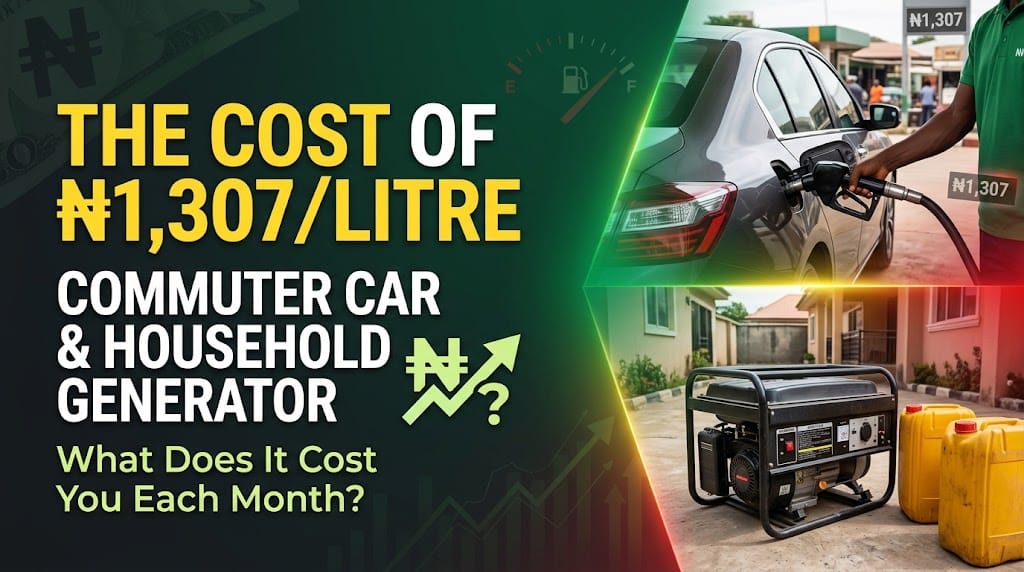
Retail petrol prices reaching approximately ₦1,307 per litre across several filling stations in Nigeria have altered household accounting across the country. Following multiple wholesale adjustments by private refiners, depot operators, and the state-owned Nigerian National Petroleum Company Limited (NNPCL), filling stations from Ogun State to parts of Lagos and Abuja have adjusted pump meters upwards. For families balancing transport with backup power, petrol is no longer an incidental weekly expense. It has become one of the single largest deductions from their monthly income.
Before May 2023, Premium Motor Spirit (PMS), the official term for petrol in Nigeria, sold for roughly ₦185 to ₦195 per litre under a decades-long government subsidy regime. Today's price of ₦1,307 represents a jump of roughly 570 per cent. Because public transit is informal and the national electricity grid remains subject to frequent interruptions, Nigerian households rely directly on refined petrol for basic mobility and domestic lighting. Calculating what this means in practice shows why domestic budgets are feeling unprecedented strain.
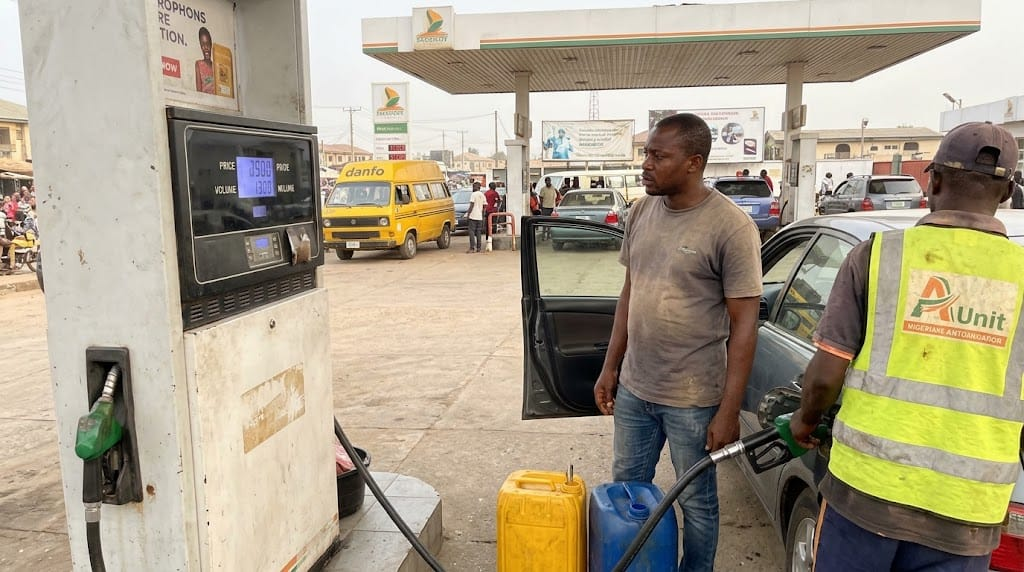
The Commuter Reality: Fuel Costs for a Saloon Car and an SUV
For a salaried worker or small business owner driving a standard four-cylinder saloon car—such as a Toyota Corolla, Honda Civic, or Hyundai Elantra—fuel efficiency varies sharply between highway driving and city traffic. In heavy urban traffic, such as the daily commute between mainland Lagos and Victoria Island, or between Mararaba and central Abuja, a 1.8-litre engine regularly burns between 10 and 12 litres per 100 kilometres.
A round-trip commute of 40 kilometres each working day totals roughly 880 kilometres across 22 working days. Adding weekend errands and church or market runs pushes average monthly driving to roughly 1,100 kilometres. At realistic consumption rates, that commute demands roughly 130 litres of petrol each month.
At ₦1,307 per litre, buying 130 litres costs ₦169,910 every month. A driver using a standard 50-litre tank spends ₦65,350 on a single visit to the filling station. To put that in perspective, Nigeria's national minimum wage stands at ₦70,000 per month. A single tank of petrol consumes nearly 93 per cent of that statutory monthly wage.
For households operating a mid-sized sport utility vehicle (SUV) or a pickup truck with a six-cylinder engine, consumption rises substantially. Vehicles in this class burn between 14 and 17 litres per 100 kilometres in stop-and-go traffic. Driving 1,200 kilometres a month requires approximately 200 litres of fuel. That brings the monthly transport fuel bill to ₦261,400. Filling an 80-litre tank on an SUV now costs ₦104,560 in cash or card transfers.
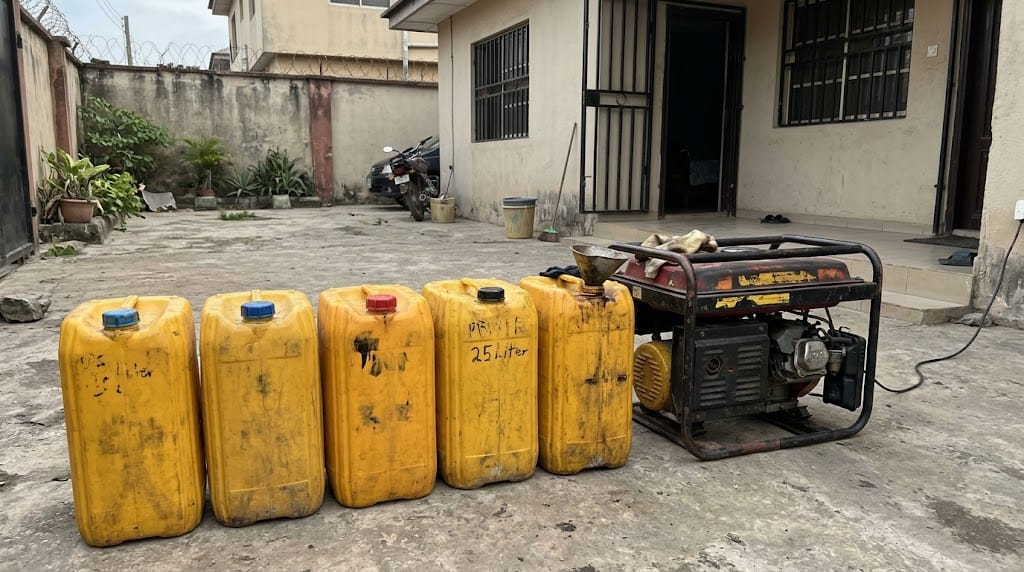
The Generator Burden: Paying for Electricity From a Jerrycan
Private cars represent only half of the fuel equation. Due to recurrent collapses of the national power grid and elevated tariffs for grid customers placed in premium supply bands (Band A), millions of homes run portable petrol generators to pump water, keep food cold, and power fans at night.
Fuel consumption depends directly on the generator engine rating and electrical load:
- Small generator (1.0 kVA to 1.5 kVA): Popularly referred to as "I-pass-my-neighbour", these units power a few energy-saving light bulbs, a television, and a standing fan. They burn approximately 0.6 litres of petrol per hour. Running one for four hours each evening consumes 2.4 litres per day, or roughly 72 litres a month. At ₦1,307 a litre, that amounts to ₦94,104 monthly.
- Medium generator (2.5 kVA to 3.8 kVA): These units run a refrigerator, fans, computers, and lighting. They burn roughly 1.2 litres of petrol per hour under normal load. Operating a 3.5 kVA unit for four hours each evening burns 4.8 litres daily, totaling 144 litres a month. At ₦1,307 per litre, the monthly cost stands at ₦188,208.
- Heavy petrol generator (5.0 kVA to 7.5 kVA): Homes operating an inverter air-conditioner alongside deep freezers and water pumps require larger generators. These machines burn between 2.2 and 2.5 litres per hour. Running one for four hours daily consumes roughly 270 litres a month, producing a bill of ₦352,890.
For independent professionals working remotely who require eight hours of generator power during daytime outages on top of three hours at night, running even a modest 2.8 kVA unit consumes upwards of 13 litres daily. That pushes standalone electricity generation beyond ₦500,000 a month for fuel alone, excluding engine oil changes and spark plug replacements.
Combined Monthly Outlay: How the Numbers Add Up
When car travel and domestic power generation combine, the financial pressure becomes severe. The table below outlines typical monthly fuel bills across different household categories based on petrol priced at ₦1,307 per litre, alongside foreign currency equivalents for readers in the Nigerian diaspora who send support payments home.
| Household Profile | Car Usage (Monthly) | Generator Usage (Monthly) | Total Litres | Monthly Cost (NGN) | Approx. Cost (USD / GBP) |
|---|---|---|---|---|---|
| Modest Urban Home 1 small generator, public transit only |
0 L (Public transit) | 72 L (1.2 kVA, 4 hrs/day) |
72 L | ₦94,104 | $59 / £46 |
| Mid-Level Commuter 1 saloon car + small generator |
120 L (Saloon, work commute) |
72 L (1.2 kVA, 4 hrs/day) |
192 L | ₦250,944 | $157 / £122 |
| Middle-Class Household 1 saloon car + medium generator |
140 L (Saloon car, family errands) |
144 L (3.5 kVA, 4 hrs/day) |
284 L | ₦371,188 | $232 / £181 |
| Upper-Middle Household 1 SUV + medium generator |
200 L (SUV, full commute) |
180 L (3.5 kVA, 5 hrs/day) |
380 L | ₦496,660 | $310 / £242 |
| Home Office / Heavy User 1 car + large generator running daytime |
150 L (Saloon car) |
300 L (5.5 kVA, 6 hrs/day) |
450 L | ₦588,150 | $368 / £287 |
For an average middle-class home operating one commuter car and a 3.5 kVA generator for four hours each evening, spending ₦371,188 per month on fuel outstrips what many professionals earn. Two years ago, that same volume of fuel cost less than ₦60,000.
The Secondary Squeeze: Maintenance and Living Expenses
The cost of fuel does not stop at the pump. Increased fuel expenses trigger direct secondary maintenance costs. Generators run on sustained loads require mineral engine oil changes every 50 to 100 running hours. A litre of standard 20W-50 engine oil, which cost ₦1,500 two years ago, now sells for between ₦4,500 and ₦6,000. For a generator running every night, oil changes add another ₦12,000 to ₦18,000 per month.
Vehicle maintenance has risen in parallel. Driving in low-gear urban traffic increases engine wear and raises tyre degradation. Because commercial bus and tricycle operators face the same ₦1,307 pump price, transport fares for dependants using commercial minibuses (danfos) or tricycles (keke) have tripled. That feeds directly into wholesale food logistics, raising food basket inflation across urban markets.
How Families Are Changing Daily Routines
Faced with fuel spending that absorbs between 40 and 70 per cent of monthly take-home earnings, urban residents have adopted strict conservation measures. Many motorists park their cars at home from Tuesday to Thursday, choosing commercial buses or carpooling with colleagues who live in the same neighbourhood.
Generator run times have been shortened in many homes. Families turn generators on at 8:00 pm to cool rooms and freeze water, switching them off by 10:30 pm or 11:00 pm rather than letting them run through the early morning hours. Others have turned to basic direct-current solar systems, consisting of a single 300-watt solar panel, a charge controller, and a lithium or tubular battery. While these installations cannot run heavy cooling equipment, they eliminate generator use for fans, phone charging, and lighting.
Interest in Compressed Natural Gas (CNG) conversion has grown across major cities. CNG sells for roughly ₦230 per standard cubic metre, offering massive operational savings compared to petrol. High conversion kit costs—frequently exceeding ₦1,000,000 for private petrol saloons—along with limited refuelling station infrastructure in most cities keep this alternative out of reach for many drivers.
The Diaspora Effect: Remittance Realities
The rise to ₦1,307 a litre also affects the Nigerian diaspora living in the United Kingdom, Canada, the United States, and across the Caribbean. Families sending monthly stipends home to support ageing parents or siblings discover that previous transfers cover a fraction of basic utilities.
A diaspora transfer of £150 or $200 used to provide comfortable living support covering food, electricity, and local errands. Today, £150 converts to roughly ₦307,000 (at open market rates around ₦2,050 to the pound sterling). That entire amount can disappear into running one car and a nighttime generator for three weeks, leaving nothing for food, medicines, or municipal water delivery. Diaspora senders increasingly find themselves earmarking specific funds solely for fuel.
Conclusion
Petrol at ₦1,307 per litre has transformed private mobility and basic home power into premium household luxuries. For households operating both a saloon car and a modest generator, monthly fuel outlays now regularly exceed ₦350,000—a figure several times higher than the national minimum wage and deeply disruptive to the middle class. Until local public transport becomes reliable or solar and gas alternatives scale down in initial cost, managing fuel volume remains the central financial challenge for Nigerian families.
Sources
- FuelTracker Nigeria - Crowdsourced Retail Pump Price Monitor
- GlobalPetrolPrices.com - Nigeria Gasoline Price Trackers and Analysis
- Major Energies Marketers Association of Nigeria (MEMAN) - Daily Energy Price Reports
- Independent Petroleum Marketers Association of Nigeria (IPMAN) - Retail Price Advisories
Disclaimer: This article reflects market prices and retail conditions at the time of writing and does not constitute financial advice. Fuel prices and exchange rates vary by state, supplier, and depot conditions.
Category: Finance